




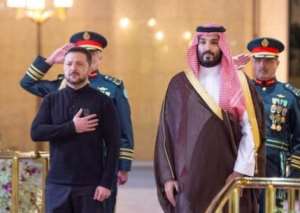
Ukraine's wartime president has turned the Middle East into a new diplomatic and military frontier and Saudi Arabia is at the center of it.
A Surprise Visit With Strategic Purpose
Ukrainian President Volodymyr Zelensky arrived in Saudi Arabia on March 27, 2026, for an unannounced visit as the war in Iran spurred intense interest among Gulf countries in Ukrainian arms technology. The trip was characteristically direct.
"Arrived in Saudi Arabia. Important meetings are scheduled. We appreciate the support and support those who are ready to work with us to ensure security," Zelensky wrote on X.
The visit was not Zelensky's first to the kingdom he has cultivated the relationship with Crown Prince Mohammed bin Salman across multiple trips but it was arguably his most consequential.
A Defense Deal Signed in Jeddah
The centerpiece of the March visit was a landmark agreement. Zelensky announced that Ukraine and Saudi Arabia had signed an agreement on defense cooperation that lays the foundation for future contracts and investment, signed ahead of his meeting with Crown Prince Mohammed bin Salman.
"We are ready to share our expertise and systems with Saudi Arabia and to work together to strengthen the protection of lives," Zelensky said, adding that Saudi Arabia "also has capabilities that are of interest to Ukraine, and this cooperation can be mutually beneficial."
The deal focused squarely on one of the defining military challenges of this moment: the Shahed drone. The two countries agreed on "security cooperation in particular, the protection of the skies," as Saudi Arabia has been targeted by Iranian drones of the same design that Russia has used against Ukraine for years.
Ukraine's Battle-Tested Pitch
Zelensky arrived with a compelling offer that only Ukraine could make. Kyiv has sought to leverage its expertise in downing Russian drones to help Gulf nations, which are being attacked with the same Iranian-designed Shahed drones that Russia fires on Ukraine. More than 200 Ukrainian anti-drone experts have been deployed to several countries in the Middle East, including Saudi Arabia.
The economic logic behind Ukraine's proposal is hard to argue with. Zelensky argued that exhausting air defenses with multi-million dollar missiles is no longer logical, and that the new strategy relies on interceptor missiles costing only $10,000 to confront Shahed drones that cost up to $130,000.
For Gulf States burning through expensive air defense stockpiles, Ukraine's cheap and proven interceptor technology is an attractive alternative.
His pitch was blunt: Iran taught Russia how to build Shaheds; Russia used them to kill Ukrainians; Ukraine learned how to stop them; and now those lessons can protect the Gulf.
A Whirlwind Gulf Tour
The Saudi visit was part of a broader regional diplomatic blitz. In late March 2026, Zelensky made a whirlwind tour Jeddah, Abu Dhabi, Doha, and Amman signing 10-year defense cooperation agreements with Saudi Arabia, the UAE, Qatar, and Jordan, covering joint projects, co-production, and tech partnerships focused on countering aerial threats.
The results are already tangible on the ground. Ukrainian counter-drone technology is now guarding a US air base in Saudi Arabia, with the Pentagon deploying Kyiv's "Sky Map" command system at Prince Sultan Air Base to stop Iranian-made Shahed drones, with Ukrainian specialists training American troops on-site.
A Mutual Need
Ukraine's Gulf diplomacy is driven by more than altruism. Zelensky is hoping to draw support from Gulf nations in Kyiv's war against Russia, now in its fifth year, as Western military aid faces new uncertainty.
The trade on offer is straightforward: Ukraine shares its hard-won drone expertise with Gulf states, and in return gains political backing, economic investment, and potentially weapons systems that Kyiv needs. Ukraine has proposed swapping its interceptors for the vastly more expensive air-defense missiles that Gulf countries are currently using to down Iranian drones arguing it needs more of them to fend off Russian missile attacks.
Saudi Arabia's Pivotal Role
Saudi Arabia occupies a unique position in all of this. The kingdom has long maintained ties with both Moscow and Kyiv, positioning itself as a neutral mediator. It hosted US-Ukraine-Russia talks in 2025 as part of ceasefire diplomacy. Now, with Iran's military aggression reshaping the Gulf's security calculus, Riyadh is moving closer to Kyiv in a concrete and practical way.
For Zelensky, turning the world's largest oil exporter into a defense partner is a diplomatic achievement that few would have predicted when Russia launched its full-scale invasion in February 2022. For Saudi Arabia, Ukraine's drone war experience may prove to be one of the most valuable and affordable security partnerships available in a rapidly changing Middle East.
Mustapha Bature Sallama.
Medical/ Science Communicator,
Private Investigator, Criminal investigation and Intelligence Analysis.
International Conflict Management and Peace Building.USIP
[email protected]
+233-555-275-880


 NDC Oforikrom polls: Treasurer aspirant challenges Ashanti Regional Minister ove...
 NDC Oforikrom constituency election stalls over ballot paper delays
 Former NDA CEO Sumaila Abdul-Rahman, three others fined GH¢84,000 each over proc...
 Wa: Abandoned newborn baby boy rescued at Sombo
 GTA Deputy CEO Abeiku Santana drags his boss Maame Houadjet to Minister over acc...
 Stop sucking breasts during intimacy to avoid stasis of milk inside — Retired nu...
 NDC Enforces Strict Verification and Voting Rules as Constituency Elections Begi...
 Protests against cost of living expected in Italy under heavy security
 Lula, Bolsonaro clash on living costs, corruption in final Brazil election debat...
 Ebola vaccine trial begins in DR Congo


