




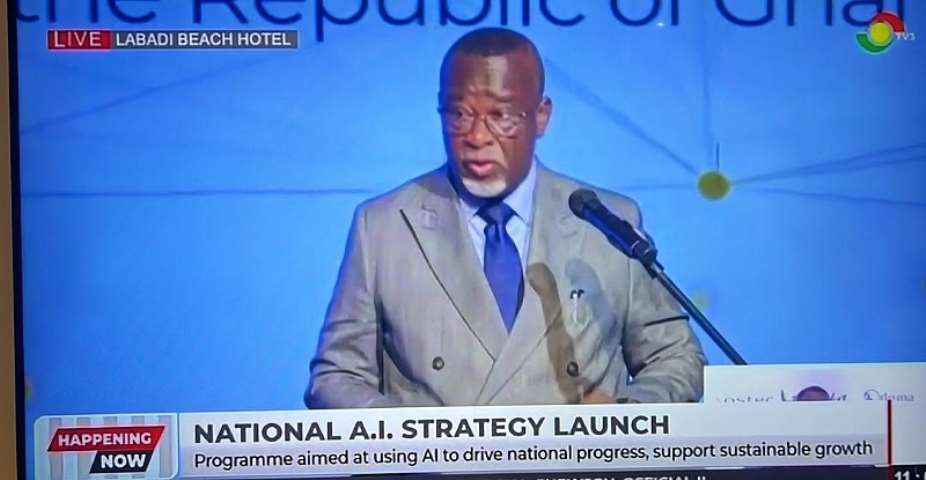
Chief Justice Paul Baffoe-Bonnie has called for a deliberate and responsible approach to integrating artificial intelligence into Ghana’s justice system, stressing that technology must serve to strengthen, not weaken the quality of justice delivery.
Speaking at the launch of Ghana’s National Artificial Intelligence Strategy, the Chief Justice described the occasion as a defining moment that signals a shift from passive observation to active leadership in shaping the country’s technological future.
He said the event represents more than the unveiling of a policy document. It is, he noted, an acknowledgement that global technological forces will not wait for Ghana, and that the nation’s duty is to provide direction rather than merely keep pace.
The Chief Justice emphasized that artificial intelligence is no longer confined to laboratories or academic discourse but is already influencing decisions, transforming economies, and reshaping how societies and institutions function. The real question, he said, is not whether Ghana will engage with AI, but on what terms that engagement will take place.
From the judiciary’s perspective, he said the moment demands careful reflection. He noted that every major political, economic, or technological shift eventually finds its way into the courtroom, where it becomes a matter of law, rights, and justice rather than just innovation.
For that reason, he insisted that no matter how advanced or efficient a technology may appear, it must remain subject to the rule of law. “Technology must serve justice, and justice must never be made to serve technology,” he stated.
The Chief Justice pointed out that while the Constitution does not speak in the language of algorithms or data systems, it speaks clearly in the language of values — freedom, justice, fairness, accountability, and human dignity. These values, he said, are even more critical in the age of AI and must act as guardrails for innovation.
He acknowledged AI’s considerable potential within the justice sector, including improving case management, enhancing legal research, and expanding access to justice for those who currently struggle to engage with the system. He said such changes could reduce delays, improve consistency, and bring the courts closer to citizens.
However, he cautioned against overlooking the risks that come with AI adoption. He raised concerns about who designs these systems, what biases may be embedded in them, how decisions are reached, and who bears responsibility for their outcomes.
“Justice cannot be automated. It cannot be outsourced. It can be enhanced and made more efficient through technology, but it cannot be replaced,” the Chief Justice asserted, stressing that justice at its core requires human judgment shaped by experience and conscience.
He however said the National AI Strategy is important not just for embracing technology but for guiding it responsibly. Its focus on ethics, accountability, and inclusion, he said, places Ghana in a position not just to adopt technology, but to shape it for the public good.


 National Service personnel to demonstrate over delayed refunds, unpaid allowance...
 Even a dog would win Karaga seat from Dr. Amin Adam for NDC in 2028 — Former MP
 UK stranded Barosky to receive psychological, financial support after his repatr...
 Highlife Musician Barosky repatriated to Ghana after homelessness in Manchester
 Mahama dragged to Supreme Court over Council of State vacancy
 Contractors risk blacklisting over delayed projects — Works Minister
 Ghana to introduce biometric SIM verification before end of 2026 — Sam George
 Gomoa Chiefs to collect revenue in disputed areas in Effutu after clash
 Houthi attacks disrupt Saudi oil facilities and wound more than 70
 Place all 54,985 affected BECE candidates in schools and publish final outcome —...

