




Africa’s transport debate is increasingly being shaped by a force that cannot be engineered away, climate change. Rising temperatures, erratic rainfall, prolonged droughts, and extreme flooding events are no longer distant risks; they are present realities disrupting infrastructure, trade, and livelihoods. In this context, the question is no longer just how to build efficient transport systems, but how to build resilient ones.
Inland waterways, often promoted as low-cost and low-carbon transport solutions, are now at the center of this debate. Their advantages are clear, energy efficiency, capacity, and environmental sustainability. But their dependence on natural hydrological systems raises a critical concern: can inland water transport systems withstand the increasing variability and extremes of climate change?
The Double-Edged Nature of Water-Based Transport
Unlike roads and railways, which are engineered to control their environment, inland waterways are shaped by it. River depth, flow velocity, seasonal patterns, and weather conditions all influence their performance. This makes them inherently vulnerable, but also uniquely adaptable. Climate change is intensifying this vulnerability.
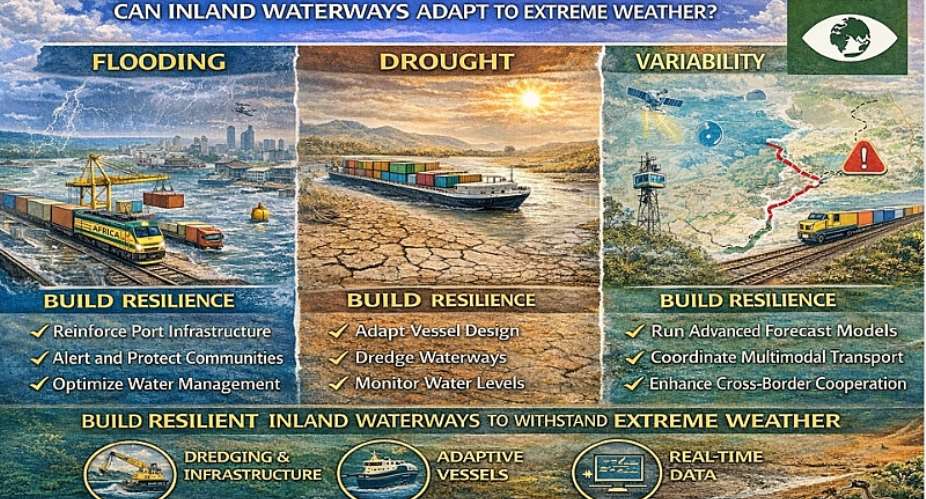
- Flooding can disrupt navigation, damage port infrastructure, and increase safety risks.
- Droughts reduce water levels, limiting vessel movement and, in extreme cases, halting transport altogether.
- Variability, unpredictable shifts between high and low water levels, creates uncertainty, making scheduling and logistics planning more difficult.
Across Africa, these challenges are already emerging. Rivers that once provided reliable navigation windows are becoming less predictable. Seasonal cycles are shifting. Extreme events are becoming more frequent. Yet, to view inland waterways solely through the lens of vulnerability is to miss a crucial point: they can also be part of the solution.
Resilience Through Adaptation, Not Abandonment
The instinctive response to climate risk is often to retreat, to invest more in “controlled” infrastructure like roads. But this approach is short-sighted. Roads themselves are highly vulnerable to climate impacts, particularly flooding and heat-related degradation.
The more strategic approach is adaptation.
Inland waterways, when properly managed, can be made resilient through a combination of engineering, technology, and governance:
- Dredging and river training can maintain navigable channels even during low-water periods.
- Adaptive vessel design, such as shallow-draft barges, allows transport to continue under varying water levels.
- Hydrological monitoring systems provide real-time data, enabling better planning and risk management.
- Climate-resilient port infrastructure can withstand flooding and fluctuating water levels.
In essence, resilience is not about eliminating variability, it is about designing systems that can function within it.
The Role of Integrated Transport Systems
The most important resilience strategy is integration. No single mode of transport can withstand all climate risks. Roads can be washed away by floods. Rail tracks can buckle under extreme heat. Rivers can become too shallow during droughts. The strength lies in diversity and redundancy. By integrating inland waterways with rail and road systems, countries can create flexible transport networks that adapt to changing conditions:
- During high water levels, waterways can handle increased cargo volumes
- During droughts, rail systems can compensate for reduced river capacity
- Roads can serve as last-mile connectors, ensuring continuity of movement
This multimodal approach transforms vulnerability into resilience. Instead of relying on a single mode, the system adjusts dynamically, maintaining flow even when individual components are disrupted.
Climate Resilience as an Economic Imperative
The case for resilient transport is not just environmental, it is economic. Unreliable transport systems increase costs, disrupt supply chains, and deter investment. For a continent seeking to industrialize and expand trade under the African Continental Free Trade Area (AfCFTA), resilience is essential.
Inland waterways, when adapted to climate realities, can enhance this resilience by:
- Providing cost-effective alternatives during disruptions
- Supporting bulk transport with lower emissions
- Strengthening regional connectivity, especially in landlocked areas
Moreover, investing in climate-resilient transport infrastructure creates jobs, stimulates innovation, and builds long-term economic stability.
The Governance Challenge
Despite the potential, achieving resilience requires more than technical solutions—it demands institutional capacity and coordination.
Waterways often cross national borders, making their management inherently complex. Climate adaptation strategies must therefore be:
- Transboundary, involving cooperation between countries
- Data-driven, supported by shared hydrological information systems
- Long-term, moving beyond short political cycles
This is where regional institutions and partnerships become critical. Without coordinated governance, even the best-designed systems will struggle to deliver resilience.
Rethinking the Narrative
There is a tendency to view climate change as a threat that limits options. But in reality, it is also a forcing function, pushing systems to evolve. For Africa, this means rethinking transport not as a set of isolated infrastructures, but as adaptive systems capable of responding to uncertainty. Inland waterways, with all their variability, offer a unique opportunity to develop such systems. The question, then, is not whether inland waterways can adapt to extreme weather. The real question is whether policies, institutions, and investments will adapt fast enough to support them.
Conclusion: Building Transport Systems That Endure
Climate change is redefining what it means for infrastructure to be “fit for purpose.” Efficiency alone is no longer enough. Systems must also be resilient, flexible, and adaptive.
Inland waterways, despite their vulnerabilities, have a critical role to play in this future. With the right investments and integration, they can become pillars of climate-resilient transport systems, complementing rail and road, reducing emissions, and sustaining economic activity even under extreme conditions. Africa’s challenge is not to choose between modes, but to design systems that endure.
Because in a world of increasing uncertainty, the most valuable infrastructure is not the strongest, it is the one that can adapt and continue to function when conditions change.
Author: Joseph Fuseini ([email protected])


 'Stop excessive financial demands before sharing information with us' — Interior...
 EC will serve national interest, not partisan politics – Deputy Chair Dr Kwaku A...
 I expect no preferential treatment from EC for myself as President, my party or ...
 Afenyo-Markin meets management, proposes reforms to turnaround struggling ECG
 ECG management commends Afenyo-Markin for reforms during short stay as Board Cha...
 Mahama tasks new EC deputy chairpersons to uphold impartiality
 Attorney-General urges court to reject Adu-Boahene’s no-case submission
 Nyaho Medical Centre ordered to report to CID over expired data protection certi...
 Mahama swears in new Electoral Commission deputy commissioners
 PTAAM-Africa calls for government probe into alleged World Cup visa fraud


