




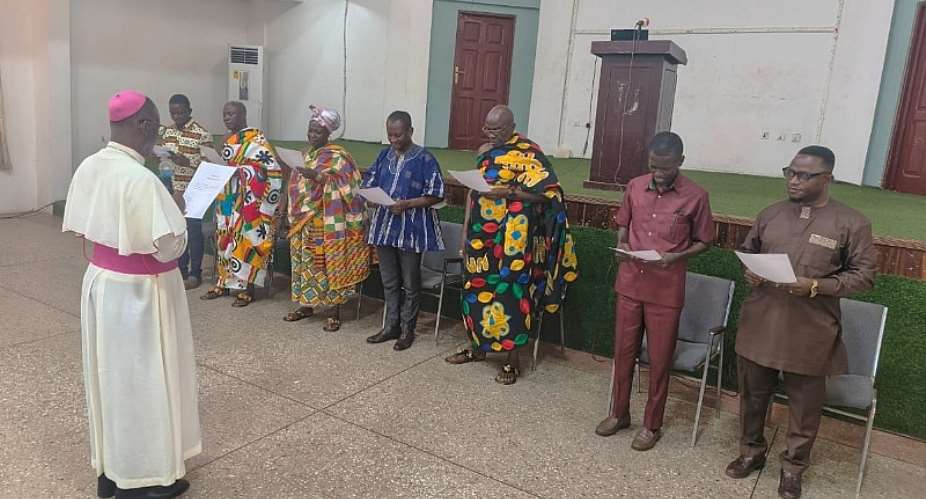
A ten-member Governing Advisory Board of the Bonoman Institute, a public policy research and advocacy think tank, has been inaugurated in Sunyani.
Bonoman Institute is dedicated to accelerating the development, cultural preservation, and socio-economic empowerment of the Bono people in Ghana. It acts as a resource hub, focusing on preserving the Bono Twi language/heritage and advancing regional development initiatives.
The Advisory Board is chaired by Prof. Richardson Addai-Mununkum, an Associate Professor of Curriculum and Pedagogy at the University of Education, Winneba with Nana Saa Gyamfuaa, Member of the Council of State and the Queen Mother of Anyima as Vice Chairperson.
Dr. George Adjei-Henne (Barima Dr. Adjei-Henneh Aframfo), the Atipimhene of Mpuasu- Japekrom Traditional Area will serve as the Secretary to the Board.
Members of the Advisory Board include a former Deputy Attorney-General, Alfred Tuah-Yeboah; Nana Sasraku Sradaa I, a renowned broadcast journalist and the Adontenhemaa of Dormaa Aboabo No. 4; Nana Asamoah Kumtwie I, the Chief of Nseseresu and Mansen Manwerehene; Solomon Ameyaw, CEO of Lionsgate Logistics, Citizen Frozen foods, K&A Building Materials Limited; Emmanuel Kwasi Anyimadu, a retired Public Servant; Joyce Gyedu, a Health Administrator at the University Hospital, Lewisham, London and Francis Kwaku Ansu Gyabaa, Founder and President of the Bonoman Institute.
Bono heritage
Inaugurating the Board, the Catholic Bishop of Sunyani, Most Rev Matthew Kwasi Gyamfi, stressed the urgent need for documenting and promoting Bono history and tasked institutions such as the Bonoman Institute to lead efforts in researching, writing and disseminating a comprehensive account of the Bono heritage.
“Without a clear understanding of our history, we risk losing our identity,” he noted, adding that history plays a critical role in shaping a people’s confidence and future.
Bishop Gyamfi, who is also the President of the Catholic Bishops Conference, further advocated the promotion of Bono language and literature, including its introduction in schools, as part of broader efforts to preserve cultural identity.
The Bishop called on Bono leaders, intellectuals and policymakers to take deliberate steps towards reclaiming their history and strengthening their cultural identity and emphasized that true freedom and dignity must be pursued actively by the people themselves.
Resource hub
The Founder and President of the Bonoman Institute, Kwaku Ansu Gyabaah, called for renewed commitment to the development of the Bono people, describing the inauguration of the Board as a significant milestone in the Institute’s journey since its establishment in 2019.
He said the organization was founded on the belief that “meaningful change begins when people come together with shared values, clear purpose, and unwavering commitment.”
He noted that over the years, the Institute has positioned itself as a resource hub dedicated to research, documentation, preservation, and promotion of Bono culture and heritage, while also contributing to education, youth empowerment, and community development.
Unity in diversity
According to him, the inauguration comes at a critical moment for Bonoman, as the region navigates challenges that require unity, reflection, and renewed determination. “We have faced adversities, but our spirit remains unbroken. Now, we look ahead to reconciliation, rebuilding, and rejuvenation,” he said.
Mr. Gyabaah emphasized the importance of unity in diversity, describing Bonoman as a region rich in cultures, languages, and traditions but bound by a shared destiny. He stressed that the Institute’s vision is to create an inclusive society where every individual is empowered and every tradition respected.
He explained that the Advisory Board will play a crucial role in shaping the Institute’s future, providing strategic guidance and expertise to strengthen its impact. “This Board is more than a governance structure – it is a beacon of experience and insight that will help us navigate challenges and seize opportunities,” he stated.
Challenges
Despite the optimism, Mr. Gyabaah acknowledged significant operational challenges facing the Institute, particularly in funding and logistics. He revealed that the organization currently relies on the goodwill of individuals, with no remuneration for its leaders and limited access to office space, equipment, and vehicles.
These constraints, he said, are affecting the Institute’s ability to fully implement key initiatives such as the School-Based Bono Twi Pilot under the Bono Literacy Programme, even as demand for its services continues to grow.
Describing the situation as challenging but not insurmountable, he called on stakeholders, individuals, and corporate bodies to support the Institute through funding, resources, and partnerships.
“I stand before you not just to welcome you, but to invite you to be part of the solution,” he said, urging members of the Advisory Board and the wider community to contribute their expertise, networks, and resources to advance the Institute’s mission.
Mr. Gyabaah expressed confidence that with collective effort, the Institute can overcome its challenges and drive meaningful transformation in Bonoman, ultimately positioning the Bono people to make a positive impact on the world.
Partnerships
Drobohene, Okokyeredom Sakyi Ako II, who chaired the occasion, tasked the Bonoman Institute to build strategic partnerships with the media, other policy and research think tanks and universities towards the promotion of the socio-economic development of the Bono people, and further urged the institute to ne non-partisan in its work.
Bonoman Institute
The Bonoman Institute has over the years been actively documenting, preserving, and promoting the Bono Twi dialect, aiming for its adoption in education and examination under the Bono Twi Language Project
It has also been advocating regional development, championing economic, social, and infrastructure development in the Bono and Bono East regions while working to protect and promote the history, culture, and traditions of the Bono people.
Led by Executive Director Mr. Francis Kwaku Ansu Gyabaa, the institute seeks to engage with chiefs, local residents, and Bono natives in the diaspora to create a united, developed region.


 Allow the law to deal with defilement perpetrators - Director tells families
 Gov’t to develop policy for Ghanaian sign language in education
 Two Ada SHS students plead guilty to assault, slapped with 12-month bond
 Enlistment: GAF begins documentation, body selection from September 28
 Violent rainstorm rips off roofs, displaces residents in Krachi Nchumuru
 Ghana risks EU gas market access over methane emissions
 Tumu landlord gives road encroachers 2-week ultimatum to relocate for road const...
 Serbian President Aleksandar Vucic resigns
 Tigray TV station hit by drone, rebels advance in north Ethiopia
 Swiss reject plan to toughen neutrality


