




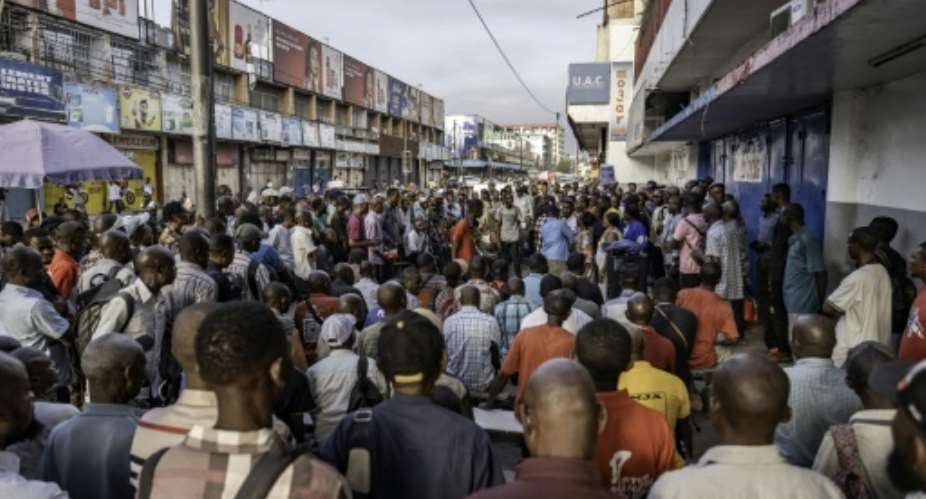
At daybreak in Kinshasa, dozens gathered on a main road to chant pro-government slogans at a "standing parliament" -- gatherings that observers say President Felix Tshisekedi is exploiting to push for constitutional change to allow him a third term in office.
"We must support Felix Tshisekedi's projects, he is our solution," a man dressed in the presidential movement's yellow, blue and white shouted through a megaphone.
A circle of listeners, both passersby and supporters of the presidential party, gathered in front of shops not yet open, already seemed convinced.
The seemingly spontaneous political street debates are organised by word of mouth and are being used to test and promote certain ideas coming from those in power, observers say.
The tradition of "standing parliaments" began in the 1970s as a way to challenge the authoritarian rule of dictator Mobutu Sese Seko by the current president's father Etienne Tshisekedi, who was then an opposition leader.
Felix Tshisekedi, 62, who has been in power since 2019, comes to the end of his second five-year mandate in 2028.
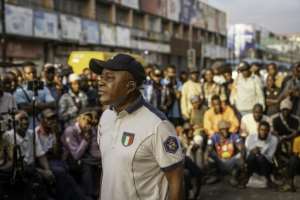 Observers say the political street debates are being used to test and promote ideas coming from those in power. By Glody MURHABAZI (AFP)
The constitution of the Democratic Republic of Congo limits presidents to two terms but Tshisekedi began to float the idea of a revision soon after his re-election.
In 2024, on a trip to the northeastern city of Kisangani, he slammed a constitution riddled with "weaknesses" and "not adapted to the realities of the country", although he did not go into details.
A few months later, he called in parliament for "a national reflection on constitutional reform" and announced the creation of a "national commission", while denying that he was seeking another term.
'Constitutional coup'
"Standing parliaments are essential levers of the ruling party to mobilise public opinion around changing the constitution and securing popular support," Ithiel Batumike, political analyst at the Ebuteli think tank, told AFP.
Questioned by AFP, a senior official from Tshisekedi's UDPS party, who spoke on condition of anonymity, insisted that "no instructions are given to the 'standing parliaments'".
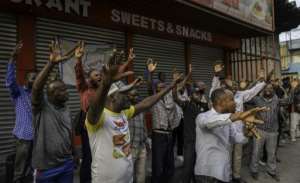 The tradition of 'standing parliaments' began in the 1970s as a way to challenge the authoritarian rule of dictator Mobutu Sese Seko. By Glody MURHABAZI (AFP)
Nevertheless, he described them as "informal structures of the party".
Weakened by successive defeats at the ballot box, the opposition has accused Tshisekedi of manoeuvring to cling to power.
It argues that any attempt to amend the constitution would amount to a "constitutional coup".
And some opposition figures have promised street protests across the vast central African country if the president pushes ahead.
In 2015, an attempt to revise the electoral law that could have allowed former president Joseph Kabila to remain in office beyond two terms sparked demonstrations that turned into riots and looting, leaving dozens dead.
Paused by war
The conflict in the eastern DRC, which intensified early last year when the Rwanda-backed M23 anti-governmental group captured the major cities of Goma and Bukavu, forced Tshisekedi to pause any ambitions for constitutional reform.
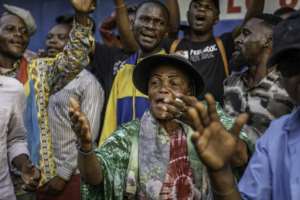 Under the Congolese constitution, President Felix Tshisekedi can only stand for two terms in office. By Glody MURHABAZI (AFP)
But in recent weeks, as clashes between the armed group and government forces have eased, the idea has been revived -- and the street seems to be serving as a testing ground.
"The current constitution was drafted by foreigners," said Jean-Claude Mwamba, 45, coordinator of the around 50 standing parliaments active in the Congolese capital, to applause.
Abdel Mutombo, an employee of a state-owned company who said he attends the gatherings every morning before heading to work, called the constitution a "bill of sale to Rwanda".
Adopted in 2006 under Kabila, the current constitution is often derided for having been "written by foreigners" -- largely because international advisers and legal experts provided technical assistance during its drafting.
The argument has now become a political instrument to rally the population around the idea that the current text must be amended, or that an entirely new one is needed.
Any constitutional change must be approved in a referendum called by the president, unless the proposal is approved by a three-fifths majority in parliament, where Tshisekedi's ruling coalition holds an overwhelming majority.

 Kenyan starvation cult leader guilty of 123 manslaughter deaths
 December 4 declared public holiday for 2026 Farmers’ Day celebration
 GRA flags 29 shops at A&C and Marina malls over tax infractions
 Stop using media to pressure NACOC if cocaine case not going your way in court –...
 Cashew farmers demand suspension of export ban until local processors can absorb...
 Upper West Regional Police only invited me, not arrest — Nadowli-Kaleo NPP chair...
 Osahen Afenyo-Markin questions EOCO unlawful transfers of funds in frozen accoun...
 Paris court orders Depardieu to stand trial over alleged 2018 rape of actress
 Mahama arrives in Barbados for five-day state visit
 Galamsey threatens food security, public health and national security – Zanetor


