




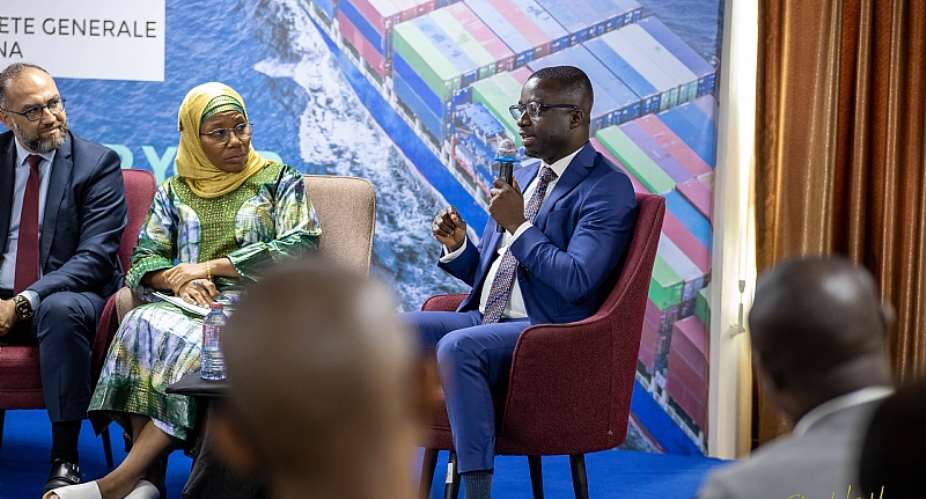
At a time when financial innovation is increasingly being positioned as the solution to Ghana’s SME financing challenges, the remarks by Gabriel Siaw offered a necessary pause—and perhaps, a reality check.
Speaking during a panel session and reported Accra Street Journal at a recent trade and credit insurance engagement organised by Coface and Activa International Insurance Ghana, the Head of Large Local Corporates at Société Générale Ghana addressed a question that continues to linger across Ghana’s business ecosystem:
If tools like credit insurance exist, why are SMEs still struggling to access finance?
The Illusion of Access
There is a growing narrative that financial instruments—particularly credit insurance—are bridging the financing gap for businesses. And to some extent, that narrative holds.
Credit insurance, especially from global players like Coface, provides:
- protection against non-payment,
- improved confidence in trade transactions,
- and stronger assurance for lenders.
Yet, as Siaw pointed out, this does not automatically translate into access. Because in banking, risk reduction is not the same as risk elimination.
Bankability Still Comes First
From the perspective of lenders, financing decisions are not built on a single instrument. Even with credit insurance in place, banks continue to evaluate:
- the financial strength of the business,
- the credibility of its trading partners,
- and the structure of the transaction itself.
This means that while credit insurance may strengthen a case, it does not replace the fundamentals required for lending.
In simple terms: insurance can support financing—but it cannot create bankability where it does not exist.
Why Structure Matters More Than Ever
Siaw’s intervention highlights a deeper issue within Ghana’s SME landscape—one that often goes unaddressed.
Many businesses operate with:
- limited financial documentation,
- inconsistent reporting systems,
- and informal trading structures.
In such an environment, even the most sophisticated financial tools struggle to gain traction.
Banks, by design, are structured institutions. And they lend more comfortably to businesses that reflect that same structure.
Trust, Built Over Time
However, the story does not end there.
According to Siaw, businesses that integrate credit insurance into their operations often experience a different outcome—not necessarily instant financing, but stronger, more sustainable banking relationships.
Over time, insured transactions create:
- transparency in dealings,
- predictability in cash flow,
- and reduced exposure to default risk.
This, in turn, builds trust.
And in banking, trust is not just a value—it is an asset.
A Gradual Shift, Not a Quick Fix
What emerged from the discussion is that Ghana’s financing ecosystem is evolving—but not at the speed many expect.
With institutions like Coface providing risk mitigation and Activa International Insurance Ghana facilitating access to such products locally, the tools are increasingly available.
But adoption—and more importantly, integration—remains gradual.
The Bigger Question From Me
Siaw’s remarks ultimately shift the conversation from availability to readiness. The challenge is no longer just about whether financial solutions exist. It is about whether businesses are structured enough to use them.
Ghana’s SME financing gap is often framed as a failure of the financial system. But perhaps, as insights from Gabriel Siaw suggest, it is equally a reflection of the structural realities of businesses themselves.
Until those realities evolve, even the best financial innovations may continue to fall short of their full potential.


 Judiciary must earn public trust, not demand it — Asiedu Nketiah
 Any sod-cutting ceremony at Upper East Airport site this weekend will be 419 — G...
 Mahama must investigate GoldBod over alleged US$1.7bn loss — Abena Osei-Asare
 Attorney General opposes Wontumi’s bail application pending appeal in 20-year se...
 'I will continue to sit until Chief Justice revokes warrant' - High Court judge ...
 August 11: Cedi sells at GHS12.45 on forex market, GHS11.78 on BoG interbank
 Hopeson Adorye eats humble pie, retracts claim linking Ekow Assafuah to Ghana To...
 Legal vacation does not mean lawyers can halt court proceedings – Deputy Attorne...
 Forensic audit reveals how Ghana’s Embassy in the U.S. extorted $19.3 million fr...
 EVIDENCE: How Ghana’s Washington Embassy staff shared money extorted from visa a...

