




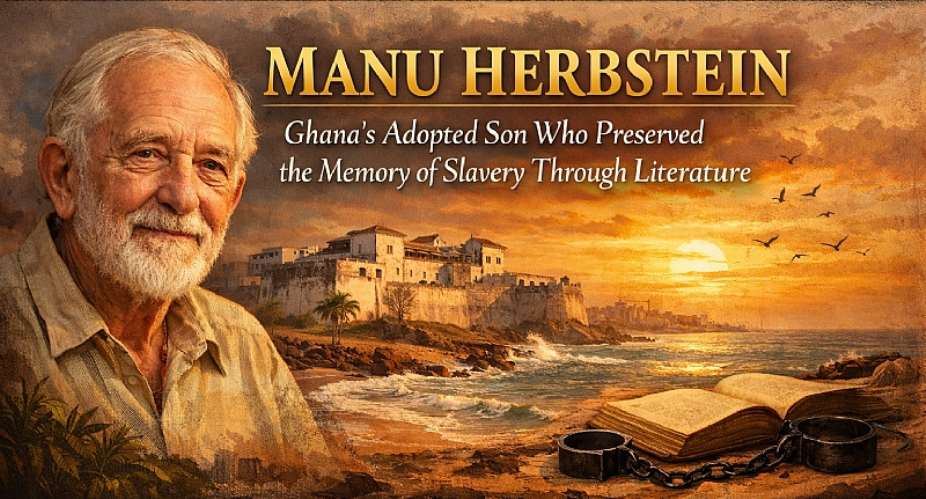
In the struggle over history and memory, few voices have dared to confront the Atlantic slave trade with the depth, courage, and empathy of Manu Herbstein. Though born in South Africa, Herbstein has lived in Ghana for more than half a century, marrying into Ghanaian life, culture, and citizenship. His novels—Ama, A Story of the Atlantic Slave Trade and Brave Music of a Distant Drum—are not just works of fiction; they are monuments of remembrance, carved in words to honor the millions whose humanity was stolen.
At ninety years old, Herbstein reflects on whether his books will endure. For Ghanaians, the answer must be yes. His legacy is ours to protect, amplify, and pass on to future generations.
A Ghanaian Legacy in World Literature
Herbstein’s Ama won the 2002 Commonwealth Writers Prize for Best First Book, a recognition of its groundbreaking narrative. Unlike Eurocentric accounts, Ama centers Ghanaian voices, places, and experiences, making visible the trauma and resilience of enslaved Africans. Its sequel, Brave Music of a Distant Drum, continues this saga, weaving survival into family memory.
Herbstein’s work has been embraced by African scholars, who have written dissertations, journal articles, and conference papers affirming its importance. One scholar described Ama as “a gift to the world, a gift that no historian thought of or achieved before you.”
Why Ghanaians Must Lead
The muted reception of Herbstein’s novels in Western literary circuits is not surprising. Western publishers often prefer softened narratives of slavery. Herbstein’s novels do the opposite: they demand discomfort, empathy, and accountability.
For Ghana, however, his work is a national treasure. It is our responsibility to ensure these stories are taught in schools, commemorated in cultural institutions, and preserved digitally. Herbstein’s novels are not only Ghana’s gift to the world—they are Ghana’s inheritance to safeguard.
Availability and Access
- Brave Music of a Distant Drum is available internationally on Amazon (US, UK, Germany) and Bookshop.org.
- Ama, A Story of the Atlantic Slave Trade is widely distributed in Ghana through Techmate Publishing.
- Other works include The Boy Who Spat in Sargrenti’s Eye, Ramseyer’s Ghost, and Akosua and Osman.
Yet availability alone is not enough. We must actively promote these books, integrate them into curricula, and encourage translations into French, Portuguese, and Spanish to reach wider African and diaspora audiences.
A Call to Action for Ghana
- Universities: Embed Ama and Brave Music into African history (AfricanStudies) and literature courses.
- Secondary Schools: Commission abridged editions with study guides, maps, and discussion questions.
- Preschools: Develop illustrated picture books inspired by Herbstein’s narratives, teaching courage and heritage at an early age.
- Diaspora Communities: Use these novels in commemorations and advocacy.
- Publishers: Reissue and translate Herbstein’s works for global circulation.
Manu Herbstein is more than a novelist—he is Ghana’s adopted son, a custodian of African memory, and a voice of resistance against forgetting. His concern that his books may die with him is a challenge to us all. Will we allow African voices to fade, or will we amplify them until they echo across the world?
In honoring Herbstein, we honor the millions whose names were erased but whose humanity endures. His words remind us that remembrance is not passive—it is an act of resistance. And resistance, as Ama teaches us, is the heartbeat of freedom.
The world must not let these stories fade. They are not only Ghana’s gift—they are humanity’s inheritance.
✍️ Retired Senior Citizen
For and on behalf of all Senior Citizens of the Republic of Ghana 🇬🇭
Teshie‑Nungua
[email protected]


 Bolgatanga: Man found dead by roadside in Sumbrungu as police investigate
 Ghana concludes cocoa freight negotiations for 2026/27 season
 Blakk Rasta accuses Gushegu NPP MP Alhassan Tampuli of funding Ghana Jollof atta...
 €225m Cocaine Shipment: Court to rule on bail application of six accused in 3.9-...
 BoG pilots cedi-based payment system for Ghana-China trade
 2026 BECE: Ten schools score zero percent in Adaklu as girls outperformed boys
 Gold shipments resume as Ghana rebuilds foreign exchange reserves — BoG governor
 ECG unions to stage nationwide protest over proposed private sector participatio...
 ‘That penalty is a joke’ — Queiroz rejects referee decision in Ghana’s loss to C...
 'Sceptics, naysayers, alarmists should be aware US ready to work with Ghana on r...


