




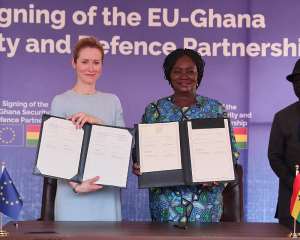
Even today, we continue to play an active role in our own voluntary subservience to former colonial powers. No matter how pragmatic one tries to be, the same question keeps resurfacing: why do we repeatedly run ourselves down to the point where dependency becomes our only option? Why do we allow ourselves to reach a deficit of choices that pushes us back into the arms of those whose dominance we claim to resist?
The official headline is simple enough: “EU & Ghana sign Security and Defence Partnership and strengthen cooperation with new equipment handover.” But the real issue lies beneath the surface. Who initiated this partnership? Did our government seek it out as a way to mask our challenges in maintaining internal security, regional stability, and the basic equipping of our own armed forces?
And what does this say about our existing alliances? Ghana is already described as having a strong military relationship with the United States, complete with a permanent presence on our soil. If the US is indeed the most advanced and powerful military force in the world, why must we now turn to Europe — often described as the next in line — to address security concerns in our sub‑region? What strategic logic underpins this dual dependency?
The principle of divide and rule has shaped our history since Europeans first arrived with smiles and gifts, offering friendship in exchange for influence. Today, even as crises escalate in the Middle East — crises we did not create — West African leaders struggle to speak directly to one another. Too often, communication between our states is filtered through European intermediaries rather than through our own regional mechanisms.
Yet West Africa possesses the natural and human resources to chart its own path. A determined, unified ECOWAS could mobilise its collective strength to navigate the global turbulence created by others. Instead, we continue to underestimate our own capacity while overestimating the intentions of those who have historically acted in their own interest.
Europeans, as history shows, negotiate with precision and self‑interest. They arrive with smiles and gifts, and we take the bait. This, even after their recent posture at the United Nations revealed a willingness to remain neutral at moments when African interests were on the line. Meanwhile, those whose friendship we often take for granted stood with us. The contrast raises uncomfortable questions about how we interpret loyalty and whose support we value.
Even if one accepts the argument that European involvement may help stabilise our security environment, the implications must be examined carefully. What obligations are embedded in this agreement? Will Ghana be expected to participate in future European military engagements, including potential confrontations involving major global powers? Will we retain the right to opt out, or will the fine print bind us to strategic decisions made far from our shores?
History urges caution. Europeans have long been skilled negotiators, and African states have too often entered agreements without fully accounting for long‑term consequences. Still, there is room to hope that this time, our leaders have assessed the situation accurately and acted in Ghana’s best interest.
The question now is whether this partnership strengthens our sovereignty — or quietly erodes it.


 Mahama wants Ghanaian football talents retained longer to revive premier league
 No businessman will sponsor NPP again because of its ‘evil and greedy nature’ – ...
 Failure to jail corrupt NPP officials will haunt NDC in election 2028 – Hopson A...
 Mamprugu Youth calls for crackdown on fake Facebook accounts over alleged false ...
 Mahama appoints Dr Abdul-Baasit Aziz-Bamba as Acting Director-General of Value f...
 2024 teacher recruits’ salary arrears processed — GES
 NPP's failure to continue E-blocks projects worsened SHS placement crisis — Tank...
 "Fix SHS placement bottlenecks for BECE graduates" — Patricia Appiagyei tells go...
 Dr Ayew Afriye secures police enquiry bail for Efya Royal
 UK stranded Barosky to receive psychological, financial support after his repatr...

