




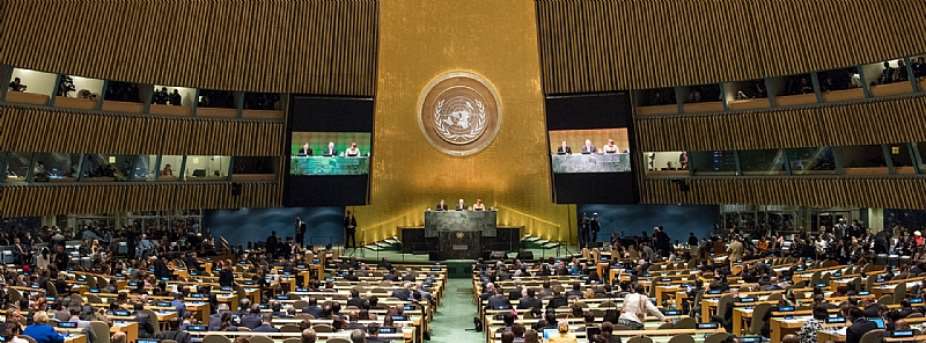
On March 25, 2026, the United Nations General Assembly adopted a historic resolution recognizing the transatlantic slave trade as the “gravest crime against humanity.” The resolution led by Ghana also encouraged discussions around reparations for affected communities.
Out of 178 countries, 123 voted in favor, but three countries the United States, Israel, and Argentina voted against, while many others abstained.
This decision raised global debate, especially in Africa and the Caribbean. However, the opposition was not a denial of slavery’s brutality it was largely based on legal, political, and diplomatic concerns.
Legal Concerns: “No Retroactive Justice”
The main argument, especially from the United States, was rooted in international law.
The U.S. argued that slavery, while morally wrong, was not illegal under international law at the time it occurred.
Therefore, recognizing it in a way that could imply legal liability today (e.g., reparations) is problematic.
In simple terms:
Countries cannot be held legally responsible today for actions that were not illegal when they happened.
This principle is known as non-retroactivity in international law.
Opposition to Reparations
Another major issue was reparations.
The resolution suggested that compensation or reparatory justice should be considered.
The U.S. explicitly stated it does not recognize a legal right to reparations for historical injustices.
Critics (including the U.S.) argue:
Modern governments and taxpayers should not be held financially responsible for actions committed centuries ago.
Determining who pays and who benefits is extremely complex.
Argentina and Israel aligned broadly with this concern, even though their detailed explanations were less publicly emphasized.
Fear of Creating a “Hierarchy of Suffering”
Another key objection was the wording of the resolution itself.
The resolution described slavery as the “gravest” crime against humanity, which raised concerns that it:
Ranks one historical atrocity above others (e.g., genocide, the Holocaust, war crimes).
Could diminish the suffering of victims of other tragedies.
The U.S. and others argued that:
All crimes against humanity are equally serious and should not be ranked.
Concerns About Historical Interpretation
Some countries also felt the resolution:
Presented a simplified or one-sided interpretation of history
Included politically sensitive or disputed historical claims
Critics argued that the UN should not:
Act as a final authority on historical debates
Or adopt language that may create political division rather than consensus
Political and Diplomatic Considerations
There are also broader geopolitical realities:
Western countries have long resisted formal reparations frameworks
Supporting such resolutions could:
Open the door to large-scale financial claims
Trigger similar demands related to colonialism or other historical injustices
Even countries that did not vote “no” (like the UK and EU members) chose to abstain, showing how sensitive the issue is globally.
Important Clarification: They Did NOT Defend Slavery
It is crucial to understand:
The U.S., Israel, and Argentina did not defend slavery
They acknowledged it as a grave historical injustice
Their opposition was mainly about:
Legal consequences
Wording of the resolution
Future implications (especially reparations)
Conclusion
The vote at the United Nations reflects a deeper global divide:
Africa and the Global South: pushing for recognition, justice, and reparations
Some Western and allied nations: cautious about legal, financial, and political consequences
In essence, the disagreement was not about whether slavery was horrific it was about how the world should define responsibility for it today.
Mustapha Bature Sallama.
Medical/ Science Communicator,
Private Investigator, Criminal investigation and Intelligence Analysis.
International Conflict Management and Peace Building.USIP
[email protected]
+233-555-275-880


 'EOCO attempted arrest of Baffour Awuah was unprofessional' — James Agalga
 'Building a congregation of 20,000 will kill you' – Duncan-Williams tells young ...
 September 29: Cedi finishes day selling at GHS12.20 on forex market, GHS11.67 on...
 ‘We’ll explore another constitutional option for narcotics probe’ – Minority on ...
 Speaker Bagbin adjourns Parliament indefinitely after rejecting narcotics probe ...
 Food Buffer Stock seeks stronger liquidity buffer despite record GH¢91.7 million...
 Ex NAFCO Boss trial: Court adjourns trial to hear application for return of seiz...
 Bagbin backs Mahama’s call for national dialogue on social media insults



Comments
Arguing that slavery was legal when it occurred does not excuse it from being recognized as a profound injustice today. Its lasting impacts persist in the form of unequal housing, employment disparities, systemic and institutional racism, and police brutality. Because these inequities are rooted in the same historical systems, the United States continues to operate within structures shaped by that injustice—making retroactive reparations a necessary step toward addressing and repairing the...