




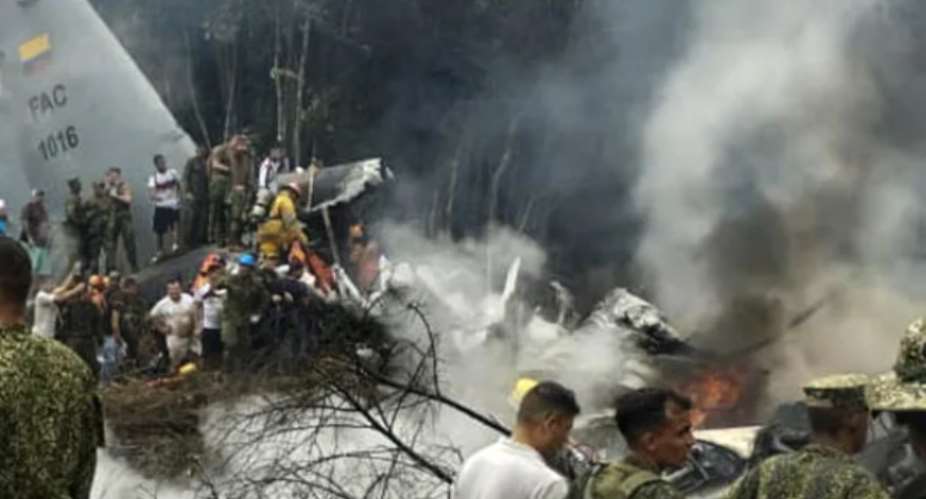
On the morning of March 23, 2026, the jungle floor near Puerto Leguízamo, a remote town in Colombia’s Amazonian province of Putumayo swallowed a military transport plane whole. A C-130 Hercules, carrying over 120 men mostly soldiers, crashed just two kilometres from the runway seconds after takeoff. At least 66 lives were lost. Dozens more were rushed to the only two small clinics in town on the backs of motorcycles driven by ordinary residents. The aircraft caught fire, and onboard ammunition detonated, turning a military mission into a national funeral.
This is not just Colombia’s tragedy. It is a story that speaks directly to Ghana, a nation that recently strengthened diplomatic ties with Bogotá and to every country that still relies on ageing aircraft to carry its sons and daughters across the sky.
A Geography Lesson in Disguise
To a geography student like me, the location of this crash is itself a chapter worth reading. Puerto Leguízamo sits in one of the most isolated corners of South America, a frontier town bordering Peru and Ecuador, deep in the Amazon basin. It is the kind of place where infrastructure is thin, hospitals are scarce, and the nearest major city, Bogotá, is a flight away. When disaster strikes in places like this, the geography punishes the victims twice: once in the crash, and again in the rescue.
This mirrors realities we know too well across West Africa, where military and civilian operations routinely push aircraft through difficult terrain, tropical humidity, and poorly equipped airstrips. The Colombia crash is, in many ways, a mirror held up to our own vulnerabilities.
The Problem with Old Wings
The C-130 Hercules is an all-around workhorse. Colombia got its first one in the late 1960s, so many of its travelers have much older parents. Though new models have come with them - at least throughout the World-Globally - many countries, particularly southern ones, still have military and civilian fleets that are in need of fixing or changing to some extent. Colombian President Gustavo Petro himself has acknowledged this and blamed bureaucracy over years for stalling that of the military. His critics, he said, pointed to budget cuts that cut flight hours as an excuse for the staff being under-trained.
It is clear why both sides are damning. Whether it is “bureaucracy” or budget the issue is the same: soldiers get on planes that should not be in a hangar and should be flying out to the sky. “The sky is not failing us but rather, we are failing the sky,” by sending old machines into it and hoping, at least on my part, for the best.
This Is Not an Isolated Incident
What makes this crash particularly alarming is its pattern. Just weeks before the Puerto Leguízamo disaster, a Bolivian Air Force C-130, the same model crashed in the city of El Alto, narrowly missing a residential building. In late January 2026, another aircraft went down near Cúcuta in northeastern Colombia, killing everyone on board, including a sitting congressman. These are not random tragedies separated by decades. They are happening within months of each other, in the same region, involving the same type of aircraft.
The frequency is a warning.
What This Means for Ghana
Ghana and Colombia are no longer distant strangers. With a new alliance forged between the two nations, the story of Colombia’s military losses carries a human dimension that touches Accra directly. Beyond diplomacy, however, this crash raises questions every Ghanaian, especially every young Ghanaian, should be asking about our own aviation safety ecosystem.
Are our military and domestic aircraft regularly and rigorously maintained? Do our pilots receive sufficient flight hours to stay sharp? Are our emergency response systems robust enough to handle remote-area disasters? In a country where flights connect the north to the south, the coast to the savannah, these are not abstract questions.
A Call to Look Up
The sky has always represented possibility in travel, in trade, in the movement of people and ideas. But it is also an environment that forgives nothing. A poorly maintained engine, an under-resourced crew, a bureaucratic delay in procurement, any one of these can send 66 young soldiers into the earth in seconds.
As a geography student, I am trained to read landscapes, that is, to understand how terrain, climate, and infrastructure intersect with human life. What I see when I look at the Colombia crash is a geographic and political failure: a remote location with no nearby medical capacity, an aircraft that belonged to another era, and a government that knew the problem existed but could not act fast enough.
Ghana must read this landscape too — and act before it becomes our own.
“The sky is not the limit. Negligence is.”
Ghana extends its deepest condolences to the people of Colombia, to the families of those lost, and to a nation now asking the hardest questions. We ask them too, for ourselves. Because the next plane could be ours. And the next lesson, if we are not careful, will be written not in ink, but in blood and ash.
Author: Isaac Adutwum Osei
Bio: PhD Student in Geography and Environment, Western University, Canada
Email: [email protected]

 Obuasi SHTS alleged sexual abuse: Kwasi Kwarteng criticises Education Minister o...
 ECOWAS’ $250,000 flood relief donation arrives in Ghana – Ablakwa
 Kennedy Agyapong has not resigned from NPP – Kwasi Kwarteng
 State failure, not GoldBod, driving galamsey – Daryl Bosu
 A Rocha Ghana raises alarm over human rights abuses in mining communities
 ECOWAS, AfDB discuss ways to advance West Africa’s development priorities
 October 16: Cedi gains against dollar, sells at GHS12.25 on forex market, GHS11....
 Galamsey: Ghana’s rivers now run chocolate and milk colour — Sam Jonah
 A nation of job-seekers will always be poor — Sir Sam Jonah
 “If you attack us with pepper spray, we’ll fight back” — NDC Yakubu Tony Aidoo w...


