




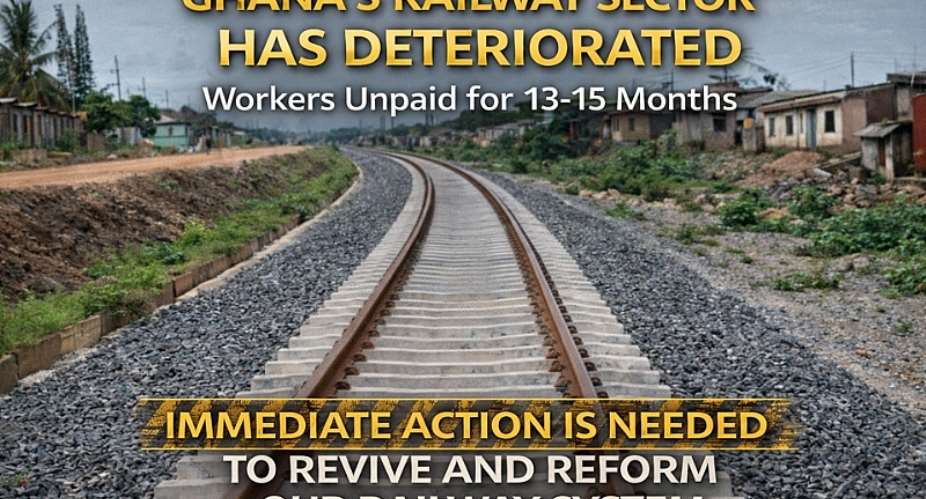
In a country with so much untapped potential in its railway sector, it’s disheartening to witness the ongoing crisis that continues to unfold. Ghana’s railway industry, once seen as the backbone of transportation and economic growth, has been reduced to a shadow of its former self. The recent strike by railway workers, protesting 13 to 15 months of unpaid salaries, brings into sharp focus the dire state of the sector and how much has gone wrong over the years.
The Ghana Railway Company Limited (GRCL), the state-run operator, is in a state of financial ruin, primarily due to years of neglect, mismanagement, and a complete lack of government commitment to invest in the sector. For workers who keep the system running, unpaid wages and poor working conditions have become a way of life. Beyond the human cost, the railway’s decline has a deep economic and infrastructural impact that threatens the nation’s long-term development.
How Can an Industry Operate When Workers Aren’t Paid?
The simple answer: it can’t. When the very individuals tasked with operating, maintaining, and overseeing the rail system aren’t compensated fairly or on time, the ripple effects are felt throughout the entire industry. Unpaid railway workers mean inconsistent services, diminished capacity, and delayed projects.
It’s hard to imagine how the system can thrive when there’s no motivation for employees to keep pushing forward. Workers who haven’t seen a paycheck in over a year are, understandably, demotivated and disillusioned. At its core, this isn’t just about salaries; it’s about the human capital needed to operate one of the most essential parts of the country’s infrastructure. Technicians, engineers, maintenance staff, and conductors, without them, the trains don’t run. And even when they do, they do so under less-than-ideal conditions.
The Deterioration: A System Left to Rot
The origins of Ghana’s railway system date back to the colonial era when it was designed to transport mineral wealth and agricultural exports from the interior to the ports. Despite being an integral part of Ghana’s economy, the railway network suffered from decades of underinvestment after independence. The lack of strategic planning, poor management, and systemic neglect compounded the challenges facing the railway sector.
Maintenance delays, ageing rolling stock, and a deteriorating infrastructure continue to plague the system. It is almost impossible for the industry to deliver efficient services when tracks are falling apart, stations are in ruins, and train cars are outdated. These long-standing problems have only worsened in recent years.
As Ghana grows more urbanized and industrialized, the need for an efficient, fast, and reliable railway system becomes more critical. Yet, the opposite has occurred, today’s rail system is so underdeveloped that it cannot meet even the most basic needs of the country. There is a disconnect between government promises of revitalization and the reality on the ground, where the railway remains stuck in a state of stagnation.
Economic Consequences: The Cost of Inaction
The economic implications of this stagnation are grave. Ghana’s railway system is crucial for reducing transportation costs, promoting regional trade, and connecting local economies. In its current state, the railway is unable to fulfill its potential to move bulk cargo efficiently, particularly in agricultural and mineral-rich regions. This leaves an overwhelming dependence on road transport, which is more costly and less efficient.
When freight doesn’t move efficiently by rail, companies incur higher transportation costs. These costs are inevitably passed on to consumers, resulting in higher prices for goods. More significantly, the failure to modernize the railway sector undermines Ghana’s competitive advantage in regional trade, particularly with landlocked neighbors who depend on more reliable transport networks. If Ghana is serious about becoming a regional logistics hub and boosting economic growth, investing in a functioning railway system is non-negotiable.
A Call for Urgent Change
The time for mere promises is over. Ghana needs a radical overhaul of its railway sector, and it needs it now. Investment in modern infrastructure, consistent maintenance, and a transparent, efficient management system are all essential to revive the railways and restore confidence in the sector. The industry must be treated as an essential service that is critical for national development, and not as an afterthought that can be ignored for decades.
Moreover, the welfare of railway workers must be prioritized. The recent strike is not just about unpaid wages; it is a cry for respect, accountability, and recognition of the value that these workers bring to the country. The government must ensure that workers are paid promptly and that their working conditions are improved. But beyond wages, there must be a long-term vision for the sector, one that builds infrastructure for the future, attracts skilled labor, and integrates the railway into the national transport strategy.
It’s also crucial that technical training and certification pathways be integrated into railway development. With a properly trained workforce, maintenance can be carried out with more efficiency, which in turn ensures that the system runs smoothly.
A Railway System That Works for Ghana
As it stands, the railway sector in Ghana is a reflection of broader infrastructural and governance failures. For decades, it has been ignored and underfunded. The recent protests by railway workers are a wake-up call that cannot be ignored. If Ghana is serious about its infrastructural and economic future, the railway must be revived and brought into the modern era.
Now is the time for Ghana to build a rail system that works for the people, one that not only facilitates trade but also connects citizens, creates jobs, and enhances national development. But that can only happen if we act decisively and invest in the future of the railway system, its workers, and the people it serves.
It’s time to stop the cycle of neglect and start the journey towards a revitalized, functioning railway system in Ghana. Ghana deserves better, and its railway workers deserve to be respected. The future depends on it.
Author: Joseph Fuseini ([email protected])


 ‘Everything is possible’ – Speaker Bagbin inspires Zenith Law students with cour...
 Zenith University Law students observe proceedings to deepen parliamentary proce...
 Mahama changes galamsey approach, summons top officials and security chiefs
 This is only the beginning of my demand for accountability – Gumah after confron...
 'Your record stinks’ – Agalga fires back at Minority over cocaine debate
 GNFS to receive first batch of 40 new fire tenders by December – Muntaka
 Okaikwei North MCE suspends PA for one week after slapping Assembly staff member
 Let Ghanaians feel the economic change in their pockets and not on paper — Afeny...
 CLOGSAG demands police probe into alleged assault on Okaikwei North Assembly sta...
 Gov't pays GHS4.9 billion to DDEP bondholders, retires 44.1% of programme


