




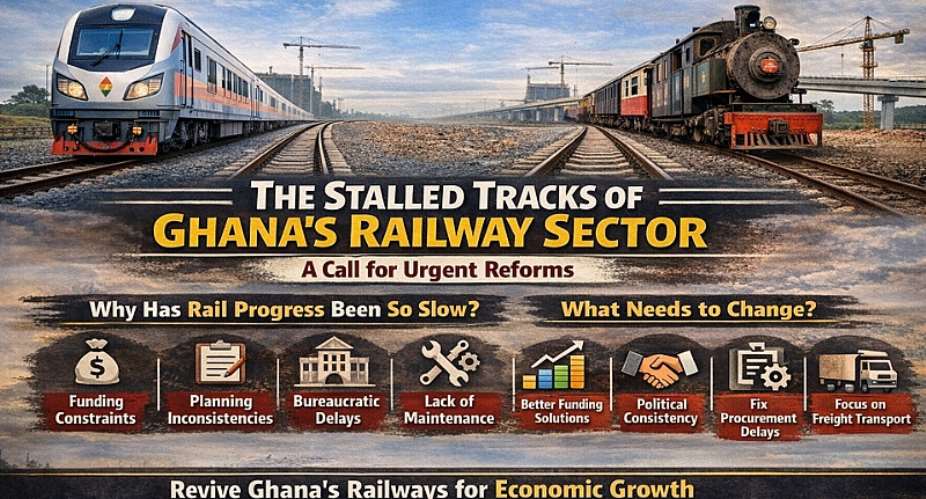
For decades, the railway sector in Ghana has been a tale of promise unfulfilled. Despite numerous ambitious projects, progress remains sluggish, with many projects stalling or moving at a pace far slower than what the country's growing economy demands. However, there is a glimmer of hope as the government has embarked on the rehabilitation of existing railway lines and the construction of new standard-gauge lines. Yet, despite these efforts, several challenges persist that prevent the sector from becoming the catalyst for economic growth it should be.
Currently, operational railway lines include the newly commissioned Tema-Mpakadan standard-gauge line, the 97.6 km stretch set to connect the port of Tema to Mpakadan, opening up potential for both passenger and freight transport. This line is part of the Ghana-Burkina Faso Railway Interconnectivity Project, which envisions connecting Ghana’s seaport to the landlocked country to the north. Additionally, parts of the older narrow-gauge network remain operational, such as the Western Line (Takoradi-Kojokrom-Awaso) and the Eastern Line (Accra-Tema-Nsawam/Kotoku). There is also work underway to modernize these existing lines, converting parts of the Western Line from narrow gauge to the more efficient standard gauge.
But this progress is tempered by the reality that many of these projects are behind schedule, primarily due to issues around funding and delays caused by debt restructuring. As a result, what should be a major national infrastructure achievement often feels like a distant dream, frustrating many observers and citizens who have waited for years.
The Root Causes of Delayed Progress
The reasons behind the slow pace of railway development in Ghana are multifaceted, but several key factors consistently stand out.
1. Funding Constraints and Debt Issues
One of the most significant hurdles has been the issue of financing. Despite the government’s stated intentions to modernize the railway sector, much-needed funding remains elusive. In particular, the Western Line Rehabilitation, which would vastly improve the movement of bauxite and manganese from Takoradi to Kumasi, has faced delays due to funding shortages tied to Ghana’s broader debt restructuring efforts. This is not just a matter of securing loans or credit; it’s also about effective financial management and ensuring that the resources allocated to railway projects are sufficient, timely, and not diverted to other less critical sectors.
2. A Lack of Consistency in Planning and Execution
Ghana’s railway sector has seen numerous starts and stops over the years. While there has been a national railway master plan since 2020, which now places emphasis on freight transportation and the integration of major mining and industrial hubs with ports, the plan’s execution has been inconsistent. The fragmentation between vision and reality is further exacerbated by shifting political priorities and a lack of long-term vision beyond the current administration. A master plan that’s not executed properly will continue to see projects left incomplete, wasting both time and resources.
3. Bureaucracy and Delays in Procurement
Bureaucratic inefficiencies and delays in procurement processes further contribute to the snail’s pace of progress. Projects like the Kumasi-Paga “Central Spine” line and the Manso-Huni Valley standard-gauge line, crucial for the nation’s rail network, have been delayed by administrative bottlenecks. This is particularly concerning given the potential these projects have for improving connectivity and facilitating economic activity across the country.
4. Inadequate Infrastructure to Support Growth
While there have been some efforts to modernize infrastructure, such as upgrading the Sekondi Railway Workshop to become a hub for repairing and maintaining new rolling stock, the overall capacity to manage these projects has remained limited. The lack of an efficient infrastructure base to service the new trains and equipment poses a significant challenge. Simply constructing tracks and laying down rail lines is not enough; there needs to be proper facilities for maintenance and repair, which are essential for the long-term sustainability of the network.
The Way Forward: What Must Change
For Ghana to realize the true potential of its railway sector, a combination of strategic reforms, better management, and sustainable investment is necessary.
1. Streamlined Financial Management and Better Funding Models
It is critical that the government seeks to ensure better financial management. Innovative funding models that leverage both local and international investment, as well as public-private partnerships, should be explored. Railways are a long-term investment, and Ghana must position itself as an attractive destination for investment in rail infrastructure. This would require not only securing loans but also efficiently managing the available funds to ensure they directly benefit railway development.
2. Political Will and Consistency in Execution
There must be greater political will to prioritize the railway sector as a critical part of Ghana’s infrastructure development. Railway projects should transcend the political cycle, ensuring that they are seen as national priorities. This requires a commitment from successive governments to follow through on the plans laid out, regardless of which party is in power. Ghana must also avoid piecemeal planning and ensure that projects are holistic, well-integrated, and aligned with the country’s overall economic strategy.
3. Tackling Bureaucracy and Improving Procurement Processes
Reducing the delays in procurement processes is a key area for improvement. A streamlined and transparent procurement system would ensure that projects get off the ground faster and are delivered on time. Governments and contractors need to work together to eliminate bottlenecks that cause delays and inefficiencies, which result in unnecessary cost overruns and missed deadlines.
4. Strengthening Maintenance Infrastructure
The rehabilitation of existing lines and the construction of new tracks must be complemented with investment in maintenance infrastructure. Upgrading workshops, depots, and other facilities will not only ensure that trains run smoothly but also create jobs and increase the overall efficiency of the rail network. Without this, even the most advanced rail system will be prone to breakdowns, delays, and additional costs.
5. Enhancing the Focus on Freight Transport
Ghana must maintain its focus on the transportation of freight, particularly from mining and industrial sites to ports. The Western and Eastern corridors must be prioritized, with proper facilities and systems in place to move bulk commodities efficiently. This would not only boost Ghana’s exports but also create an integrated transport network that feeds directly into global supply chains.
Conclusion
Ghana’s railway sector is at a crossroads. While there is hope with ongoing rehabilitation efforts and the development of new standard-gauge lines, much more needs to be done. The country’s railway system could be the backbone of its industrial and economic growth, but only if the government and stakeholders address the key challenges standing in the way. With better funding, improved planning, and a long-term commitment to modernization, Ghana’s railways could become an engine of national growth. However, until these necessary changes are made, the tracks will remain stalled, and the promise of a modern rail network will remain just that, a promise.
Author: Joseph Fuseini ([email protected])


 ‘Everything is possible’ – Speaker Bagbin inspires Zenith Law students with cour...
 Zenith University Law students observe proceedings to deepen parliamentary proce...
 Mahama changes galamsey approach, summons top officials and security chiefs
 This is only the beginning of my demand for accountability – Gumah after confron...
 'Your record stinks’ – Agalga fires back at Minority over cocaine debate
 GNFS to receive first batch of 40 new fire tenders by December – Muntaka
 Okaikwei North MCE suspends PA for one week after slapping Assembly staff member
 Let Ghanaians feel the economic change in their pockets and not on paper — Afeny...
 CLOGSAG demands police probe into alleged assault on Okaikwei North Assembly sta...
 Gov't pays GHS4.9 billion to DDEP bondholders, retires 44.1% of programme


