




Abstract
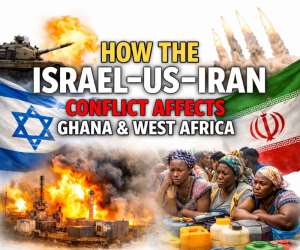
The escalating geopolitical confrontation involving the United States, Israel, and Iran has significant global implications beyond the Middle East. Although Ghana and other West African countries are geographically distant from the conflict zone, their economies and security structures remain interconnected with global trade, energy markets, and political alliances. This article examines how the conflict could influence Ghana and the broader West African region through rising energy prices, economic shocks, trade disruptions, and geopolitical realignments. Evidence suggests that Africa’s dependence on imported fuel, fragile supply chains, and limited economic resilience make the region particularly vulnerable to such global conflicts.
1. Introduction
Global conflicts often produce ripple effects that extend far beyond the battlefield. The recent escalation involving the United States, Israel, and Iran has raised concerns among policymakers and economists worldwide. The conflict threatens key global energy routes and has already begun affecting international oil prices, shipping routes, and geopolitical alliances.
For countries like Ghana and many states within West Africa, the effects are indirect yet significant. Their economies rely heavily on imports, global commodity prices, and stable international trade routes. As a result, geopolitical tensions in the Middle East could reshape economic conditions across Africa.
2. Background of the Conflict
The current tensions stem from escalating hostilities between Israel and Iran, with the United States supporting Israeli military operations. The conflict has involved missile strikes, attacks on energy infrastructure, and retaliatory actions across the Middle East. Reports indicate that the war has already caused major damage to oil facilities and civilian infrastructure, leading to hundreds of casualties and heightened regional instability.
One of the most critical geopolitical factors in the conflict is the strategic Strait of Hormuz, a narrow maritime route through which roughly 20 percent of the world’s oil supply passes. Disruptions in this route have triggered global concerns about energy supply and economic stability.
Consequently, oil prices have surged sharply, with Brent crude approaching $93 per barrel, representing a significant increase within a short period.
3. Impact on Global Energy Markets
Energy markets are extremely sensitive to geopolitical instability in the Middle East because the region hosts some of the world’s largest oil producers. When conflicts threaten oil supply chains or transportation routes, global oil prices typically rise rapidly.
Recent reports indicate that disruptions around the Strait of Hormuz and the escalation of hostilities have pushed global oil prices higher and increased uncertainty in international markets.
Analysts also warn that prolonged instability could increase energy prices by up to 80 percent, which would fuel global inflation and slow economic growth worldwide.
For many African economies that depend heavily on imported petroleum products, such price surges could have severe consequences.
4. Economic Implications for Ghana
4.1 Rising Fuel Prices
Ghana imports a large proportion of its refined petroleum products. Therefore, fluctuations in global oil prices directly influence domestic fuel costs. Rising oil prices would likely increase transportation costs, electricity generation expenses, and inflation across the economy.
Ghanaian leaders and analysts have already warned that the Middle East crisis could lead to higher fuel prices and increased cost of living if the conflict escalates further.
Higher energy costs would affect almost every sector of the economy, including agriculture, manufacturing, and transportation.
4.2 Inflation and Cost of Living
An increase in energy prices often triggers inflation. Research indicates that oil price increases have a strong relationship with inflation in Ghana’s economy.
If fuel prices rise significantly, the cost of goods and services such as food, transport, and electricity would increase. This could place additional pressure on households already facing economic hardship.
4.3 Trade and Export Implications
The conflict may also influence Ghana’s export economy. Ghana exports commodities such as gold, cocoa, and oil, and global instability can influence demand and prices for these resources.
Some analysts suggest that Ghana’s economic gains from gold and oil could face uncertainty due to disruptions in global markets caused by the conflict.
While higher gold prices during global crises could benefit Ghana, disruptions in trade routes and shipping could offset these gains.
5. Implications for West Africa
5.1 Supply Chain Disruptions
African leaders have warned that the Middle East conflict could strain supply chains across the continent. Rising shipping costs and delays may affect imports of essential goods such as fuel, fertilizer, and food.
When shipping routes are disrupted, vessels may be forced to take longer routes, increasing transportation costs and delivery times.
5.2 Energy Security Challenges
Many West African countries rely heavily on imported fuel due to limited refining capacity. This dependence makes the region vulnerable to global energy price fluctuations.
Experts warn that disruptions to global oil markets could create economic risks for several African economies, particularly those reliant on imported petroleum products.
Business Insider Africa
Countries such as Ghana, Côte d’Ivoire, Senegal, and others could experience fuel shortages or rising energy costs.
5.3 Political and Diplomatic Effects
The conflict may also influence diplomatic relations between African states and global powers. Many countries in the Global South have expressed concerns about the war and its implications for international stability.
African nations may face pressure to align with different geopolitical blocs, potentially affecting international partnerships and development assistance.
6. Security Implications
Beyond economics, global conflicts can also create security challenges.
Increased global instability may encourage extremist groups to exploit geopolitical tensions.
Refugee crises from the Middle East could indirectly affect migration patterns toward Africa and Europe.
Increased military tensions may divert international attention and resources away from African security concerns.
These dynamics could reshape security cooperation between African countries and international partners.
7. Opportunities Amid the Crisis
Despite the potential challenges, the conflict could also present opportunities for Ghana and West Africa.
Higher gold prices: Global uncertainty often increases demand for gold, which could benefit Ghana as one of Africa’s leading gold producers.
Energy investment: Rising global energy prices could stimulate investment in African oil and gas sectors.
Regional cooperation: The crisis may encourage West African countries to strengthen economic integration and energy security strategies.
8. Conclusion
The Israel–US–Iran conflict demonstrates how geopolitical tensions in one region can influence economic and political conditions across the world. For Ghana and West Africa, the most immediate impacts are likely to appear in the form of rising fuel prices, inflation, trade disruptions, and supply chain instability.
Given Africa’s dependence on imported energy and global trade networks, the region remains vulnerable to external shocks triggered by international conflicts.
However, proactive policies aimed at strengthening energy independence, improving regional trade, and diversifying economic sectors could help Ghana and West Africa mitigate the negative consequences of such global crises.
Ultimately, the conflict serves as a reminder that in an interconnected world, geopolitical stability is essential not only for regional security but also for global economic prosperity.


 'Chief Justice was talking as a citizen; you have to look at the context in whic...
 Mandatory towing to remove broken-down, stationary vehicles from roads to begin ...
 Domelevo backs OSP probe into alleged GH¢70,000 payment to Appiagyei despite den...
 WAEC releases 2026 WASSCE results, cancels entire results of 861 candidates for ...
 Baffour Agyeman-Duah explains why profitability may not be only reason behind SO...
 Kofi Bentil defends Mahama’s dissolution of nine State Boards
 5-year-old girl dies after falling into water-filled manhole at Winneba
 Sierra Leone ex-president to return after treason case dropped
 'Explain how you spent your Common Fund' — Boako, Annoh Dompreh challenge Tano N...
 Ghana ends South Africa evacuation; brings home nearly 1,900

