




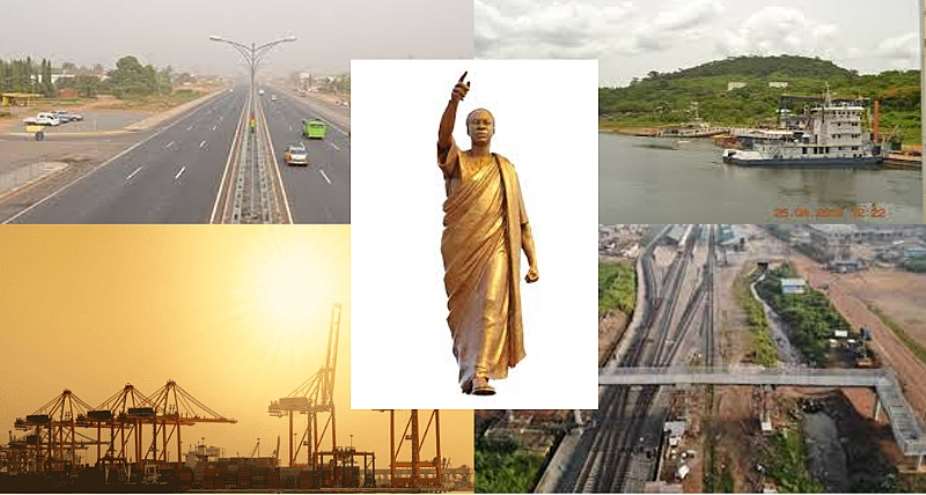
When Ghana achieved independence on 6 March 1957, the celebration was not only about political freedom. For the early national leadership, independence represented the beginning of an ambitious effort to rebuild the country’s economic and infrastructure systems to serve national development rather than colonial extraction. Transportation, particularly railways and inland water transport, was central to that vision.
The leadership of Dr. Kwame Nkrumah viewed infrastructure as the backbone of economic transformation. Under colonial rule, Ghana’s railway system had been designed primarily to move minerals, timber, and cocoa from the interior to coastal ports. The network linked areas such as Tarkwa, Obuasi, and Kumasi to the ports of Sekondi and Takoradi, ensuring efficient export of raw materials to Europe. While functional, the system was narrow in purpose. It connected extraction zones to ports but did little to integrate the country internally or support industrialization.
Nkrumah and his government sought to change that logic. Their ambition was to turn transportation infrastructure into a tool for nation-building. The goal was not simply to operate inherited railways but to use them to stimulate industrial growth, expand internal trade, and connect regions more effectively.
One of the most ambitious projects of the early post-independence era was the development of the Volta River Project, anchored by the construction of the Akosombo Dam (1961-1965). The dam created the vast Lake Volta, opening new possibilities for inland water transport. The vision was that barges and ferries would move bulk goods and agricultural produce across the lake, linking the northern regions of the country to southern markets and ports. Inland water transport was expected to become a cost-effective logistics system that complemented rail and road networks. This led to the establishment of the Volta Lake Transport System in the 1960s. with a structured inland water transport service, eventually operated by the Volta Lake Transport Company. Operational development: mid-1960s.
The aim was to develop barge and ferry services to transport passengers, vehicles, and cargo across the lake. This system was intended to reduce transport costs and support economic activity in northern Ghana and lakeside communities.
Another critical project was the construction of the Port of Tema, which became Ghana’s largest and most modern harbor. Construction started in 1958 and officially opened in 1962. Before Tema’s development, most maritime trade passed through the older port facilities in Sekondi-Takoradi. Tema was designed as a modern deep-water port capable of handling increased cargo volumes associated with industrial growth. It also supported the development of the nearby Tema Industrial Area, envisioned as the centerpiece of Ghana’s manufacturing sector. The port was integrated into national logistics planning, with road and rail links connecting it to the interior.
To connect the capital to the new industrial port city, Ghana constructed the Tema Motorway, the first major motorway in West Africa. Construction period 1961 to 1965. The motorway significantly improved the movement of goods and passengers between Accra and Tema, strengthening the logistical relationship between the country’s administrative and industrial centers. At the time of its completion, it represented one of the most modern road infrastructure projects in the region.
At the same time, the government recognized that railways were essential for industrial policy. Early national development plans emphasized modernizing and expanding rail corridors to support mining, agriculture, and emerging manufacturing industries. Rail transport was seen as the most efficient way to move heavy commodities such as bauxite, manganese, timber, and cocoa. In this sense, railways were not just infrastructure; they were instruments for economic restructuring.
Although the railway network itself had been built during the colonial era, the early post-independence government made efforts to strengthen railway operations and maintain the network managed by the Ghana Railway Corporation.
During this period:
- Railway workshops were upgraded
- Rolling stock and locomotives were maintained and expanded
- Rail freight continued to support cocoa and mineral exports
The railway system remained the primary bulk transport mode during the early years after independence, particularly for minerals and agricultural commodities.
The Strategic Vision Behind These Projects
These projects were not isolated infrastructure developments. They formed part of a coordinated national development strategy. The early leadership envisioned a transport system where:
- Railways handled heavy freight
- Inland waterways moved bulk cargo across long distances
- Roads supported regional connectivity
- Ports enabled international trade
Together, these systems were meant to support industrialization, regional integration, and economic independence.
However, these ambitions faced significant challenges. The inherited railway network required extensive modernization, but resources were limited. Political instability in later years, shifts in development priorities, and growing investment in road transport slowed the pace of railway transformation. While the early vision was bold, implementation proved more difficult than anticipated.
Nevertheless, the ambitions of the early national leadership remain important to revisit today. Their vision reflected a clear understanding that transport systems shape economic geography. Efficient railways and inland waterways could reduce transport costs, encourage industrial clustering, and integrate remote regions into the national economy.
More than six decades after independence, Ghana is once again discussing railway revival and the strategic use of inland water transport. In many ways, these conversations echo the aspirations of the country’s earliest leaders. The difference today is that the lessons of the past are clearer: infrastructure development requires long-term commitment, consistent policy direction, and sustained investment.
The post-independence ambitions of Ghana’s early leadership were rooted in a simple but powerful idea, that a newly independent nation should control not only its politics but also the corridors through which its economy moves. Revisiting that vision today may help guide the next chapter of Ghana’s transport development.
Author: Joseph Fuseini ([email protected])


 ‘Everything is possible’ – Speaker Bagbin inspires Zenith Law students with cour...
 Zenith University Law students observe proceedings to deepen parliamentary proce...
 Mahama changes galamsey approach, summons top officials and security chiefs
 This is only the beginning of my demand for accountability – Gumah after confron...
 'Your record stinks’ – Agalga fires back at Minority over cocaine debate
 GNFS to receive first batch of 40 new fire tenders by December – Muntaka
 Okaikwei North MCE suspends PA for one week after slapping Assembly staff member
 Let Ghanaians feel the economic change in their pockets and not on paper — Afeny...
 CLOGSAG demands police probe into alleged assault on Okaikwei North Assembly sta...
 Gov't pays GHS4.9 billion to DDEP bondholders, retires 44.1% of programme


