




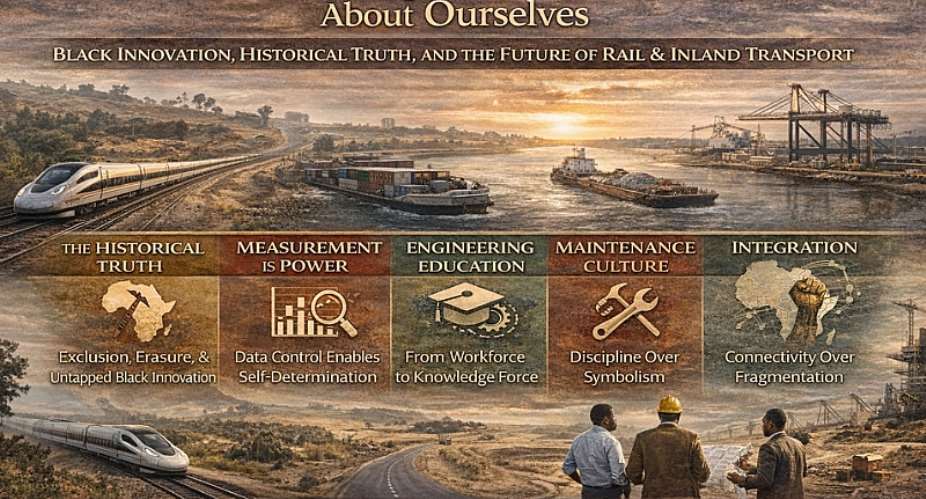
February was not just another month of policy discussion. It was a month of reflection, and appropriately so. In a period globally associated with the recognition of Black history, we were compelled to confront a deeper truth about Africa’s rail and inland transport systems: the story is not only one of colonial design and institutional neglect. It is also a story of Black innovation, overlooked contributions, interrupted continuity, and untapped intellectual power. If confidence begins with truth, then February reminded us that truth has layers.
1. The Historical Truth: Built for Extraction, but Not Built Without Black Minds
Yes, Africa’s railways were largely constructed during colonial periods to extract minerals and agricultural commodities. Lines ran from mines to ports, not from African cities to each other. Inland water systems were used selectively for imperial trade, not continental integration. These are structural facts. February forced us to go further.
Behind the steel, bridges, and river ports were Black laborers, engineers, navigators, and craftsmen whose technical knowledge was rarely documented or credited. Across the African diaspora, Black inventors and engineers shaped global transport history, from railway signal improvements to mechanical engineering breakthroughs that influenced locomotive and maritime safety systems. Yet their names are rarely embedded in Africa’s infrastructure narrative. The problem was not absence of Black innovation. The problem was erasure and exclusion from institutional control.
When technical authority and capital ownership were centralized outside African hands, innovation became disconnected from governance. February taught us that reclaiming the transport narrative requires restoring that intellectual lineage, not just politically, but technically.
2. The Data Lesson: Measurement Is Power
Throughout the month, we emphasized data, monitoring track conditions, vessel loading compliance, dredging cycles, turnaround times, and maintenance schedules. But February added a cultural layer to this conversation. Historically, control over information has equaled control over systems. When Africans did not control the data about their own transport networks, they could not control decision-making. Confidence was external. Strategy was reactive. This month reinforced a powerful lesson: data sovereignty is infrastructure sovereignty.
When African institutions measure their own freight flows, maintain their own hydrological records, and publish their own performance indicators, they shift from being operators of inherited systems to designers of future systems. Measurement is not just technical, it is emancipatory.
3. Engineering Education: From Labor Force to Knowledge Force
One of the clearest themes in February’s discussions was the need to deepen engineering education across the continent. Railways require signaling specialists, systems engineers, materials scientists, and asset managers. Inland waterways demand hydrologists, dredging engineers, naval architects, and logistics analysts. Historically, Africans often provided the labor that built systems but were excluded from the engineering schools that designed them. That imbalance created generational dependency.
February’s lesson was unmistakable: we must transition from being the workforce of infrastructure to being its knowledge architects. Black innovation has always existed. What is required now is institutional reinforcement, universities aligned with corridor development, research centers focused on rail durability in tropical climates, maritime institutes specializing in African river systems. Education is not separate from transport development. It is the engine beneath it.
4. Maintenance Culture: Discipline Over Symbolism
Another strong thread throughout February was the importance of maintenance. Across multiple articles, we examined how infrastructure expansion often overshadowed operational sustainability.
Here, history again offers clarity. Extraction-era railways were maintained when profitable to imperial interests. After independence, many systems suffered inconsistent reinvestment. The lesson is sobering: infrastructure without a maintenance culture deteriorates regardless of its origin.
But February also showed a shift in mindset. We are increasingly speaking about lifecycle budgeting, asset management systems, predictive maintenance, and performance audits. That shift reflects maturity. It signals that we are beginning to value operational excellence over symbolic expansion. It signals that we are learning to protect what we build.
5. Integration Over Fragmentation
Historically, rail lines were fragmented by design, different gauges, disconnected corridors, port-centric alignment. Inland waterways were managed nationally rather than regionally, despite rivers crossing borders.
February’s recurring message was integration.
- Integration in policy.
- Integration in data systems.
- Integration in education standards.
- Integration in continental corridor planning.
The African Continental Free Trade Area provides economic incentive. But integration requires technical harmonization, signaling standards, river navigation protocols, interoperable freight systems. We learned this month that political unity must be matched by engineering compatibility.
6. Identity and Confidence
Perhaps the most profound lesson February taught us is about identity. For too long, discussions about Africa’s transport systems oscillated between defensiveness and comparison. But confidence does not come from imitation or denial. It comes from self-awareness.
When we recognize that Black engineers and innovators have historically contributed to global transport technology, yet were systemically marginalized, we begin to understand that the capacity gap is not genetic, geographic, or cultural. It is institutional. That realization is powerful. It means that rebuilding rail and inland transport systems is not about “catching up”, it is about reclaiming continuity. It is about aligning historical innovation with modern governance.
What February Ultimately Taught Us
- From the 1st of February to today, the cumulative lessons are clear:
- Historical honesty strengthens strategic clarity.
- Black innovation must be documented, institutionalized, and funded.
- Data control equals decision-making control.
- Engineering education secures independence.
- Maintenance culture determines longevity.
- Regional integration requires technical harmonization.
February reminded us that infrastructure is not merely steel and water channels. It is memory, discipline, skill, and identity.
We are not starting from zero.
We are restarting with awareness.
Confidence begins with truth, and truth tells us that Africa has always had the intellectual capacity to build and sustain world-class transport systems. The challenge has been structural continuity, not creative ability. Building systems that reflect that truth is the next.
Author: Joseph Fuseini ([email protected])


 ‘Everything is possible’ – Speaker Bagbin inspires Zenith Law students with cour...
 Zenith University Law students observe proceedings to deepen parliamentary proce...
 Mahama changes galamsey approach, summons top officials and security chiefs
 This is only the beginning of my demand for accountability – Gumah after confron...
 'Your record stinks’ – Agalga fires back at Minority over cocaine debate
 GNFS to receive first batch of 40 new fire tenders by December – Muntaka
 Okaikwei North MCE suspends PA for one week after slapping Assembly staff member
 Let Ghanaians feel the economic change in their pockets and not on paper — Afeny...
 CLOGSAG demands police probe into alleged assault on Okaikwei North Assembly sta...
 Gov't pays GHS4.9 billion to DDEP bondholders, retires 44.1% of programme


