




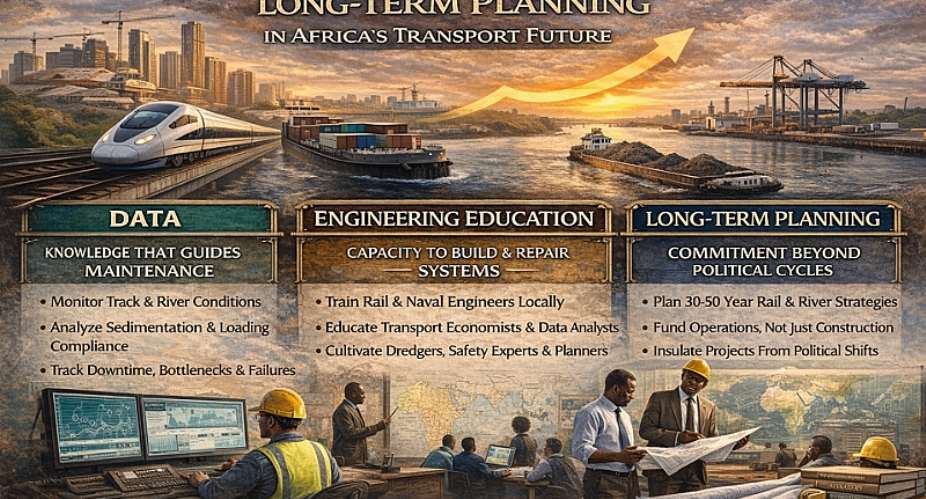
Infrastructure does not fail because Africa lacks ambition. It fails when ambition is not supported by data, engineering depth, and long-term thinking. Railways, inland waterways, and ports are not short-cycle political projects; they are generational systems. And generational systems demand three things above all else: accurate data, strong engineering education, and disciplined long-term planning.
First, data is the nervous system of modern transport. Without it, decision-making becomes reactive and expensive. Rail operators must know track condition trends, axle load stress patterns, failure rates of rolling stock, and turnaround times. Inland water authorities must track river depth variations, sedimentation rates, vessel loading compliance, accident statistics, and seasonal hydrology shifts. Data transforms anecdotes into insight. It reveals where maintenance budgets are most needed. It identifies bottlenecks before they become crises. It exposes inefficiencies that speeches cannot hide.
Yet data alone is not enough. Data must be interpreted, and interpretation requires engineering capacity. Engineering education is the backbone of system sustainability. When a railway develops persistent track deformation, it requires trained civil and mechanical engineers to diagnose root causes, not just contractors to replace sections. When an inland water channel silts up repeatedly, hydrological and dredging expertise is required to design lasting interventions. When vessels consume excessive fuel, naval architectural knowledge must guide hull redesign and propulsion efficiency improvements.
Too often, projects are imported while expertise remains external. Equipment arrives, but local technical capacity lags behind. This creates dependency. Sustainable transport systems cannot rely permanently on foreign troubleshooting missions. They require universities producing railway engineers, marine engineers, transport economists, data analysts, and safety specialists who understand local terrain, climate, and operational realities. Engineering education is not an academic luxury; it is operational insurance.
The third pillar, long-term planning, binds data and education into action. Rail corridors and river systems operate on life cycles measured in decades. Track structures may last 30 to 50 years. Bridges are even longer. River basin management requires multi-year sediment modeling and climate forecasting. Yet planning cycles in many contexts are tied to short political timelines. This mismatch creates fragmentation. New projects are announced without alignment to maintenance obligations. Expansion proceeds without secured operational funding. Infrastructure is built without lifecycle costing.
Long-term planning requires thinking beyond inauguration ceremonies. It demands lifecycle budgeting, asset management frameworks, intergenerational skill transfer, and stable regulatory environments. It means integrating rail and inland water strategies with industrial policy, agriculture logistics, and regional trade corridors. It recognizes that infrastructure is not just physical connectivity; it is economic architecture.
Importantly, Africa does not start from a vacuum. Indigenous water transport systems historically relied on observation, adaptation, and seasonal planning. Communities understood river rhythms and adjusted accordingly. That culture of observation and adjustment mirrors modern data-driven planning. The difference today is scale and complexity, but the principle remains the same: systems survive when decisions are informed and continuity is respected.
When data is weak, engineering shallow, and planning short-term, infrastructure becomes symbolic rather than functional. When data is strong, engineers empowered, and planning patient, transport systems become transformative.
Africa’s railways and inland waterways can become engines of industrialization, regional trade, and inclusive growth. But this transformation will not come from procurement alone. It will come from building institutions that value measurement, cultivate technical expertise, and think in decades rather than election cycles.
Data tells the truth.
Engineering applies the solution.
Long-term planning sustains the outcome.
Without these three, infrastructure deteriorates. With them, it endures.
Author: Joseph Fuseini ([email protected])


 ‘Everything is possible’ – Speaker Bagbin inspires Zenith Law students with cour...
 Zenith University Law students observe proceedings to deepen parliamentary proce...
 Mahama changes galamsey approach, summons top officials and security chiefs
 This is only the beginning of my demand for accountability – Gumah after confron...
 'Your record stinks’ – Agalga fires back at Minority over cocaine debate
 GNFS to receive first batch of 40 new fire tenders by December – Muntaka
 Okaikwei North MCE suspends PA for one week after slapping Assembly staff member
 Let Ghanaians feel the economic change in their pockets and not on paper — Afeny...
 CLOGSAG demands police probe into alleged assault on Okaikwei North Assembly sta...
 Gov't pays GHS4.9 billion to DDEP bondholders, retires 44.1% of programme


