




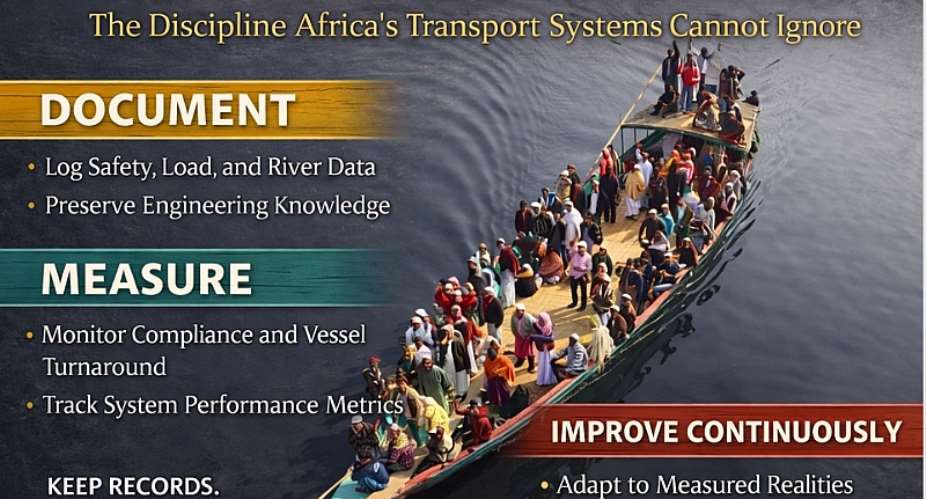
Transport systems do not collapse overnight. They deteriorate quietly, gradually, almost politely, until one day the failure becomes too visible to ignore. A derailment, a vessel breakdown, a closed port terminal, a river route declared unsafe. What appears sudden is often the predictable result of something far less dramatic: the absence of discipline. The discipline to document properly, to measure honestly, and to improve continuously.
Documentation: The Foundation of Reliability
In Africa’s rail and inland water transport sectors, this discipline is not optional. It is foundational. Documentation is not a bureaucratic routine; it is the written memory of a system. Maintenance logs, inspection reports, hydrological surveys, safety records, asset registers, these are the instruments through which experience becomes institutional knowledge. When documentation is weak, systems become dependent on individuals rather than processes. And when those individuals retire, transfer, or disengage, the knowledge leaves with them. The result is institutional amnesia, and systems without memory eventually fail.
Measurement: The Discipline of Honesty
Measurement is the second pillar. Many transport institutions speak confidently about performance, yet few measure it rigorously and consistently. How many kilometers of track are under speed restriction? What is the average turnaround time for wagons? How frequently do vessels exceed safe loading thresholds? How effective is dredging in maintaining navigable depth? Without reliable data, leadership operates on assumptions rather than evidence. Measurement introduces accountability. It forces uncomfortable truths into decision-making rooms. It distinguishes between perception and performance.
Continuous Improvement: The Missing Culture
Documentation and measurement alone are insufficient if they do not lead to improvement. Continuous improvement is not a slogan; it is a culture. It requires analyzing breakdowns not to assign blame, but to redesign procedures. It requires adjusting maintenance schedules based on performance trends. It demands that training programs evolve in response to recurring operational weaknesses. Rail track fatigue. Riverbeds shift. Engines age. Climate conditions change. Systems that do not adapt in response to measured realities inevitably decline.
Across the continent, significant resources are being invested in expanding infrastructure. New locomotives are purchased. Inland ports are modernized. Dredging programs are funded. Yet expansion without operational discipline merely scales inefficiency. A new railway managed with old habits will inherit old failures. A modern river terminal without data-driven oversight will underperform despite its appearance. Infrastructure does not reward optimism; it rewards method.
There is, however, nothing foreign about the principle of continuous refinement. Historically, African water transport systems evolved through observation and adaptation. Communities adjusted navigation routes with seasonal changes, refined vessel designs to suit hydrological conditions, and regulated loading practices to maintain safety. Observation led to adjustment. Adjustment led to resilience. Modern systems require the same logic, strengthened by engineering tools, digital platforms, and institutional accountability.
The Cost of Skipping the Cycle
When documentation is weak, measurement is inconsistent, and improvement is irregular, three consequences follow:
1. Maintenance Becomes Crisis Management
Reactive spending replaces preventive planning.
2. Budgets Grow but Performance Stagnates
Investment increases without proportional gains in efficiency.
3. Public Trust Erodes
Unreliable transport undermines economic integration and investor confidence. Inland waterways, in particular, suffer when river depth monitoring is irregular or vessel compliance data is incomplete. Small inefficiencies compound into system-wide decline. Railways suffer when performance metrics are not tied to operational accountability. Skipping the cycle creates slow decay.
Building a Culture of Relentless Refinement
For rail and inland water systems to mature, governments and operators must institutionalize:
1. Standardized Documentation Frameworks
Digitized maintenance logs, hydrological records, and asset inventories.
2. Transparent Performance Dashboards
Publicly available operational indicators to enforce accountability.
3. Technical Audit Cycles
Independent engineering reviews at defined intervals.
4. Feedback Loops
Lessons from breakdowns must reshape procedures, not disappear into reports. The path forward is neither glamorous nor headline-driven. It lies in disciplined repetition: document every procedure, measure every critical variable, analyze every deviation, and improve every cycle. Over time, this creates reliability. Reliability builds trust. Trust strengthens economic integration. And economic integration fuels development.
Transport systems endure not because they are newly built, but because they are consistently refined. The nations that understand this do not simply construct infrastructure; they cultivate performance. In rail corridors and along inland waterways, the future will belong not to those who build the most, but to those who manage the best, documenting, measuring, and improving without interruption.
Author: Joseph Fuseini ([email protected])


 ‘Everything is possible’ – Speaker Bagbin inspires Zenith Law students with cour...
 Zenith University Law students observe proceedings to deepen parliamentary proce...
 Mahama changes galamsey approach, summons top officials and security chiefs
 This is only the beginning of my demand for accountability – Gumah after confron...
 'Your record stinks’ – Agalga fires back at Minority over cocaine debate
 GNFS to receive first batch of 40 new fire tenders by December – Muntaka
 Okaikwei North MCE suspends PA for one week after slapping Assembly staff member
 Let Ghanaians feel the economic change in their pockets and not on paper — Afeny...
 CLOGSAG demands police probe into alleged assault on Okaikwei North Assembly sta...
 Gov't pays GHS4.9 billion to DDEP bondholders, retires 44.1% of programme


