




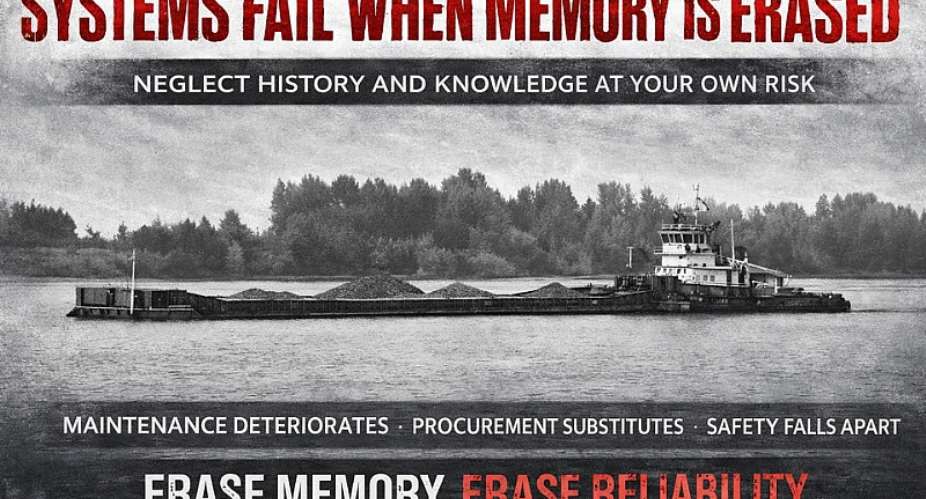
There is a dangerous pattern repeating itself across Africa’s railways, inland waterways, and ports: we build, we celebrate, we neglect, we collapse, and then we start again as if nothing existed before. .
Not just historical memory. Institutional memory. Technical memory. Engineering memory. Operational memory. Infrastructure does not fail only because of age. It fails when the knowledge required to maintain, adapt, and improve it disappears.
The Myth of “Starting From Scratch”
Across the continent, transport reforms are often framed as fresh beginnings:
- “New rail era.”
- “Modern port transformation.”
- “Reviving inland waterways.”
- “Brand new transport masterplan.”
Africa is not starting from zero
Many countries once operated and still operate:
- Functional inland water fleets on the Volta, Niger, Congo, Nile, and Zambezi systems
- Railway training schools and mechanical workshops
- River ports that connect hinterlands to markets
- Locally adapted maintenance regimes suited to tropical climates
The problem is not that systems never existed.
- The problem is that we allowed their technical memory to dissolve.
- When engineers retire without mentoring successors…
- When training colleges close…
- When maintenance logs are not digitized or preserved…
- When policy resets every five years…
We erase memory, and systems collapse.
Infrastructure Is a Living System
A railway is not steel and sleepers.
A river port is not concrete and cranes.
A barge fleet is not hulls and engines.
They are systems built on accumulated knowledge:
- Track geometry standards adapted to local soils
- River depth management tied to seasonal hydrology
- Workshop improvisation skills for spare parts shortages
- Safety cultures built from decades of operational lessons
Remove that memory, and even brand-new infrastructure becomes fragile.
Locomotives can be imported. Institutional memory cannot be imported overnight.
The Cost of Forgetting
When memory is erased, three things happen:
1. Maintenance Becomes Reactive
Without documentation and continuity, maintenance becomes emergency-based instead of preventive.
2. Procurement Replaces Engineering
Instead of fixing systems intelligently, governments buy replacements. Projects multiply. Capacity does not.
3. Safety Declines
Many transport accidents are not caused by new technology failures, but by forgotten procedures and weakened oversight cultures. For inland water transport, especially, safety knowledge, navigation channels, seasonal risk mapping, and vessel loading discipline depend on accumulated local expertise. When that expertise disappears, so does reliability.
Colonial Disruption and Post-Colonial Amnesia
Let us be honest: much of Africa’s transport memory was disrupted by colonial extraction systems that prioritized export corridors over integrated domestic networks. However, post-independence governance added another layer of amnesia:
- Political resets erased continuity.
- Budget instability dismantled training systems.
- Over-reliance on foreign contractors weakened local technical evolution.
The result?
We often operate infrastructure without owning the knowledge that sustains it.
Indigenous Knowledge Was Technical Memory
Before formal ministries, African water systems were governed by embedded knowledge:
- Seasonal flood navigation
- Canoe and rivercraft design adapted to hydrology
- Community-regulated river crossings
- Localized boatbuilding craftsmanship
This was not folklore. It was decentralized engineering memory.
When formal systems replaced traditional ones without integrating their accumulated wisdom, a layer of resilience disappeared. Modern inland water policy rarely consults the communities that have navigated those rivers for centuries. Erasing memory weakens systems.
Why Rail and Inland Water Are Especially Vulnerable
Airports can be outsourced.
Highways can be concessioned.
On the other hand, railways and inland waterways require long-term institutional consistency:
- Asset lifecycle management
- River basin coordination
- Training pipelines
- Intergenerational skill transfer
These systems demand patience. They punish discontinuity.
When political cycles override technical cycles, systems deteriorate quietly, until collapse becomes visible and expensive.
Memory Is Infrastructure
If Africa wants reliable rail and inland water transport, we must treat memory as infrastructure.
1. Archive and Digitize Historical Technical Records
Old workshop manuals, river surveys, and engineering drawings are assets, not relics.
2. Rebuild Training Institutions
Technical colleges for rail engineering, maritime navigation, dredging science, and transport safety must be strengthened.
3. Formalize Knowledge Transfer
Senior engineers should mentor systematically. Retirement should not mean intellectual evacuation.
4. Stabilize Policy Frameworks
Five-year political cycles cannot dictate 50-year infrastructure lifecycles.
The Illusion of Shiny Projects
Africa has no shortage of new projects. Projects without memory decay faster than expected.
A new locomotive without trained maintainers fails early.
A modern port without operational continuity underperforms.
A river dredging program without long-term sediment management collapses after funding cycles end. . And memory erodes quietly.
The Real Question
The question is not whether Africa can build. History shows we have built before. The question is whether we can preserve what we build by preserving the knowledge that sustains it. Infrastructure is hardware. Memory is software. Without software, hardware rusts.
A Final Thought
As Black History Month reminds us of past achievements, we must also confront a difficult truth:
Progress is not only about innovation. It is about continuity. If we do not protect institutional memory in rail depots, river ports, ministries, and training schools, we will continue rebuilding what we already once knew how to sustain.
. Meanwhile, systems endure when memory is honored. And endurance, not spectacle, is what Africa’s transport future requires.
Author: Joseph Fuseini ([email protected])


 ‘Everything is possible’ – Speaker Bagbin inspires Zenith Law students with cour...
 Zenith University Law students observe proceedings to deepen parliamentary proce...
 Mahama changes galamsey approach, summons top officials and security chiefs
 This is only the beginning of my demand for accountability – Gumah after confron...
 'Your record stinks’ – Agalga fires back at Minority over cocaine debate
 GNFS to receive first batch of 40 new fire tenders by December – Muntaka
 Okaikwei North MCE suspends PA for one week after slapping Assembly staff member
 Let Ghanaians feel the economic change in their pockets and not on paper — Afeny...
 CLOGSAG demands police probe into alleged assault on Okaikwei North Assembly sta...
 Gov't pays GHS4.9 billion to DDEP bondholders, retires 44.1% of programme


