




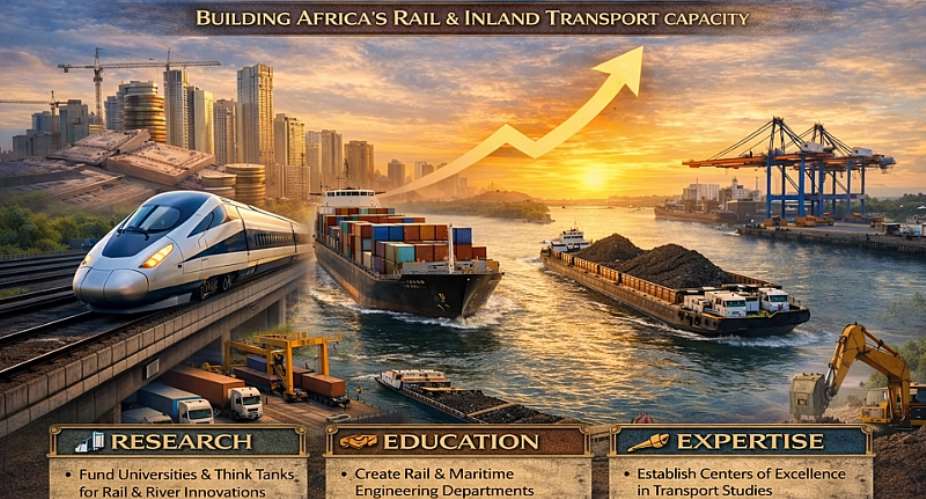
As Black History Month draws to a close, Africa faces a sobering question: after celebrating centuries of Black ingenuity, will we invest in the knowledge systems that sustain innovation, or will we remain satisfied with cutting ribbons on imported infrastructure?
Across the continent, rail corridors are expanding and inland ports are being modernized. New locomotives glide across freshly laid tracks. Dredging projects reopen river channels. Terminals rise along strategic waterways. These are visible achievements. They photograph well. They make headlines. But infrastructure without knowledge is dependency in disguise.
If Africa is serious about transforming rail and inland water transport into engines of economic sovereignty, it must shift from financing projects to financing expertise. Concrete and steel alone will not industrialize the continent. Engineers, researchers, technicians, and institutions will.
The Illusion of Progress
Over the past two decades, billions of dollars have flowed into African transport infrastructure. Standard gauge railways, inland dry ports, river transport corridors, and logistics hubs have emerged across multiple regions. Yet too often, these projects are delivered as turnkey systems, designed abroad, engineered abroad, manufactured abroad, and maintained under foreign technical supervision.
When the inauguration ceremonies end, the knowledge gap remains
Maintenance manuals are foreign-owned. Spare parts are imported. Software systems are proprietary. Even routine diagnostics sometimes require external consultants. The project exists, but the capability does not. This is not transformation. It is managed consumption.
Knowledge Is Infrastructure
A rail network is not only track and rolling stock. It is signaling engineering, materials science, data analytics, mechanical diagnostics, safety modeling, and operational research. Inland water transport is not only vessels and ports; it is hydrology, marine engineering, naval architecture, river morphology analysis, and logistics optimization.
These are knowledge-intensive systems
When Africa underinvests in transport research institutes, maritime academies, railway engineering departments, and technical apprenticeship programs, it weakens the backbone of its own infrastructure. Projects age. Systems deteriorate. Budgets strain under avoidable maintenance crises.
Meanwhile, African engineers continue to prove themselves globally. The talent exists. What is missing is sustained domestic investment in technical ecosystems.
Black Innovation Is Not Historical, It Is Instructional
Black History Month is not only a commemoration of past brilliance; it is a policy lesson. From early railway inventors and mechanical innovators of African descent to indigenous watercraft engineers who mastered hydrodynamics on Africa’s rivers, history shows a clear truth: Black communities have always engineered solutions under constraint. The problem was never intellectual capacity. The problem was structural exclusion from capital and institutional support.
Today, the risk is repeating that pattern, celebrating Black innovation rhetorically while underfunding the universities, research labs, and technical training centers that would enable the next generation of transport engineers. Commemoration without investment is symbolism without strategy
Projects End. Knowledge Multiplies
A rail project may last 30 years before major rehabilitation. A trained engineer contributes for decades. A research institution produces generations of innovators. A well-funded maritime training academy strengthens safety standards, vessel efficiency, and environmental resilience across an entire region.
Knowledge compounds
Consider the impact of:
- Dedicated railway research centers focused on tropical track durability.
- Inland water transport institutes studying sedimentation and climate-resilient river navigation.
- Local software development hubs creating signaling and fleet management systems.
- Technical colleges training specialized welders, marine technicians, and rolling stock engineers.
- Regional certification bodies strengthening safety regulation and compliance.
- These are not secondary investments. They are primary infrastructure.
The Cost of Neglect
When knowledge is neglected, infrastructure becomes fragile. Accidents rise. Maintenance costs escalate. Downtime increases. Public confidence declines. Governments return to external contractors. The dependency cycle tightens.
Inland water transport, in particular, suffers from this pattern. Many African rivers are underutilized not because they lack navigability, but because hydrological research, vessel design optimization, and safety enforcement systems remain underdeveloped. Rail networks struggle with signaling failures and track maintenance challenges that could be mitigated through localized research and predictive analytics. Every technical gap eventually becomes a financial burden.
A Call to Action
As Black History Month closes, African policymakers, development banks, and private investors must make a deliberate shift:
Allocate a fixed percentage of every rail and inland water project budget to knowledge development.
This means:
- Funding university research tied directly to ongoing infrastructure.
- Embedding technology transfer requirements in procurement contracts.
- Establishing joint innovation labs between African institutions and international partners.
- Supporting scholarships in railway and marine engineering.
- Creating regional centers of excellence in inland navigation and rail systems.
- Incentivizing local manufacturing through research grants and industrial clusters.
- Investment in knowledge should not be an afterthought tucked into corporate social responsibility reports. It should be a contractual obligation and a strategic priority.
The Continental Opportunity
With the African Continental Free Trade Area (AfCFTA) expanding intra-African commerce, efficient rail and inland water transport will be indispensable. But efficiency will not come solely from imported systems. It will come from locally adapted engineering solutions, homegrown digital platforms, and regionally coordinated safety frameworks.
Africa cannot industrialize by renting expertise indefinitely.
If we build knowledge capacity today, Africa can export transport technologies tomorrow, shallow-draft vessels designed for variable river depths, tropical climate rail components, cost-effective signaling software tailored to emerging markets.
The transition from consumption to contribution begins with intellectual infrastructure.
Beyond the Month
Black History Month reminds us that Black innovation has always existed, even when it was unrecognized or underfunded. The real tribute is not a celebration alone. It is structural investment.
- Invest in laboratories.
- Invest in apprenticeships.
- Invest in maritime academies.
- Invest in railway engineering departments.
- Invest in research.
Projects will rust without knowledge.
Knowledge will renew projects.
As the month ends, let us choose the harder path, the path that builds institutions, not just infrastructure.
Africa’s rail tracks and river channels depend on it.
Author: Joseph Fuseini ([email protected])


 ‘Everything is possible’ – Speaker Bagbin inspires Zenith Law students with cour...
 Zenith University Law students observe proceedings to deepen parliamentary proce...
 Mahama changes galamsey approach, summons top officials and security chiefs
 This is only the beginning of my demand for accountability – Gumah after confron...
 'Your record stinks’ – Agalga fires back at Minority over cocaine debate
 GNFS to receive first batch of 40 new fire tenders by December – Muntaka
 Okaikwei North MCE suspends PA for one week after slapping Assembly staff member
 Let Ghanaians feel the economic change in their pockets and not on paper — Afeny...
 CLOGSAG demands police probe into alleged assault on Okaikwei North Assembly sta...
 Gov't pays GHS4.9 billion to DDEP bondholders, retires 44.1% of programme


