




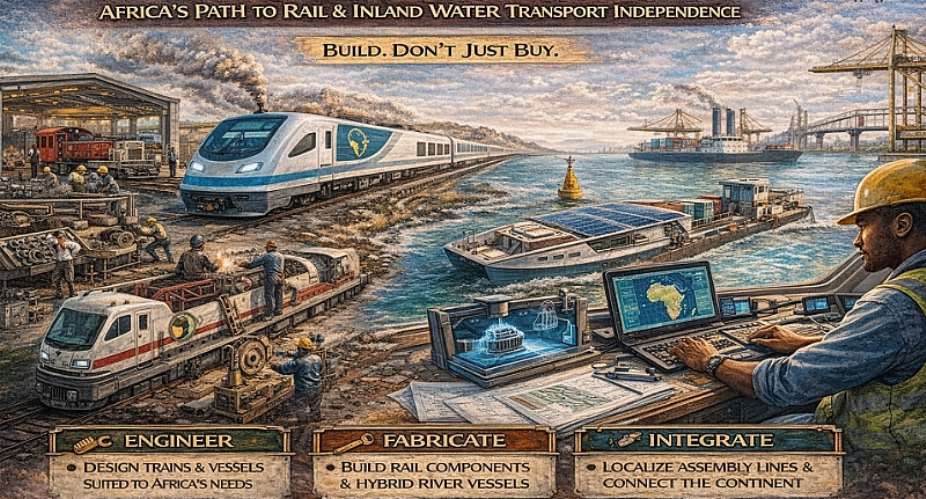
For decades, Africa has been positioned primarily as a consumer in the global transport economy, importing locomotives, vessels, signaling systems, port equipment, and even technical expertise. Rail lines are financed externally, inland vessels are manufactured abroad, spare parts are sourced overseas, and maintenance contracts are often tied to foreign firms. While infrastructure has expanded in some regions, the structure of participation has remained largely the same: Africa buys; others design, patent, manufacture, and export.
This model is not sustainable
If rail and inland water transport are to become engines of continental transformation rather than corridors of dependency, Africa must move decisively from consumption to contribution, from importing systems to engineering them, from assembling components to designing them, from operating infrastructure to innovating within it.
The Consumption Trap in Rail and Inland Transport
Across the continent, modern rail revival projects, from standard gauge lines to urban light rail, have improved connectivity. Inland ports and river transport initiatives have expanded in West, Central, and East Africa. Yet the deeper value chain remains external. Locomotives are imported. Signaling technologies are proprietary. Dredging equipment is foreign-owned. Software systems for fleet management and cargo tracking are licensed rather than locally developed.
The economic consequences are profound:
- Limited local industrialization
- Minimal technology transfer
- Persistent foreign exchange pressure
- Weak domestic supply chains
- Skills gaps in advanced engineering
Inland water transport, despite Africa’s vast navigable river systems, the Congo Basin, Niger River, Nile River, Zambezi, River/Lake Volta, and Lake Victoria corridor, remains under-industrialized. Even where river traffic is active, vessel design optimization, hydrodynamic modeling, and safety technologies are rarely domestically produced at scale.
Africa moves goods. Others move knowledge. That imbalance must change.
Contribution Begins with Engineering Ownership
Moving from consumption to contribution does not require reinventing the wheel. It requires strategic participation in design, manufacturing, and maintenance ecosystems.
Rail and inland transport systems are not simply hardware. They are integrated engineering systems involving:
- Mechanical engineering (rolling stock, propulsion, hull design)
- Civil engineering (track systems, bridges, ports, dredging)
- Electrical engineering (signaling, electrification, power systems)
- Software engineering (logistics platforms, safety monitoring, fleet optimization)
- Materials science (durable track components, corrosion-resistant vessels)
Africa already produces world-class engineers. The problem is not talent scarcity, it is industrial alignment. Universities train engineers who often migrate or work in sectors disconnected from domestic manufacturing. Meanwhile, transport megaprojects are structured around turnkey imports rather than phased localization.
If policy frameworks required progressive local content integration, component manufacturing, joint research labs, and domestic fabrication yards, the contribution gap would begin to close.
Rail as an Industrial Multiplier
Railways are not just transport infrastructure; they are industrial catalysts. Historically, rail expansion in many parts of the world triggered steel production, machine tooling industries, electrical equipment manufacturing, and standardized logistics systems. In Africa, rail can play that same catalytic role, if procurement policies prioritize domestic participation.
Local assembly plants for rolling stock can evolve into full manufacturing hubs. Signaling software can be adapted and coded locally. Predictive maintenance systems can be developed by African data engineers. Component manufacturing, from sleepers to braking systems, can stimulate SMEs and specialized suppliers.
Without this shift, rail risks becoming a debt-financed consumption cycle rather than a productive industrial platform.
Inland Water Transport: A Forgotten Innovation Space
Inland water transport offers perhaps the greatest opportunity for African contribution. River transport is energy-efficient, cost-effective for bulk goods, and environmentally favorable compared to road freight. Yet it remains technologically underdeveloped across much of the continent. This gap is not due to a lack of historical expertise. African communities developed sophisticated vessel designs adapted to specific hydrological conditions, shallow drafts, seasonal water fluctuations, and complex river currents.
Modern engineering can build on that foundation:
- Shallow-draft cargo barges optimized for fluctuating river depths
- Hybrid propulsion systems to reduce fuel costs
- Locally fabricated modular vessels for regional trade
- Digital navigation aids tailored to African river systems
- Flood-resilient port infrastructure designed for tropical hydrology
Instead of importing standardized vessel models designed for European waterways, Africa can design rivercraft suited to African rivers. That is contribution.
Policy Failure: Infrastructure Without Industry
One of the most persistent policy failures has been treating infrastructure as an end rather than a means. Governments negotiate financing for tracks and ports but often neglect industrial ecosystem development around them.
The result: shiny new rail corridors with limited local value capture.
True transport transformation requires coordinated policy across:
- Industrial strategy
- Education reform
- Research and development funding
- Public procurement rules
- Regional trade integration
The African Continental Free Trade Area (AfCFTA) creates a framework for scale. Rail and inland water systems should be designed not only to move goods but to stimulate cross-border engineering collaboration, joint manufacturing, and regional specialization.
A locomotive assembled in one country could integrate components produced in another. A vessel hull fabricated along the Congo could use propulsion systems engineered elsewhere on the continent. Contribution becomes continental.
From Extraction Corridors to Innovation Corridors
Historically, African rail networks were built to extract resources from inland regions to coastal ports. That colonial design logic still shapes many networks today. To move from consumption to contribution, the philosophy must shift.
- Transport corridors should connect:
- Industrial clusters
- Agricultural processing zones
- Inland manufacturing hubs
- Research institutions
Rail and inland waterways should serve value addition, not raw material export alone. When Africa processes its minerals domestically, assembles its rolling stock locally, fabricates its vessels regionally, and exports transport technology abroad, it moves from dependency to agency.
The Strategic Imperative
The global transport sector is undergoing transformation, automation, electrification, hydrogen propulsion, digital twins, and AI-driven logistics optimization. Africa has a choice: Remain a market for these technologies, or become a contributor to their development.
The continent’s youthful population, expanding urbanization, and growing technical institutions provide a foundation. What is required now is deliberate policy alignment that links infrastructure spending to industrial growth. Moving from consumption to contribution is not about rejecting partnerships. It is about redefining them, insisting on co-development, local manufacturing, skills transfer, and research collaboration.
Rail and inland water transport can either reinforce Africa’s role as a buyer of systems or redefine it as a builder of systems. The question is not whether Africa has the capacity to contribute. The question is whether it will design policies that demand it. If Africa builds its own transport technologies, adapting them to its rivers, terrain, and markets, it will not only move goods more efficiently. It will move its economies forward with ownership, resilience, and technical dignity.
Contribution is not a slogan. It is an engineering decision. And it begins with rail tracks and river channels.
Author: Joseph Fuseini ([email protected])


 ‘Everything is possible’ – Speaker Bagbin inspires Zenith Law students with cour...
 Zenith University Law students observe proceedings to deepen parliamentary proce...
 Mahama changes galamsey approach, summons top officials and security chiefs
 This is only the beginning of my demand for accountability – Gumah after confron...
 'Your record stinks’ – Agalga fires back at Minority over cocaine debate
 GNFS to receive first batch of 40 new fire tenders by December – Muntaka
 Okaikwei North MCE suspends PA for one week after slapping Assembly staff member
 Let Ghanaians feel the economic change in their pockets and not on paper — Afeny...
 CLOGSAG demands police probe into alleged assault on Okaikwei North Assembly sta...
 Gov't pays GHS4.9 billion to DDEP bondholders, retires 44.1% of programme


