




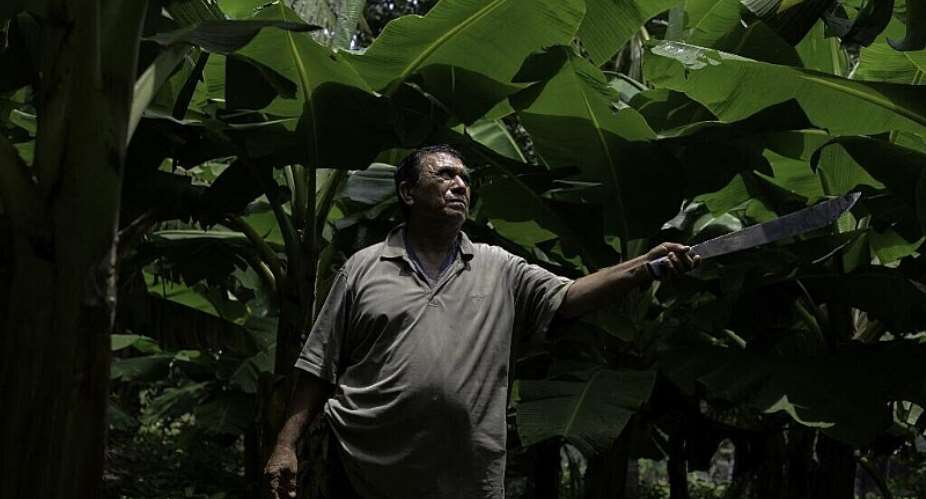
The Paris Court of Appeal has rejected a compensation claim against three US multinationals by Nicaraguan plantation workers left sick or sterile after working with the toxic pesticide Nemagon.
Nicaraguan farm workers who had been left sick or sterilised after exposure to the toxic pesticide Nemagon on banana plantations in the 1960s, 70s and 80s saw their case rejected by a Paris court on Tuesday, over what it called "disproportionate" damages.
In 2006, a Nicaraguan court ordered multinational chemical giants Shell Oil Company, The Dow Chemical Company and Occidental Chemical Corporation, which sold the pesticide, to pay $805mn in compensation to 1,234 former workers.
Nemagon, which contained dibromochloropropane (DBCP), was used to kill pests in the soil. As early as the late 1960s, it was found to be linked to infertility, cancers and severe neurological disorders.
But the companies withdrew their assets from Nicaragua, according to the farmers' legal team, and insisted Nicaraguan courts lacked jurisdiction. Attempts to collect the compensation in the US have so far failed. Many of the victims have since died.
In 2018, a collective of Nicaraguan, American and French lawyers turned to France to enforce the judgments, using a procedure called "exequatur”, which allows a foreign court decision to be recognised and enforced in France.
The French courts rejected the lawsuit in May 2022. In its ruling on Tuesday, the appeals court confirmed that decision, saying “the sums awarded to each claimant […] are manifestly disproportionate”.
It said it could therefore not implement the Nicaraguan sentence on French soil as it did not confrom to "international public order" – one of the conditions needed for it to be implemented.
'Error of assessment'
The farm workers' legal team said they believed the criterion of disproportionality is an "error of assessment".
"It is very likely that an appeal will be lodged against this ruling... at the Court of Cassation," said lawyer Gonzague d'Aubigny.
He underlined, however, that the court had acknowledged the Nicaraguan judge had been competent after all, contrary to the 2022 ruling in first instance.
"It's an error that we managed to get corrected... so on this point it's a victory," Aubigny told RFI.
Nicaraguan plantation workers 'poisoned' by pesticides fight for justice
Why France?
Nemagon was banned in the United States in 1977 after it was found to cause sterility in men. But chemical multinationals continued to export it and use it across Central America until 1985.
"Farm workers have been contaminated and all are suffering from more or less serious pathologies," Aubigny says. "Some form infertility, others from cancer or respiratory diseases. And inevitably there are deaths every year."
But the three multinationals have no assets in Nicaragua, and the US refused to execute the Nicaraguan judgments.
So in 2018 the claimants turned to France.
Aubigny points to France's civil law being "quite close" to that of Nicaragua and the fact that "France has a certain image in the world as the home of human rights, and a bridghead for enforcing foreign judgments in Europe".
In addition, Shell, Dow and Occidental all hold significant assets in France and in the EU, so enforcement in France "offered real possibilities of seizure to secure payment of the compensation", the lawyers wrote in an op-ed published on Sunday in the French daily Libération.
Echoes of chlordecone scandal
The Nemagon case is reminiscent of that of chlordecone – a pesticide used on banana plantations in the French Caribbean islands of Martinique and Guadeloupe until 1993, despite being officially banned in 1990 in mainland France.
Chlordecone has been classified as a carcinogen by the World Health Organization since 1979 and was banned in the United States in 1977.
Chlordecone victims in French West Indies demand justice as state denies liability
Ninety percent of the population of Martinique and Guadeloupe have been contaminated by chlordecone.
In March 2025, the Paris Administrative Court of Appeal found the French state responsible for allowing its use long after its dangers were known and ruled it must pay compensation to victims who can demonstrate a “moral anxiety prejudice”.
The French government lodged an appeal against the decision.


 'Do I look like somebody who can be bullied as Majority Leader?’ – James Agalga
 Contractor hands over Weija Children’s Specialist Hospital to govt
 Car dealer shot dead outside residence at Beach Drive Estate near Tuba
 Former TOR boss Asante Berko convicted in US over Ghana power plant bribery sche...
 NDC slams Afenyo-Markin's 'nobody' remark against Nana Yaa Jantuah
 Heavy security deployed to Laboma Beach ahead of demolition exercise
 James Agalga named majority leader following Mahama Ayariga's ministerial appoin...
 Omane was a true friend, a younger brother and a loyalist — Mahama eulogises lat...
 'My focus is on delivering the mandate' — Prof. Opoku-Agyemang responds to rumou...
 US appeals court halts construction of Trump’s $400 million White House ballroom...

