




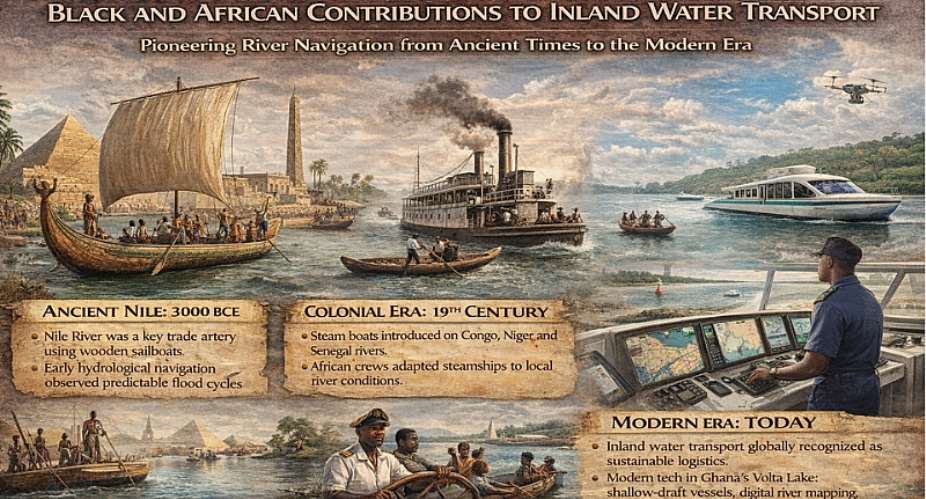
Inland water transport has played a documented and significant role in African economic and social history. Long before colonial railways and paved roads, major African river systems, including the Nile, Niger, Congo, Senegal, and Zambezi, served as structured trade corridors. Archaeological, historical, and geographic records confirm that African societies developed organized systems of river navigation that facilitated commerce, state formation, and regional integration.
The Nile River offers one of the earliest recorded examples of structured inland navigation in Africa. Ancient Egyptian civilization relied extensively on river transport as early as 3000 BCE. Historical evidence shows the use of wooden cargo vessels equipped with sails and steering oars to move agricultural goods, stone blocks, and people along the river. The Nile’s predictable flood cycle enabled planned navigation seasons, and port installations along its banks supported organized river trade. These developments demonstrate early advances in vessel construction, hydrological observation, and river-based logistics management.
In West Africa, the Niger River functioned as a central artery for trans-Saharan and regional trade between approximately the 8th and 16th centuries. Empires such as Ghana, Mali, and Songhai utilized the river to transport gold, kola nuts, grain, and other commodities. Historical accounts from Arab chroniclers, including Al-Bakri and Ibn Battuta, describe organized river transport systems and professional boatmen operating large wooden canoes capable of carrying passengers and cargo across significant distances. The Niger Delta also became known for specialized canoe-building traditions, with vessel designs adapted to tidal conditions and shallow waterways.
In Central Africa, the Congo River basin supported extensive precolonial trade networks. Ethnographic records document large dugout canoes capable of carrying multiple traders and goods between inland communities. The scale of these vessels indicates advanced woodworking skills and hydrodynamic understanding suited to powerful river currents.
These historical examples demonstrate that inland water transport in Africa was not incidental; it was structured, economically significant, and technologically adaptive.
During the colonial period in the 19th and early 20th centuries, European administrations introduced steam-powered vessels on rivers such as the Congo, Niger, and Senegal. However, historical shipping records and administrative reports confirm that African labor, navigation expertise, and mechanical skills were central to operating and sustaining these systems. African crews served as pilots, engineers, deckhands, and repair technicians. In many cases, imported steam vessels required adjustments to accommodate seasonal water-level changes and sediment conditions. Local technical adaptation was essential for continued navigability.
In the contemporary period, inland water transport remains relevant across Africa, though underdeveloped relative to its potential. According to the African Development Bank and regional transport assessments, inland waterways offer lower fuel consumption per ton-kilometer compared to road transport, making them cost-effective and environmentally advantageous. For example, barge transport can consume significantly less energy per ton of freight than heavy trucks, reducing emissions and road congestion.
In Ghana, Volta Lake, created following the construction of the Akosombo Dam in 1965, represents one of the largest artificial lakes in the world by surface area. It spans approximately 8,500 square kilometers and extends over 400 kilometers northward. The lake supports passenger and cargo transport, particularly linking northern agricultural zones with southern markets. The Volta Lake Transport Company (VLTC) operates cargo vessels and ferries that facilitate movement of goods such as maize, yam, and charcoal.
However, official reports and transport sector analyses highlight persistent challenges, including limited navigation aids, aging vessels, inadequate safety enforcement, and inconsistent maintenance of landing sites. Incidents involving overloaded boats and insufficient life-saving equipment have underscored safety gaps. Infrastructure at several lake ports remains underdeveloped, constraining efficiency.
River navigation technologies today involve several measurable components: hydrographic surveys to map channels and sediment levels; installation of navigation buoys and lighting systems; vessel tracking and communication systems; and standardized safety compliance frameworks. In parts of Africa, pilot projects using GPS-based vessel monitoring and digital mapping tools are being introduced to improve route planning and hazard detection.
Globally, inland water transport is recognized for its role in sustainable logistics. The United Nations Conference on Trade and Development (UNCTAD) and the International Transport Forum have noted that waterways can significantly reduce freight transport emissions when properly integrated into multimodal systems. For African countries, strengthening inland navigation aligns with climate goals and regional trade objectives under the African Continental Free Trade Area (AfCFTA).
The historical record demonstrates that Black and African societies have long engaged in organized river navigation supported by practical engineering knowledge. Contemporary inland water transport policy in Africa, including in Ghana, must build on this foundation through targeted investment in navigation infrastructure, safety regulation, vessel modernization, and technical training.
Recognizing documented African contributions to inland water systems is not symbolic, it is evidence-based. Rivers have been structured transport corridors on the continent for millennia. Modern innovation in inland water transport should therefore be seen not as an imported concept, but as a continuation of a longstanding African engagement with river navigation technologies.
Author: Joseph Fuseini ([email protected])


 'Stop excessive financial demands before sharing information with us' — Interior...
 EC will serve national interest, not partisan politics – Deputy Chair Dr Kwaku A...
 I expect no preferential treatment from EC for myself as President, my party or ...
 Afenyo-Markin meets management, proposes reforms to turnaround struggling ECG
 ECG management commends Afenyo-Markin for reforms during short stay as Board Cha...
 Mahama tasks new EC deputy chairpersons to uphold impartiality
 Attorney-General urges court to reject Adu-Boahene’s no-case submission
 Nyaho Medical Centre ordered to report to CID over expired data protection certi...
 Mahama swears in new Electoral Commission deputy commissioners
 PTAAM-Africa calls for government probe into alleged World Cup visa fraud


