




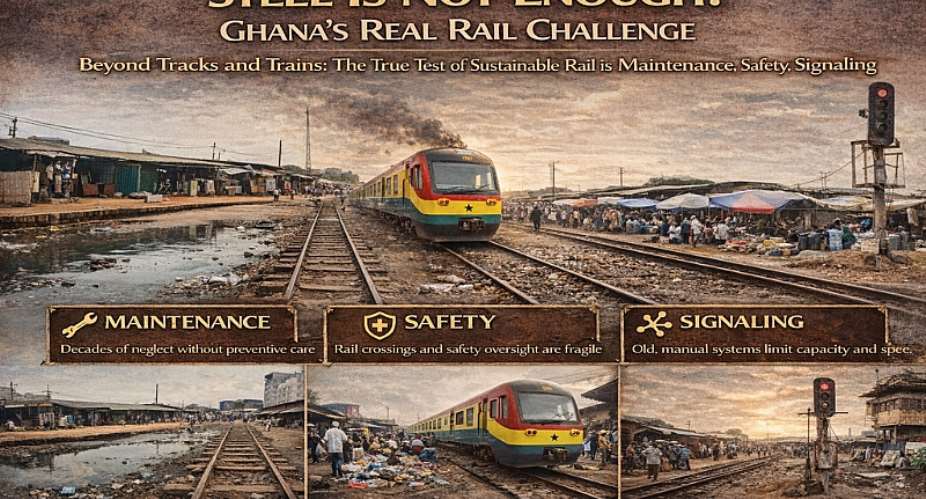
Across Africa, railway conversations often begin with kilometers of track, locomotives purchased, and ribbon-cutting ceremonies. Steel dominates the headlines. But railways do not fail because of a lack of steel. They fail because of weak maintenance systems, fragile safety cultures, and outdated signaling.
These are the issues that demand urgent attention in the rail sector.
The Quiet Crisis of Maintenance
Rail infrastructure is not a one-time investment. It is a living system. Tracks expand and contract. Ballast shifts. Bridges age. Rolling stock deteriorates. Without consistent inspection, preventive maintenance, and technical renewal, even the most modern railway can decline rapidly.
Ghana’s railway history shows a recurring pattern: expansion followed by neglect. Colonial-era lines that once carried cocoa and minerals deteriorated over decades due to underinvestment and institutional instability. Post-independence ambitions to revive rail were often undermined by inconsistent funding and limited technical continuity.
Maintenance in Ghana has too often been reactive, repairing after failure rather than preventing it. This approach is costly. It shortens asset life, increases derailment risks, and erodes public trust.
Policy intervention:
- Establish a ring-fenced Rail Maintenance Fund, insulated from annual political cycles.
- Mandate preventive maintenance schedules with publicly reported compliance indicators.
- Invest in local rail engineering training programs, ensuring Ghana builds in-house capacity rather than relying solely on external contractors.
- Deploy asset management systems that digitally track infrastructure conditions in real time.
A railway cannot be sustainable without institutionalizing maintenance as a core function, not an afterthought.
Safety: Beyond Infrastructure to Culture
Rail safety is not only about equipment. It is about systems, standards, and accountability. Across parts of Africa, derailments, level-crossing accidents, and signaling failures have highlighted the fragility of operational safety frameworks.
In Ghana, as new standard gauge projects move forward, the country has an opportunity to reset its safety architecture. But safety must be embedded from the design stage through to daily operations.
Key concerns include:
- Informal settlements and road crossings along rail corridors.
- Limited public awareness of railway safety protocols.
- Gaps in independent regulatory oversight.
Policy intervention
- Strengthen the independence and technical capacity of a Rail Safety Authority, with enforcement powers.
- Implement automated level-crossing systems and fencing in high-risk areas.
- Launch nationwide rail safety awareness campaigns, particularly in urban and peri-urban corridors.
- Introduce mandatory incident reporting and public disclosure systems to improve transparency and accountability.
Safety must be measurable, monitored, and enforced. It cannot rely on hope or habit.
Signaling: The Invisible Backbone
Perhaps the most overlooked challenge is signaling. Without reliable signaling, railways cannot operate efficiently or safely at scale. Modern rail networks depend on centralized traffic control, digital communication, and real-time monitoring systems.
In many African countries, including Ghana, legacy systems have historically relied on manual signaling and limited telecommunication infrastructure. While new lines promise modern systems, the integration of technology across the entire network remains uneven.
Signaling is not glamorous, but it determines
- Train frequency and capacity.
- Collision prevention.
- Network coordination.
- Operational resilience.
Policy intervention:
- Prioritize investment in modern signaling and centralized traffic control systems alongside track construction.
- Develop local expertise in railway systems engineering and signaling technology.
- Ensure interoperability standards so new and old segments can communicate effectively.
- Integrate rail operations into a broader transport data ecosystem, improving coordination with ports and inland logistics.
A railway without robust signaling is a risk. A railway with modern signaling is a system.
The Bigger Lesson for Ghana
Ghana’s railway revival must move beyond infrastructure symbolism. The country does not merely need new tracks, it needs durable institutions. It needs engineers empowered to maintain systems, regulators empowered to enforce safety, and planners equipped with data to manage complexity. Steel attracts attention. Maintenance sustains trust. Safety protects lives. Signaling enables growth.
If Ghana addresses these three pillars decisively, it can avoid the cycle that has undermined rail systems across the continent, ambitious beginnings followed by gradual decay. The opportunity today is not just to rebuild railways, but to rebuild the governance culture that sustains them.
The real measure of railway success is not how impressive it looks at commissioning, but how reliably it runs twenty years later.
That is where the real work begins.
Author: Joseph Fuseini ([email protected])

 One dead, fire officer hospitalised after bee attack at Quarry Site in Sokode Gb...
 Israel and Iran step back from further strikes after renewed clashes
 Patients stranded as doctors, nurses refuse to see new patients over KATH CEO su...
 Avenor Rural Bank CEO’s house destroyed by fire
 Three arrested in Winneba for illegal mining near GWL water lines
 Two pupils of Alice Elite Academy laid to rest after fatal school bus crash
 Here are areas to be affected by ECG's planned maintenance on Tuesday
 Family of civil engineer killed in alleged military shooting demands justice
 SHS teacher allegedly beats female student over unpaid hostel fees
 Blow to EU defence cooperation as France, Germany abandon joint fighter jet prog...


