




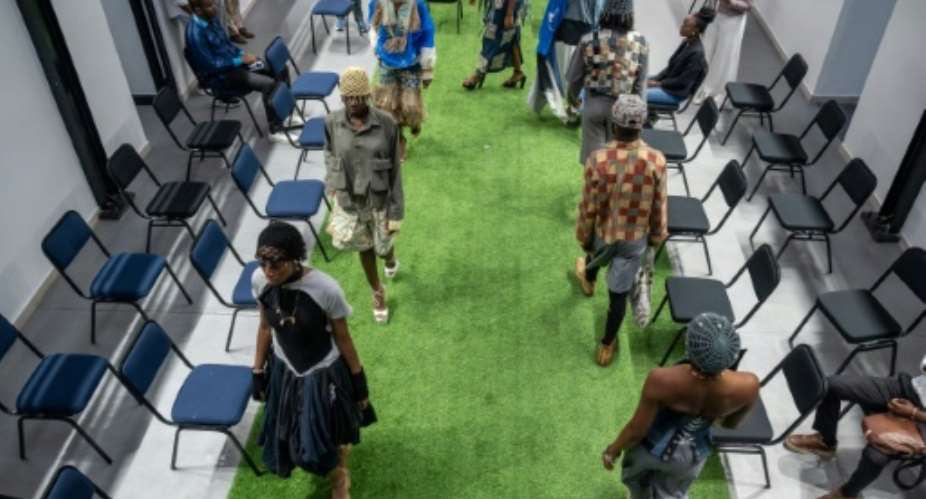
In an abandoned hangar surrounded by dusty trucks in Kinshasa, young student models strut down a catwalk of artificial grass, showcasing their first-ever collection to their Congolese fashion school peers.
Container ships rumble outside in the Democratic Republic of Congo's capital, but the room holding the makeshift runway in the Regional Fashion Institute in Africa (IRMA) reverberates with chic electro basslines.
IRMA welcomed a dozen students from five African countries in July, offering them free training in the basics of sewing and fashion entrepreneurship.
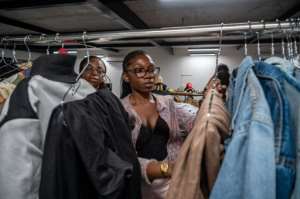 Benjamine Biloa, a 24-year-old Cameroonian designer, dreams of opening a 'haute couture house' in Yaounde. By Hardy BOPE (AFP)
"I want to get noticed by brands or sponsors," Benjamine Biloa, a 24-year-old Cameroonian designer who dreams of opening a "haute couture house" in Yaounde, told AFP.
The France-backed project aims to train more than 200 young people by 2026 in a bid to scout talent and boost the Congolese fashion industry, which is struggling in the face of low-price textiles imported from Asia.
"The idea is to turn it into a fashion laboratory" in Central Africa, explained director Sidonie Latere during a tour of the institute, which boasts a photography studio, a library and an exhibition space.
Waste into work of art
The students rush to apply the finishing touches before gracing the catwalk. One model slips into a pair of tartan ankle boots designed by the Congolese sapeur designer Koko Lingwala.
The model's immaculate suit, completed with a top hat and feathered cane, is an expression of "Sape", which stands for Societe des Ambianceurs et des Personnes Elegantes -- roughly translating from French as the Society of Ambiance Makers and Elegant People.
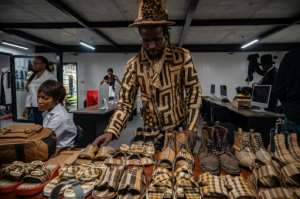 The 'Sape' subculture traces it origins to the colonial era when locals encountered European fashion. By Hardy BOPE (AFP)
The subculture traces it origins to the colonial era when locals encountered European fashion, and sapeurs are known for their ultra-elegant clothing and sense of style.
Other fashionistas don a coat made of old curtains and hessian, a bag of "tears of Job" from a bead-producing plant, and a skirt of plastic bags -- all with a view to giving a new lease of life to used clothes imported from Europe by blending them with natural materials.
"We can't keep going with fast fashion. I discovered that the textile industry is one of the most polluting," said Biloa, who designed a jacket of kuba cloth, a traditional textile made from the raffia palm.
"You can't go into fashion today and ignore the environmental consequences," Latere agreed.
"We can create an industry that turns this waste into works of art."
According to the director, most Congolese people already dress themselves in secondhand clothes.
Congolese creativity
Jules Kumpava, 27, was living on Kinshasa's streets when he decided to apply for the IRMA programme.
"My parents didn't want me to become an artist, so I had to leave home and find a way to support myself," said the young man, who has tried to launch his own T-shirt brand.
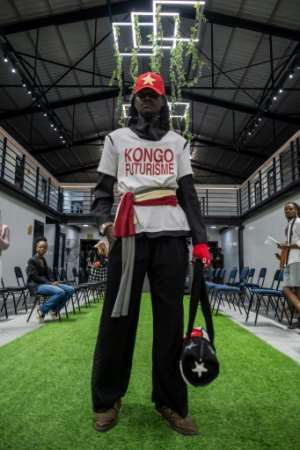 One of the DRC's real strengths is its culture and creativity, IRMA's director says. By Hardy BOPE (AFP)
"He has found his calling," said Latere, who points to a lack of infrastructure and resources as obstacles to professional training for creatives.
The DRC is one of the poorest countries in the world, and Latere is hoping to create more fashion jobs throughout the country.
In IRMA's sizeable garment workshop, around 40 industrial sewing machines whir away next to 3D printers and heat presses.
"Here, you can make a shirt in a single day instead of three or four days of work on an ordinary machine. We'll also be able to make the equipment available to professionals," the director said.
"One of the DRC's real strengths isn't its mines; it's our culture and our creativity."


 Anthropic boss calls for AI slowdown, Altman and Musk agree
 Saudi Arabia closes East-West pipeline as Houthis tighten grip on Red Sea
 Uganda buries 'youngest' king amid succession row
 'If we were wrong, we must first apologise to NPP' – Mustapha Gbande on National...
 Han SHS to get boarding status as Mahama inspects GETFund projects in Upper West
 Late herbal doctor’s wife granted GH¢100,000 bail amid poisoning, arson claims
 NDC has failed to deliver on Agenda 1-3-3 for 24-hour economy – Sam Pyne
 Wa-Bolgatanga trunk road to be asphalted – Mahama
 Gbewaa College of Education lecturer dies after alleged military assault in Pusi...
 Ghana won’t back down on mining value addition – Ambassador Kojo Bonsu


