




At the World Economic Forum in Davos, Canada’s Prime Minister Mark Carney recently referenced Václav Havel’s The Power of the Powerless, a slim but profound essay written under authoritarian rule in Czechoslovakia in 1978. One quote from that piece remains striking decades later: the greengrocer who places a slogan “Workers of the World Unite!” in his shop window not because he believes in it, but because he is expected to.
Havel explains that the greengrocer’s sign is not an expression of conviction; it is a ritual of compliance. By displaying it, he signals that he understands the system, accepts its rules, and wishes to be left alone. The sign’s real message is unspoken: “I am obedient. I know my place.”
After reading this essay over the night, I believe this metaphor offers a powerful lens through which to view Ghana’s rail transportation story.
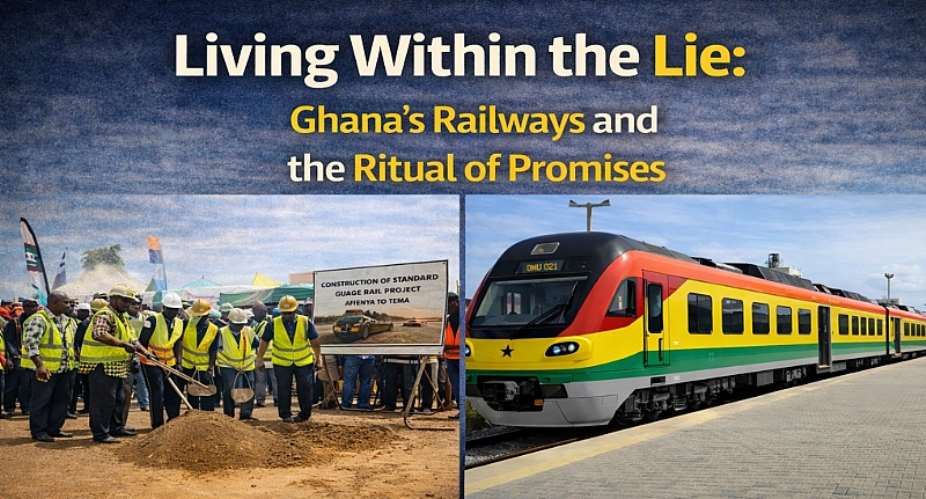
For decades, Ghana has spoken the language of rail revival. Strategic plans are launched, masterplans unveiled, commissions inaugurated, sods cut. Each announcement is another slogan in the window: “Rail is a priority.” Yet trains do not run, tracks decay, and freight continues to grind roads into dust. Like the greengrocer’s sign, the declarations exist more to satisfy expectation than to express genuine commitment.
The tragedy is not that Ghana lacks knowledge of rail’s importance. We know rail reduces logistics costs, supports industrialization, protects roads, and anchors urban transport. The tragedy is that the system has normalized pretending. Institutions repeat the ritual, policymakers inherit the language, and citizens quietly lower their expectations. Rail exists as policy theatre rather than lived infrastructure.
Havel warns that such systems survive not only because of those at the top, but because ordinary people participate in the lie, by accepting it as normal. In Ghana’s rail sector, this “living within the lie” appears when year after year passes without accountability, when abandoned tracks provoke nostalgia instead of outrage, and when rail is forever postponed to the next administration.
But The Power of the Powerless is not cynical. It is ultimately hopeful. Havel argues that change begins when individuals and institutions choose to “live within the truth”, to stop performing belief and start acting on it.
Applied to Ghana, living within the truth would mean admitting that rail cannot survive on announcements alone. It would mean protecting rail policy from electoral cycles, funding maintenance as seriously as construction, and measuring success by tonnage moved and passengers carried, not by press releases issued.
The greengrocer becomes powerful not when he shouts, but when he quietly removes the sign.
Perhaps Ghana’s rail revival will not begin with another grand launch, but with a smaller, braver act: refusing to pretend that intention is the same as action. Only then can the tracks we inherited and the future we keep promising finally move again.
Read the full essay here: https://www.nonviolent-conflict.org/wp-content/uploads/1979/01/the-power-of-the-powerless.pdf
Author: Joseph Fuseini ([email protected])


 ‘Everything is possible’ – Speaker Bagbin inspires Zenith Law students with cour...
 Zenith University Law students observe proceedings to deepen parliamentary proce...
 Mahama changes galamsey approach, summons top officials and security chiefs
 This is only the beginning of my demand for accountability – Gumah after confron...
 'Your record stinks’ – Agalga fires back at Minority over cocaine debate
 GNFS to receive first batch of 40 new fire tenders by December – Muntaka
 Okaikwei North MCE suspends PA for one week after slapping Assembly staff member
 Let Ghanaians feel the economic change in their pockets and not on paper — Afeny...
 CLOGSAG demands police probe into alleged assault on Okaikwei North Assembly sta...
 Gov't pays GHS4.9 billion to DDEP bondholders, retires 44.1% of programme


