




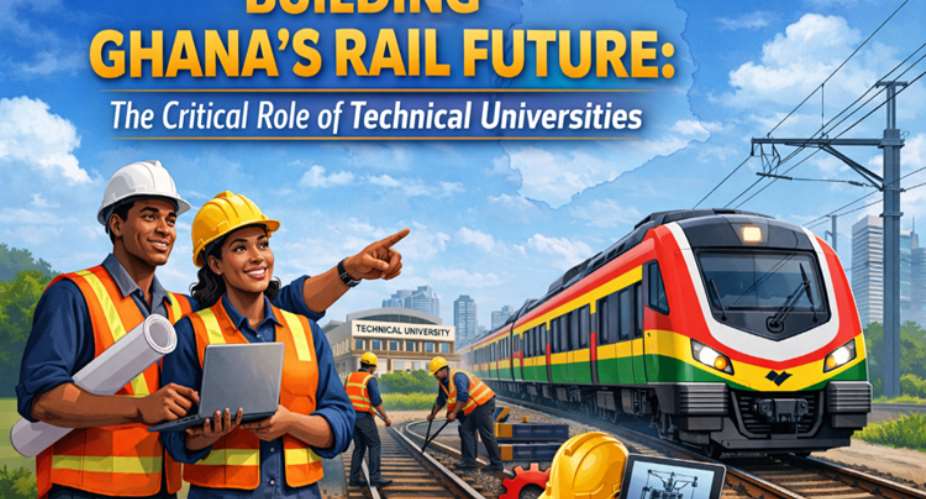
As Ghana intensifies discussions around developing a robust rail system, attention often focuses on funding, political will, and infrastructure delivery. Yet, one foundational pillar is frequently overlooked: institutional and technical capacity. Without a skilled local workforce and strong institutions to design, operate, and maintain rail systems, even the most ambitious rail projects risk failure, as the Takoradi to Kojokrom railway line. In this regard, Ghana’s Technical Universities (TUs) have a strategic and indispensable role to play.
Urban rail systems are not one-off construction projects; they are complex socio-technical systems requiring continuous expertise in engineering, operations, maintenance, safety management, data systems, and project governance. Countries with successful rail networks, such as Germany, China, Japan, and increasingly Ethiopia, have invested heavily in technical education aligned with transport and railway needs. Ghana must follow a similar path, and its Technical Universities are the natural starting point.
First, Ghana’s Technical Universities can serve as centres for rail-focused skills development. Existing programmes in mechanical engineering, electrical engineering, civil engineering, mechatronics, welding, and construction technology can be deliberately tailored to include railway engineering, rolling stock maintenance, signalling systems, electrification, and track technology. Short-cycle professional certifications and Higher National Diploma (HND) upgrades focused on rail operations would allow Ghana to rapidly build a domestic skills base instead of relying excessively on foreign contractors.
Second, Technical Universities can bridge the persistent gap between theory and practice in Ghana’s infrastructure sector. Through structured partnerships with the Ghana Railway Development Authority, Ghana Railways Company Limited, metropolitan assemblies, and private transport firms, students can undertake mandatory industrial attachments, apprenticeships, and field-based projects directly linked to rail rehabilitation and urban transport planning. Such collaboration ensures that graduates are job-ready and grounded in Ghana’s real operational challenges.
Third, Technical Universities can become hubs for applied research and local innovation in urban rail systems. While Ghana may import rolling stock or signalling technology, local institutions can adapt these technologies to local climatic conditions, energy constraints, and urban realities. Research on low-cost maintenance techniques, rail safety in informal urban environments, digital ticketing systems, and energy-efficient operations can significantly reduce long-term operating costs. This aligns well with Ghana’s broader industrialisation and green transition agenda.
Fourth, Technical Universities can support institutional capacity-building beyond engineers. Urban rail systems also require technicians in project management, procurement, health and safety, quality assurance, and asset management. By expanding curricula to include rail project management, infrastructure economics, and transport regulation, Technical Universities can help professionalise rail governance and reduce inefficiencies that have historically undermined public infrastructure projects in Ghana.
Finally, investing in Technical Universities strengthens national ownership and sustainability of urban rail systems. When rail systems are designed, operated, and maintained largely by local professionals, Ghana reduces foreign exchange leakages, improves system reliability, and builds institutional memory. More importantly, it creates dignified, skilled employment opportunities for young Ghanaians while embedding rail development into the country’s long-term human capital strategy.
In conclusion, Ghana’s quest for a functional rail system will not succeed through steel and concrete alone. It must be underpinned by strong institutions and skilled human capital, and Ghana’s Technical Universities are central to this mission. By aligning technical education with rail sector needs, fostering industry partnerships, and promoting applied research, these institutions can transform urban rail from a recurring policy aspiration into a sustainable national reality.
Joseph Fuseini


 'Stop excessive financial demands before sharing information with us' — Interior...
 EC will serve national interest, not partisan politics – Deputy Chair Dr Kwaku A...
 I expect no preferential treatment from EC for myself as President, my party or ...
 Afenyo-Markin meets management, proposes reforms to turnaround struggling ECG
 ECG management commends Afenyo-Markin for reforms during short stay as Board Cha...
 Mahama tasks new EC deputy chairpersons to uphold impartiality
 Attorney-General urges court to reject Adu-Boahene’s no-case submission
 Nyaho Medical Centre ordered to report to CID over expired data protection certi...
 Mahama swears in new Electoral Commission deputy commissioners
 PTAAM-Africa calls for government probe into alleged World Cup visa fraud


