




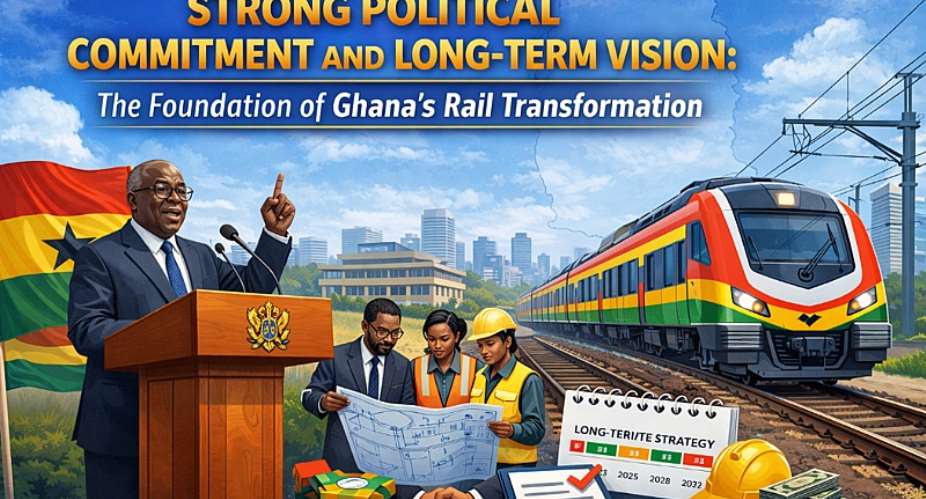
No country has built a successful and sustainable rail system without strong political commitment and a long-term strategic vision. In Ghana’s case, the absence of consistent political support has been one of the most significant obstacles to the development of a reliable rail network. Urban and national rail projects have often been announced with enthusiasm, only to stall, change direction, or be abandoned due to shifting political priorities. If Ghana is serious about building a modern rail system, political leadership must move beyond short-term symbolism toward enduring institutional commitment.
Rail infrastructure is inherently long-term. Planning, land acquisition, financing, construction, and system optimization can span decades, far exceeding the life of a single government. This reality demands a national rail vision anchored in law and policy, rather than party manifestos. A clearly articulated rail master plan, covering urban, intercity, and freight rail, should define priorities, timelines, and integration with national development strategies such as industrialization, climate action, and urban mobility. Once established, this vision must be protected from frequent policy reversals.
Strong political commitment also requires the creation and empowerment of credible institutions. Rail development should be led by technically competent agencies with clear mandates, financial autonomy, and accountability mechanisms. Political leaders must resist the temptation to micromanage projects or use rail initiatives for short-term political gain. Instead, they should focus on providing stable policy direction, ensuring continuity across administrations, and supporting professional decision-making. Countries that have succeeded in rail development, such as Japan and Morocco, demonstrate that institutional stability matters as much as financial investment.
Furthermore, long-term political vision must recognize rail as a public good, not merely a commercial venture. Urban rail systems worldwide depend on sustained public support because of their benefits, reduced congestion, lower emissions, improved productivity, and social inclusion, extend far beyond fare revenue. Political leaders must therefore be willing to justify public investment in rail as part of a broader economic and environmental strategy, particularly in fast-growing cities like Accra and Kumasi.
Finally, strong political commitment involves public communication and consensus-building. Citizens must understand why rail matters, how it improves daily life, and why patience is required during its development. Transparent engagement builds public trust and reduces resistance to land acquisition, construction disruptions, and necessary subsidies. When political leaders consistently communicate a shared rail vision, it becomes a national project rather than a partisan one.
In summary, Ghana’s rail future will not be secured by engineering expertise alone. Without unwavering political commitment and a long-term vision that transcends electoral cycles, investments in rail infrastructure and technical capacity will remain fragile. Strong leadership, institutional continuity, and strategic foresight are the bedrock upon which Ghana can finally build a resilient and modern rail system.
Joseph Fuseini


 ‘Everything is possible’ – Speaker Bagbin inspires Zenith Law students with cour...
 Zenith University Law students observe proceedings to deepen parliamentary proce...
 Mahama changes galamsey approach, summons top officials and security chiefs
 This is only the beginning of my demand for accountability – Gumah after confron...
 'Your record stinks’ – Agalga fires back at Minority over cocaine debate
 GNFS to receive first batch of 40 new fire tenders by December – Muntaka
 Okaikwei North MCE suspends PA for one week after slapping Assembly staff member
 Let Ghanaians feel the economic change in their pockets and not on paper — Afeny...
 CLOGSAG demands police probe into alleged assault on Okaikwei North Assembly sta...
 Gov't pays GHS4.9 billion to DDEP bondholders, retires 44.1% of programme


