




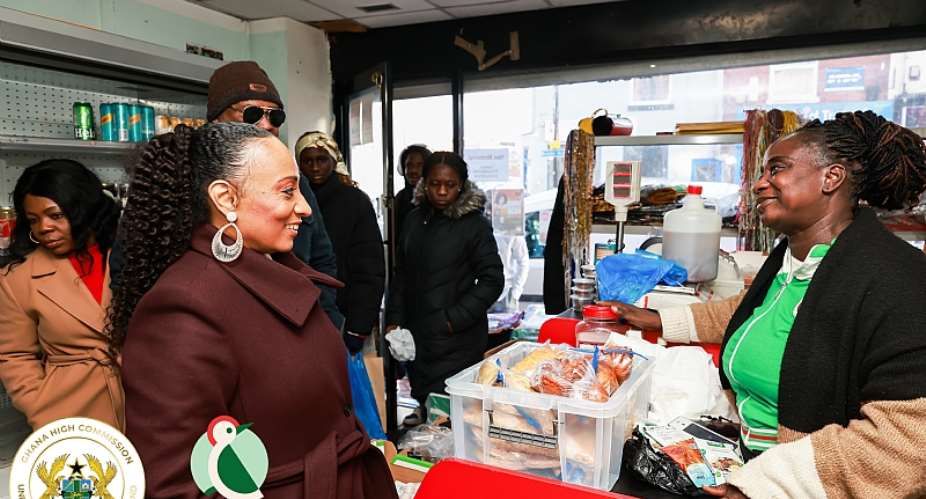
The recent three-day visit of Ghana’s High Commissioner to the United Kingdom and Northern Ireland, Her Excellency Sabah Zita Benson, to Birmingham deserves more than polite applause. It deserves serious reflection because it touches the nerve centre of Ghana’s economic future: the diaspora.
Birmingham, home to one of the most vibrant Ghanaian communities in the UK, became a fitting stage for a message that Ghana can no longer afford to treat lightly. From small traders to established entrepreneurs, the High Commissioner made a deliberate effort to engage almost every Ghanaian-owned business, listening to their concerns, encouraging collaboration, and urging them to invest back home.
That approach matters.
Too often, diaspora engagement has been reduced to speeches, photo opportunities, and ceremonial dinners. This visit, however, showed signs of practical diplomacy walking into businesses, hearing real frustrations, and acknowledging the daily struggles of Ghanaians who contribute significantly to Ghana’s economy from abroad.
Investing Back Home: A Call, Not a Command
High Commissioner Benson’s call for Ghanaians abroad to invest in Ghana and take advantage of available opportunities is timely. Ghana needs capital, expertise, innovation, and confidence. The diaspora has all four.
But encouragement alone will not suffice.
Many Ghanaian entrepreneurs abroad have heard similar appeals before, often followed by bureaucratic bottlenecks, policy inconsistencies, weak institutional coordination, and unclear investment protections. If this renewed call to invest is to translate into action, it must be matched with reforms that make Ghana genuinely investor-friendly, not just rhetorically attractive.
Listening to diaspora challenges, as the High Commissioner did, is a good start. Acting on them will be the real test.
A Historic First—and a Heavy Responsibility
As the first Ghanaian female High Commissioner to the UK, Sabah Zita Benson carries both symbolism and responsibility. Her message urging Ghanaians abroad to urgently support President John Mahama’s agenda to reset the Ghanaian economy places the diaspora squarely within the national recovery conversation.
This is a strategic move.
No serious economic reset can succeed without the diaspora. Remittances alone account for billions of dollars annually, often surpassing foreign direct investment and donor inflows. Yet the diaspora’s contribution goes beyond money: skills transfer, market access, technology, and global networks are equally critical.
By explicitly linking diaspora engagement to the government’s economic reset agenda, the High Commissioner has raised expectations not just of the diaspora, but of government institutions back home.
Ghana Card in London: Small Step, Big Relief
One of the most practical and widely welcomed announcements during the visit was that Ghanaians in the UK can now obtain their Ghana Cards in London.
This is no small matter.
For years, access to basic national documentation has been a frustrating and costly process for many abroad. Bringing Ghana Card services closer to the diaspora is a sign of administrative responsiveness and a reminder that citizenship should not be suspended by distance.
Partnership, Not One-Way Traffic
The High Commissioner’s emphasis on stronger partnerships between the diaspora and Ghanaian institutions is the right language. The relationship must move away from seeing the diaspora merely as a source of remittances, and toward recognising them as stakeholders in national development.
Ghanaians abroad are not just wallets; they are partners, critics, innovators, and investors who want value for their contribution.
Government recognition of the “enormous contribution” of Ghanaians abroad must now be institutionalised through policy clarity, accountability, and sustained engagement beyond visits and speeches.
The Road Ahead
The Birmingham visit sends a positive signal, but signals alone do not build economies.
If this outreach is followed by concrete action, policy follow-through, and genuine institutional reform, it could mark the beginning of a new chapter in diaspora–government relations. If not, it risks joining a long list of well-intentioned engagements that raised hope but delivered little.
For now, credit must be given where it is due. The visit was visible, engaging, and purposeful. The challenge ahead is simple but demanding: turn encouragement into confidence, and confidence into investment.
The diaspora is watching. Ghana must now respond.

 GJA Applauds Ghana’s Sharp Rise in Global Press Freedom Rankings
 US Embassy Cautions Against Censorship in Fight Against Misinformation
 Interior Minister Blames Weak Enforcement by Assemblies After Avenor Building Co...
 Gov’t Warns Against Rising Misinformation, Calls for Stronger Journalistic Stand...
 Ramaphosa Warns Against Vigilante Crackdowns on Foreign Nationals
 Global InfoAnalytics Boss Rejects Claims Polls Are Destabilising NDC
 Bawumia to Propose Policy Alternative as Cocoa Sector Tensions Deepen
 ECG Announces Scheduled Outages and Technical Fault Affecting Multiple Regions o...
 Investigation committee uncover GH¢19.5m loss at Bolgatanga Technical University...
 Afenyo-Markin calls for protection of journalists, warns against suppression of ...


