




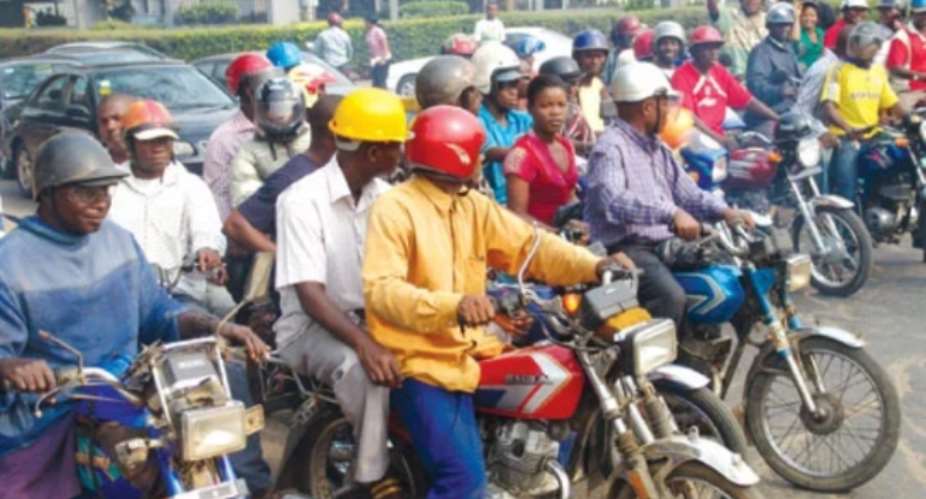
What “Okada” Means in Ghana
In Ghana, okada refers to commercial motorcycles bikes that operate similarly to motorcycle taxis in other West African countries. Despite being widely used by commuters, especially in urban and peril-urban areas, their legal and regulatory status has been a subject of debate.
Current Legal Framework in Ghana
Legal Status
Under Ghana’s Road Traffic Regulations, 2012 (LI 2180), motorcycles and tricycles are not permitted to be used for commercial passenger transport meaning okadas are technically illegal for fare-paying purposes.
Officials from the National Road Safety Authority (NRSA) have repeatedly reiterated that this prohibition remains in force.
Draft Reforms and Proposed Regulations
The Ministry of Transport has been working on a revised Legislative Instrument (LI) to change that, setting out structured requirements for lawful commercial motorcycle operations, including:
Rider Qualifications
Valid National ID.
A commercial motorcycle licence from the Driver and Vehicle Licensing Authority (DVLA).
Minimum age requirements for riders, which have seen some adjustment proposals (initially 25, later proposed to be lowered to 21).
Operational Requirements
Riders must be registered with a recognized union or licensed company.
Certified helmets for riders and passengers.
Special yellow licence plates.
Adherence to all road laws, speed limits, and safety standards.
Enforcement and Penalties
Operating without proper licensing or outside approved unions could attract fines (up to 100 penalty units) or imprisonment.
Despite these plans, enforcement remains inconsistent, and okada operations continue in a legal gray area across many cities, with occasional crackdowns by traffic authorities.
Historical Roots in Nigeria A Case Study
To understand the okada phenomenon in Ghana, it’s useful to look at its more established cousin in Nigeria, where motorcycle taxis have become deeply embedded in urban transport.
Origins of Okada in Nigeria
Motorcycle taxis emerged in the early 1970s in various Nigerian regions (e.g., Cross River State and parts of the north) originally known as Achaba. They spread to Lagos in the late 1970s and became widespread by the 1980s.
Their popularity surged during the late 1980s following worsening economic conditions linked to Nigeria’s Structural Adjustment Programme (SAP) under General Ibrahim Babangida policies that devalued the naira, drove up unemployment, and undercut formal urban transport systems.
Why the Name “Okada”?
The term “okada” comes from Okada Air, a private Nigerian airline popular in the 1980s and 1990s. Motorcycle taxis were likened to the airline’s speed and ability to navigate quickly hence the nickname. The airline ceased operations in 1997, but the term stuck.
Evolution and Regulatory Responses
As the numbers of okadas exploded (tens of millions in Nigeria today), so did safety concerns. Cities like Lagos and Abuja have attempted partial or total bans, especially on highways and bridges, citing crashes, crime facilitation, and traffic danger.
However, these bans often created economic hardship for riders (many of whom had little alternative livelihood) and transport gaps for commuters who rely on the service underscoring the need for balanced regulation rather than outright prohibition.
Motorcycle Taxis in Togo and the Region
While Ghana and Nigeria often grab headlines, similar forms of motorcycle taxi transport under different names are common in neighboring West African countries:
Togo: motorcycle taxis known locally as oléyia are a mainstay of urban transport.
Benin: zémidjans operate with organized uniforms and negotiable fares.
These regional parallels indicate a shared transport ecosystem shaped by urbanization, limited public transit, high youth unemployment, and infrastructure gaps reinforcing that okada-style transport fills real socioeconomic and mobility needs.
Lessons Ghana Can Learn
Regulation Over Prohibition
Nigeria’s mixed experience suggests that banning motorcycle taxis without viable alternatives can push operations underground undermining safety, employment, and enforcement efforts. Effective regulations that recognize economic realities tend to work better than total prohibition.
Structured Licensing and Training Work
Formal rider licensing, training, and vehicle inspections as Ghana’s draft LI aims to establish help professionalize the sector, improve safety, and build accountability.
Integrate with Broader Transport Policy
Standalone motorcycle regulation works best when paired with public transport expansion, safer infrastructure (e.g., dedicated motorcycle lanes), and data-driven urban planning reducing over-reliance on informal taxis while improving overall mobility.
Economic Support and Inclusion
Most okada riders are young workers with limited alternatives. Policies should include economic support mechanisms access to finance for safety equipment, training subsidies, and pathways into formalized unions to ensure protections rather than penalties.
Conclusion
In Ghana today, okada occupies a contentious space illegal on paper, widespread in practice. The government’s proposed regulations aim to foster safety and accountability, but must be balanced with employment realities and transport needs.
By studying Nigeria’s long journey with okadas and the experience of motorcycle taxis across West Africa, Ghana can design structures that protect public safety, recognize economic opportunity, and improve mobility without simply criminalizing an entrenched informal sector.
Mustapha Bature Sallama
Medical Science communicator.
Private Investigator and Criminal
Investigation and Intelligence Analysis,
International Conflict Management and Peace Building. Alumni Gandhi Global Academy United States Institute of Peace.
[email protected]
+233-555-275-880


 Appointment of Emelia Agbenyo as EC deputy chair was well calculated, reasoned –...
 Relief for students as GAUA and TUSAAG call off strike; declare return to work o...
 Who gave Cabinet authority to decide for Ghanaians to join BRICS without parliam...
 Mahama urges Ghanaian businesses to tap CSIR innovations
 Partisan EC appointments could set dangerous precedent — NPP's Kamaldeen
 Winneba: Afenyo-Markin commissions police apartments at Fetteh-Osakam
 Council of State failed Mahama over Emelia Agbenyo’s EC appointment – Prof. Asa...
 CDD‑Ghana: EC Deputy Chair Should Step Down Now
 Family Announces October 23 Memorial Mass for Nana Konadu Agyeman-Rawlings
 Eduwatch Urges Nationwide Audit of Sexual Misconduct in Secondary Schools


