




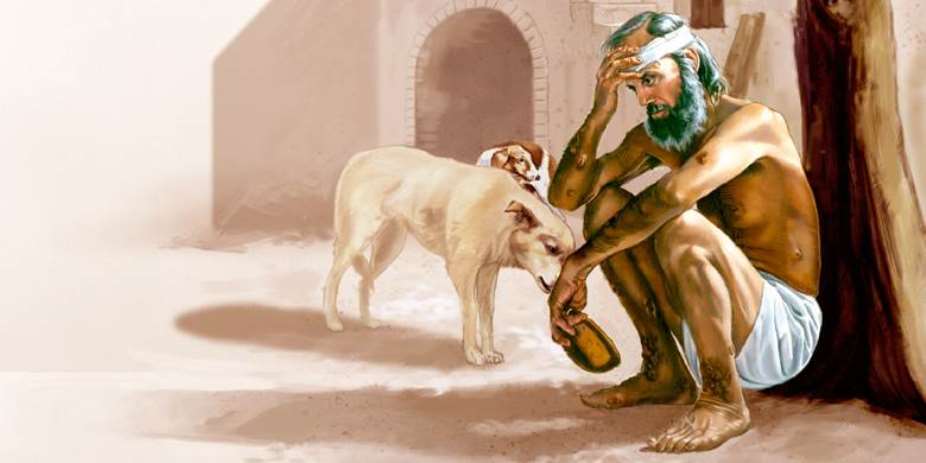
In the Gospel of St, Luke 16: 19 - 31, we are told the story of Lazarus and the rich man. For centuries, what transpired between the two men has stood out as one of the most thought-provoking parables Jesus ever told. It was a story of two men whose lives, both on earth and in the hereafter, contrasted sharply. One was wealthy and lived in splendour every day, dining sumptuously and wearing fine clothes. The other, Lazarus, was a poor man who constantly lay at the rich man’s gate, covered with sores and hoping to eat the crumbs that fell from the rich man’s table. The puzzle begins here. To be able to eat the crumbs, Lazarus would be expected not only in the house but also near the dining table. Alternatively, the rich man's cook or steward could scoop the left over and brought it to him. But that could only have happened if Lazarus reached out to them with his desires. He did not.
While the rich man lived in comfort and excess, Lazarus suffered hunger and neglect. When both died, their destinies were reversed: Lazarus was comforted in Abraham’s bosom while the rich man suffered torment in Hades.
For centuries, preachers and scholars have drawn moral lessons about compassion, charity, humility, and the eternal consequences of neglecting the suffering of others from this story. But when we read the story carefully, a deeper and perhaps uncomfortable question arises: where was justice between Lazarus' comfort in the bosom of Abraham and the rich man suffering in Hades? The common interpretation condemned the rich man as heartless and selfish because he ignored a suffering man at his gate. But a closer look reveals that Lazarus himself never once reached out to the rich man or any of his assistants for help. If he had, obviously the story might have taken a different slant. The text says Lazarus was laid at the gate, meaning that someone placed him there, perhaps daily, but there was no indication that he ever reached out to the rich man for assistance.
That silence is what makes the story so intriguing. Why did Lazarus not speak up? Why did he not ask for help? Was he too weak, too proud, or too afraid? Did he believe that his suffering was his destiny, a burden only he should quietly bear? We may never know. What we definitely know is that his silence raised an ethical and theological question: if he never sought help, was the rich man truly guilty of neglecting him?
Some scholars argue that the rich man’s guilt was not that he failed to respond to a plea for help. It was that he was indifferent to Lazarus' circumstance. He saw Lazarus at his gate every day and simply stepped over him, as though he didn’t exist. The story makes it clear that he knew Lazarus, which was why in the afterlife, he called him by name: “Father Abraham, send Lazarus to dip the tip of his finger in water to cool my tongue.” That suggested that he recognized Lazarus during his lifetime. The rich man was therefore not ignorant of the beggar’s condition. He knew who Lazarus was and what he suffered, but chose to do nothing.
But we might as well ask: does knowing someone’s suffering automatically obligate us to act? In a world where suffering surrounds us on our streets, on television, in hospitals, and refugee camps and so on, do we bear equal guilt for every instance of human misery we do not or cannot intervene upon? Is compassion an obligation or a voluntary virtue? The story seems to imply that it is both. But a parallel drawn between the story and the act of prayer would make another interesting dimension.
If God, who is all-knowing, understands every human problem even before it is spoken, why then do we still need to pray? Why must we reach out in words to a Being who already knows our hearts, our desires and our aspirations? According to some theological traditions, prayer is a special bond in the relationship between the Creator and the creature. Prayer is not simply a request for intervention, it is an act of humility to God, recognition of his power over us, and our dependence on his divine authority. When we pray, we acknowledge that we need God’s help, and we submit ourselves to His authority and mercy. Prayer, therefore, is not about informing God but about transforming us.
In that sense, Lazarus’ silence can be seen as a failure to reach out to God through his fellow human being who could have helped him, in accordance with the demands of Jesus who said: "Inasmuch as you did it not for these little ones, you did it not for me." The rich man might have been able to assist, but perhaps he never got the chance to truly understand Lazarus’ needs because Lazarus never spoke to him about his needs. Should we then fault the rich man for what Lazarus failed to communicate? Or should we assume that seeing Lazarus’ condition was enough communication?
The dilemma becomes sharper when we recall that Jesus did not name the rich man, while He gave the poor man the name Lazarus, meaning “God has helped.” It was perhaps a deliberate choice of illustration to make readers sympathize with the poor man. Yet, from the perception of human fairness, we can argue that both men were consummated in their own blindness - Lazarus in his silence and the rich man in his indifference.
Many people overlook a simple truth: sometimes, those who are in need suffer silently, expecting others to notice and act. But silence can be mistaken for contentment, or at least acceptance. In real life, how often do we walk past people who seem to be managing, not realizing they are struggling inside? And how often do we assume that if someone truly needed help, they would ask for it? That assumption may have been what the rich man thought, too. He might have believed that if Lazarus really wanted something, he would have said so. After all, people came to him every day with requests — servants, traders, friends — and he responded accordingly. But Lazarus all along said nothing, from day to day.
Still, there is another way to look at it. Perhaps Lazarus did not speak because he had already given up hope. Perhaps he believed the rich man, like others, would reject or insult him on account of his condition. In the ancient world, poverty and disease were often seen as divine punishment. A leprous beggar was considered cursed or sinful. So, Lazarus might have thought that even asking for help was pointless. He simply lay there, enduring his suffering, while the dogs licked his sores. And, if that was the case, then the moral weight of the story shifts again. The rich man becomes guilty not because he ignored a plea, but because he failed to show spontaneous compassion.
True compassion does not wait to be asked, it acts when it sees pain. That is perhaps the real lesson Jesus wanted to teach, that love for one’s neighbour requires initiative, not response. It is not enough to say, “I would have helped if he had asked.” The rich man’s sin was that he had eyes and yet did not see, ears and yet did not hear. This might be corroborated by the parable of the Good Samaritan. The man did not ask for help and actually even a priest saw him and passed another way but when a Samaritan saw him and realised he had been attacked by robbers, he did not wait to be asked to help the victim. His compassion propelled him to take the wounded man to the hospital and to pay his bills.
That then leaves us with the question of justice. Was the rich man’s punishment of eternal torment proportionate to his crime? He was not accused of theft, murder, or oppression. His fault was that of omission, not commission. And yet his suffering in the afterlife was portrayed as severe and unending. One might be tempted to argue that the punishment appeared to be very extreme. If divine justice was truly just, why would a man be tormented forever for failing to share his wealth with someone who never asked for it?
It is possible that perhaps the parable was not so much about literal justice as it was about spiritual awakening. The story was not necessarily a courtroom verdict but a mirror showing each reader what could happen if they lived without empathy. It reminds us that wealth, comfort, and status can blind us to the humanity of others. The rich man’s torment in Hades could have represented the torment of conscience, the eternal regret of realizing too late that one lived selfishly. Yet the parable also exposes the tension between divine justice and human reasoning. From a human perspective, justice should balance crime and punishment, cause and effect. But from a divine perspective, justice often reveals moral truths that transcend logic. God’s justice, as many theologians say, is restorative rather than punitive. The rich man’s suffering could be the ultimate awakening — a painful recognition of his spiritual failure.
However, that does not erase the puzzle at the heart of the story. Was it fair to reward Lazarus so greatly when he himself took no initiative to change his situation? He was passive in life, and yet he received comfort in death. Meanwhile, the rich man, who may not have actively harmed anyone, was condemned. If we measured justice by human standards, the scales would seem uneven. Or could it have been that Jesus wanted to precisely challenge that notion of fairness. The story was not just about two men but about two worlds, one where human pride and material success define worth, and another where humility and suffering are seen through the lens of divine mercy. The kingdom of God, Jesus often said, upends human expectations. “The first shall be last, and the last shall be first.”
In that sense, it is possible that the parable of Lazarus and the rich man was not meant to satisfy our earthly sense of justice but to unsettle it. It invites us to question how we perceive responsibility, compassion, and silence. Was Lazarus’ silence a sign of faith that was based on trusting that God would help him, even if man did not? Or was it the kind of fear that makes many poor people accept their suffering without complaint? Was the rich man’s neglect deliberate cruelty, or just the blindness that comes with comfort? What about us today? Are we any different? Every day, we walk past people in need, the homeless man by the traffic light, the neighbour who struggles to pay school fees for his children, the old woman who sits alone in the evening sun. We see them, yet we are busy, distracted, preoccupied. Like the rich man, we live behind gates that are sometimes literal, sometimes digital. We hear about suffering and injustice, but rarely do we pause long enough to act.
Unlike Lazarus, most people today are not entirely silent. They cry out through social media, through protests, through appeals in churches and communities. And still, the world often turns a deaf ear. So, perhaps the real message is not about whether Lazarus asked or not, but about whether humanity still listens when the poor cry.
In the end, the story remains open-ended. It is less a verdict than a riddle about the nature of justice, mercy, and responsibility. Perhaps both Lazarus and the rich man represent parts of us, the silent sufferer who endures and the comfortable soul who overlooks. Between them lies the question that no sermon fully answers: in a world where God knows our needs before we ask, and yet commands us to pray, what then is the measure of compassion and justice among men? Maybe, after all, the justice between Lazarus and the rich man is not for us to define. It is a mystery left for theologians, scholars, and all who seek truth to ponder — a timeless reminder that divine justice is not always humanly fair, and that silence, whether from need or neglect, can speak louder than words. For all who read this, I will appreciate your thoughts.

 GJA Applauds Ghana’s Sharp Rise in Global Press Freedom Rankings
 US Embassy Cautions Against Censorship in Fight Against Misinformation
 Interior Minister Blames Weak Enforcement by Assemblies After Avenor Building Co...
 Gov’t Warns Against Rising Misinformation, Calls for Stronger Journalistic Stand...
 Ramaphosa Warns Against Vigilante Crackdowns on Foreign Nationals
 Global InfoAnalytics Boss Rejects Claims Polls Are Destabilising NDC
 Bawumia to Propose Policy Alternative as Cocoa Sector Tensions Deepen
 ECG Announces Scheduled Outages and Technical Fault Affecting Multiple Regions o...
 Investigation committee uncover GH¢19.5m loss at Bolgatanga Technical University...
 Afenyo-Markin calls for protection of journalists, warns against suppression of ...


