




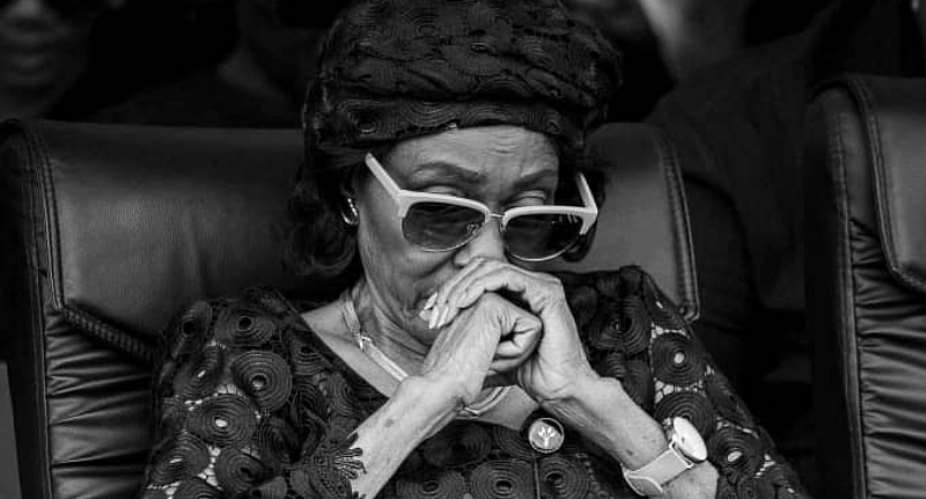
There are moments in history when laws are not just written, they are felt. PNDC Law 111 was one of those moments. Behind it stood a woman whose courage was stronger than the times she lived in. Nana Konadu Agyeman-Rawlings did not simply marry into power; she used that power to question the very foundations of Ghanaian custom and law. She saw injustice where others saw “tradition,” and she refused to look away.
Before 1985, when a man died intestate in Ghana, the story that followed was almost always the same. His widow would be pushed out of the house they had built together, and the children they had raised would be stripped of their father’s possessions by uncles and cousins who claimed it was their “customary right.” Women wept in silence, children suffered quietly, and the law looked away. That silence offended Nana Konadu. She believed a revolution that claimed to fight for justice could not ignore the injustices faced by women within their own homes.
PNDC Law 111, the Intestate Succession Law, changed that. For the first time, the law recognized that when a man dies, his wife and children have a rightful share in what he leaves behind. It was a bold move that struck directly at the heart of patriarchy and it took a woman of unusual conviction to make it happen. Nana Konadu did not stand outside the corridors of power begging for recognition; she entered those corridors and reshaped them. Through the 31st December Women’s Movement, she made women’s welfare a political issue, not a charity project.
What made her remarkable was her vision of justice as something personal, not abstract. She understood that peace in society begins with peace in the home. A widow denied inheritance, a child stripped of security, and a family torn apart by greed. these were not private misfortunes to her. They were social wounds. Her activism grew from that understanding, and she carried it with a rare mix of grace and steel.
Her influence on PNDC Law 111 is often spoken of quietly, but its effects are profound. The law became the bridge between Ghana’s customary system and its constitutional promise of equality. It offered women dignity where there had been dependency, and gave children protection where there had been neglect. To many, it was the first time the state openly stood with the vulnerable against the weight of culture.
Yet her story is not just about legal reform. It is about a woman who refused to be confined to the background of Ghana’s revolution. She stood beside Jerry Rawlings through coups, reforms, and democratic transitions, not as a shadow, but as a conscience. She reminded a revolutionary regime that justice is hollow if it does not reach the home. That, perhaps, was her greatest revolution: she made social justice intimate.
Today, as Ghana continues to grapple with questions of gender, inheritance, and equality, PNDC Law 111 remains one of the most humane pieces of legislation in our history. It is a quiet testament to what happens when compassion meets courage.
To remember Nana Konadu Agyeman-Rawlings, then, is not merely to recall a former First Lady. It is to remember a reformer who humanized the law and gave voice to the voiceless. Her work reminded us that revolutions are not only fought with guns and slogans, but also with empathy and conviction. She taught Ghana that justice, to be real, must begin at home.
And so, when history writes her name, it should not only place her beside the men of her time. It should place her beside the law she inspired, "PNDC Law 111' the law that turned the pain of countless widows into the promise of fairness. That is how she should be remembered: as the woman who made justice breathe.
Written by: Abubakar Mohammed Aminu, Security, Conflict and Human rights Analyst and Advocate

 Abronye loses again as Court of Appeal dismisses bid to halt Samson Anyenini’s d...
 Over 30 women feared trapped in prostitution in Savannah as GIS arrests traffick...
 Govt pays GH¢24.8bn to statutory funds since January — Ato Forson
 Seven missing Axim fishing canoe crew located in Togo’s waters — Western Regiona...
 Health Ministry assures Ghanaians of readiness to manage Ebola cases
 FDA shuts down Arcan Bitters factory again over illegal production in Ashanti Re...
 PAC chair praises NPA CEO Edudzi Tameklo’s performance at committee hearing
 Ghanaian jailed nine months in US for using relative’s social security number to...
 Ukraine war: I'm going to Russia to convince President Putin to ceasefire — Maha...
 'Prof. Jane Naana is Vice President of Ghana; not for women and girls' — Victori...


