




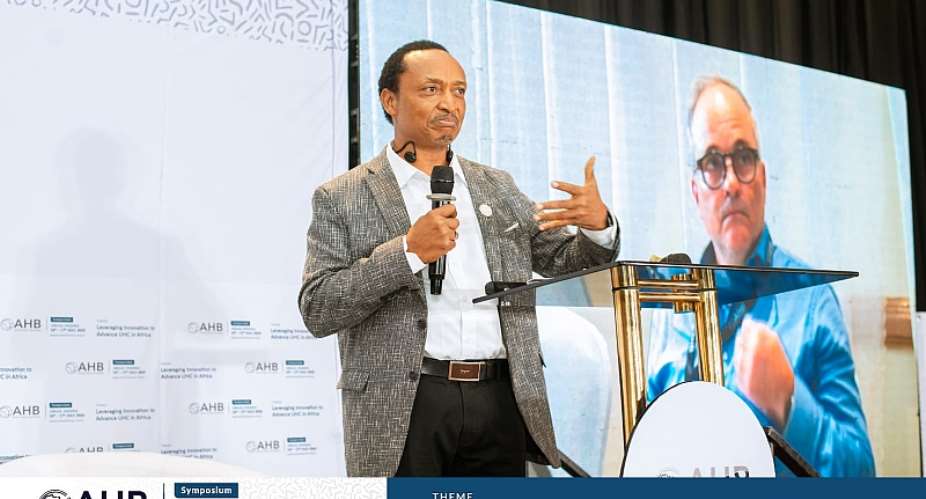
Africa must seize its moment to transform health systems through digital innovation, regional collaboration, and local ownership, says Dr. Francis Ohanyido, a leading voice in public health and digital health integration on the continent.
Speaking ahead of the upcoming 4th Annual International Conference on Public Health in Africa (CPHIA 2025), Dr. Ohanyido declared, "Africa has arrived at its M-PESA moment in healthtech. Let’s make it count.”
The statement echoes his conviction that the continent stands on the brink of a technological breakthrough capable of revolutionizing healthcare access and delivery—if backed by political will and decisive action.
Dr. Ohanyido, who serves as Director-General of the West African Institute of Public Health (WAIPH) and co-lead for Track 4 on Digital Innovation and Artificial Intelligence at CPHIA 2025, described the upcoming conference as a defining opportunity to set an African-led health agenda grounded in innovation, investment, and self-reliance.
Scheduled to take place from October 22 to 25 in Durban, South Africa, the conference is co-hosted by the Africa Centres for Disease Control and Prevention (Africa CDC) and the South African government, in collaboration with Africa Bio’s 8th Annual BIO Africa Convention.
This year’s theme—"Moving towards self-reliance to achieve universal health coverage and health security in Africa”—speaks directly to a renewed vision for the continent.
“CPHIA is more than a gathering,” Dr. Ohanyido said. “It’s where knowledge meets action, innovation meets impact—and where we begin to take full ownership of our health systems.”
He emphasized that digital solutions—ranging from artificial intelligence to telemedicine, electronic health records, and mobile applications—are already making an impact across several African countries. In Ghana, for instance, the ‘Gold Keys’ system is being used to verify genuine medicines and combat the influx of counterfeits. In Rwanda, the government is advancing a national electronic records program under its Smart Rwanda initiative. Morocco has also emerged as a frontrunner in investing in robust digital infrastructure for health.
“These are not isolated efforts—they are proof that Africa is not only ready but already leading in some areas. The narrative must shift,” he said.
However, he cautioned that the journey to universal health coverage is being undermined by systemic challenges. Drawing on research from WAIPH, Dr. Ohanyido outlined the “7 Ps” blocking progress: poor political will, policy gaps, population growth, provider-to-patient shortages, paucity of investment, patchy technology integration, and poor infrastructure and services.
While these challenges are interconnected and longstanding, he believes the current digital age offers a chance to leapfrog traditional barriers. “The key is not just in identifying solutions but in executing them. Africa must move from collaboration to ‘collabo-action’—cooperation that leads to tangible results.”
Dr. Ohanyido also underscored the value of African-led innovations in reducing dependency on external aid. He pointed to Kenya’s revolutionary M-PESA platform as a model of local ingenuity that has inspired similar strides in health innovation. Additionally, South Africa’s involvement in the Medicines Patent Pool, which enables local production of affordable medications, reflects a growing emphasis on self-reliance in pharmaceutical manufacturing.
“Ownership matters. It’s about solutions built by us, for us—tailored to our context and capable of sustaining our future,” he said.
On the question of long-term funding, Dr. Ohanyido described himself as an “Afroptimist,” confident that Africa can secure sustainable health financing through blended models, public-private partnerships, and domestic resource mobilization—provided the policy and political environment supports it.
He also pointed to the critical roles of young professionals and journalists in Africa’s health transformation. According to him, youth are driving innovation on the front lines, while the media holds the power to spotlight solutions, demand accountability, and shift public narratives.
“Journalists are the watchdogs of public health. Their pen can be mightier than the virus. And young professionals, empowered by knowledge and technology, are the real architects of tomorrow’s healthcare systems,” he said.
Looking ahead to CPHIA 2025, Dr. Ohanyido issued a clear call to action for African governments, health leaders, and development partners.
“Repositioning Africa’s health systems is not a solo mission—it’s a shared journey,” he concluded. “As the African philosophy of Igwebuike reminds us, ‘we are only as strong as the sum of all our numbers.’ Let us walk this path together—with vision, resolve, and the courage to lead ourselves.”
As Africa gathers in Durban this October, CPHIA 2025 promises more than policy dialogue—it signals a continental shift in mindset and mission. With the right investments in digital innovation and African-led solutions, the road to universal health coverage and true health sovereignty is not just possible—it is within reach.

 Halt proposed VALCO sale — ICU-Ghana tells Mahama
 Security beef up at Krobo College of Nursing and Midwifery during students prote...
 EOCO probe: IMCC insists forensic audit findings implicated Miracles Aboagye
 NDC rules out deadline extension for govt appointees seeking party positions
 80 to 90% of the people you saw wearing red protesting were not VALCO workers — ...
 Here are areas to be affected by ECG's planned maintenance on Tuesday
 NDC supporters mass at Kasoa Police Station after arrest of Zongo Ward Organiser
 Police arrest 93 suspected drug traffickers in Major Ashanti Region crackdown
 Chief Justice directs all courts to suspend sittings for Supreme Court 150th ann...
 63% Ghanaians support establishment of tribunals – Global InfoAnalytics poll

