




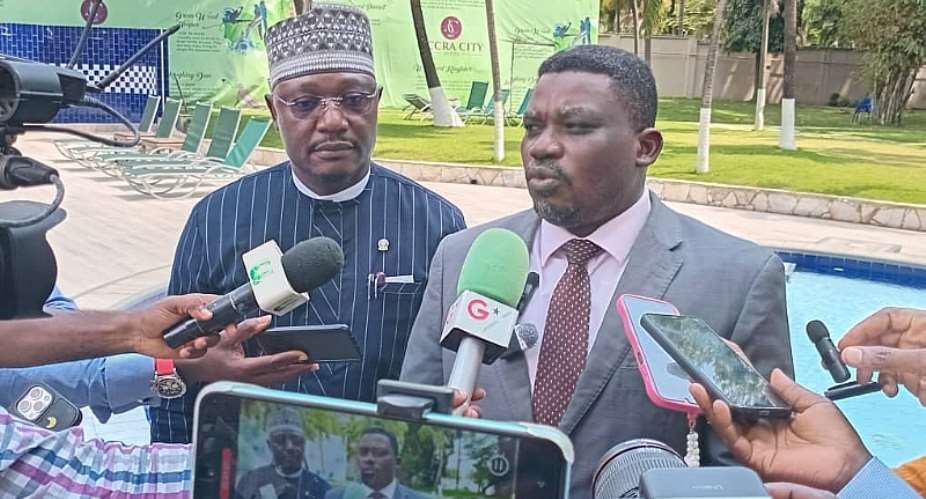
Churches, mosques, and other faith-based organisations have become new targets for criminal networks seeking to clean dirty money under the cover of religious donations, according to Ghana’s Attorney-General, the Inter-Governmental Action Group Against Money Laundering in West Africa (GIABA), and the Financial Intelligence Centre (FIC).
At a high-level sensitisation seminar held on Tuesday, 21 October 2025, at the Accra City Hotel, the Attorney-General and Minister for Justice, Hon. Dr. Dominic Akuritinga Ayine, represented by Mrs. Yvonne Atakora Obuobisa, Director of Public Prosecutions, cautioned religious bodies not to allow their institutions to become conduits for money laundering and terrorist financing. The event was jointly organised by GIABA and the FIC and attended by leaders of major Christian and Muslim denominations, including the Catholic Church, the Methodist Church, the Pentecostal and Charismatic Councils, the Office of the National Chief Imam, Ahmadiyya, Shia, and Ahlussunna Missions.
Mrs. Obuobisa, speaking on behalf of the Attorney-General, explained that criminals are increasingly exploiting the trust and community-based nature of religious organisations. “Faith-based institutions are sacred spaces meant to promote peace and righteousness. Yet, because of their trusted nature, they can be exploited to disguise or transfer illicit funds when safeguards are weak or absent,” she warned.
She noted that many churches and mosques depend heavily on cash donations, often collected during services or special events, which can easily be mixed with illicit funds. Foreign contributions meant for charity or projects are also being misused to disguise illegal cross-border transactions.
The Attorney-General reaffirmed Ghana’s commitment to international anti-money laundering and counter-terrorism financing (AML/CFT) standards under Act 1044, the Anti-Money Laundering Act of 2020; Act 875, the Anti-Terrorism Amendment Act of 2014; and Act 1015, the Corporate Insolvency and Restructuring Act of 2020. However, he cautioned that the best laws will remain ineffective if faith-based institutions fail to appreciate their crucial role in enforcement.
He called on religious leaders to uphold transparency and accountability in their financial dealings through proper bookkeeping, donor verification, and internal audits. “Your leadership is indispensable in promoting transparency, integrity, and accountability. In protecting your institutions from abuse, you are protecting the very values you stand for,” he said.
Mr. Edwin W. Harris Jr., Director-General of GIABA, whose speech was delivered on his behalf by Timothy Melaye, highlighted the growing menace of financial crimes in West Africa, including corruption, human trafficking, drug smuggling, and kidnapping—all of which generate illicit funds that criminals seek to launder through legitimate channels. “The voice of our religious leaders must be strongly heard against those ills ravaging our societies—especially violent extremism, terrorism, corruption, and trafficking. They must not only be heard but must be seen to lead the way by actions and exemplary lifestyles,” he stressed.
Mr. Harris explained that GIABA, a specialised ECOWAS institution established in 2000, is a Financial Action Task Force (FATF)-style regional body with a mandate to protect member states’ economies from money laundering and terrorist financing. He said GIABA promotes regional cooperation, conducts mutual evaluations, and supports member countries to strengthen their Financial Intelligence Units (FIUs).
He recalled GIABA’s previous engagements with faith-based organisations, including participation in the 2011 Ahmadiyya Muslim Youth Convention in Nigeria and the 2013 Church Leaders’ Security Conference, which inspired targeted programmes for religious institutions from 2017 onward. The Accra seminar, he said, was part of ongoing efforts to deepen collaboration with religious communities.
In a passionate appeal, Mr. Harris urged clerics to use their influence to drive moral reform and financial integrity. “In no other time has our society required moral rebirth than now. The importance of this gathering cannot be overemphasised,” he said.
Taking his turn, Deputy CEO of the Financial Intelligence Centre, Mr. Kofi Boakye, who represented the FIC CEO and GIABA National Correspondent, Mr. Kwadwo Twum Boafo, described the seminar as timely and critical in strengthening national safeguards against financial crime. He explained that money laundering involves concealing the origins of illicit funds and financing terrorism, warning that the practice has deep political, social, and economic implications.
According to Ghana’s 2024 national risk assessment report, the country continues to face a medium-level threat of money laundering, with emerging vulnerabilities in the real estate, NGO, and virtual asset sectors. Mr. Boakye also cited the gold trade as a high-risk area due to ongoing smuggling concerns.
He warned that faith-based groups are increasingly being used to mask financial crimes. Illicit funds, he explained, are often mixed with regular church or mosque donations, presented as tithes or project support, or structured into smaller amounts to avoid detection. In some cases, fake congregants or shell donors are used to hide the true source of money.
Mr. Boakye assured that the government, through the FIC and its partners, is committed to tackling high-risk sectors and maintaining strict alignment with international AML/CFT standards.
The sensitisation seminar ended with a united call for religious institutions to become bastions of financial integrity and moral leadership. The Attorney-General’s final appeal captured the essence of the gathering: “Let your integrity—not loopholes—define your ministry.”
 Government to introduce ID verification for access to porn sites — Sam George
 African governments failing on commitments to increase agriculture funding — Eri...
 45-year-old ex-convict arrested over alleged rape and murder of wife's 17-year-o...
 We’re working to provide shelter for police officers displaced after barracks fi...
 No arrests made over Accra Central Police Barracks fire yet — Police
 Mahama told UK Prime Minister anti-LGBTQ+ bill is far from becoming law — Minori...
 Leaked judgment? NDC activists confirms jail term for Wontumi on social media
 Minority demands passage of original 2024 anti-LGBTQ+ bill, accuses NDC of decep...
 "Flagrant disrespect" — Court remands Abronye over failure to surrender passport...
 High Court remands Abronye over failure to surrender passport


