




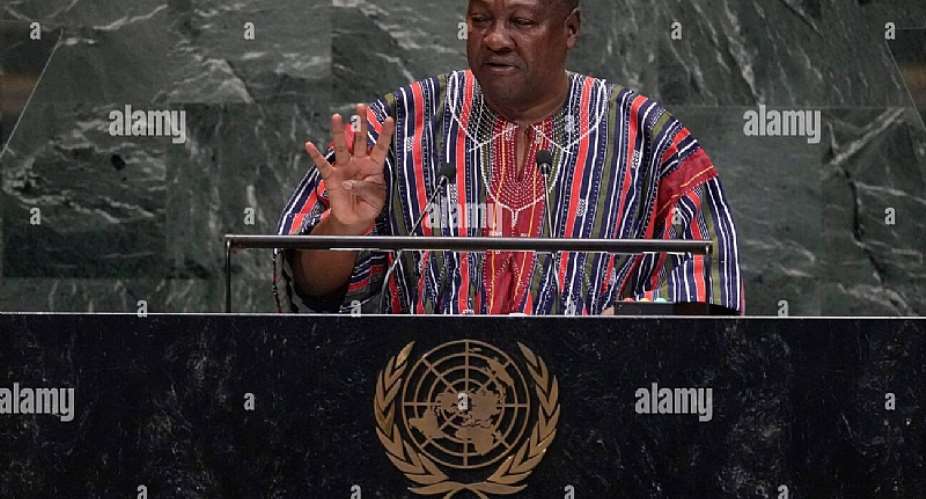
In a speech that has reverberated across continents, Ghana’s President John Dramani Mahama delivered a masterclass in statesmanship at the 80th United Nations General Assembly (UNGA) in New York. His address was not only cogent in its structure and historical grounding but potent in its unapologetic call for justice, reform, and recognition of Africa’s rightful place in global governance.
A Speech Rooted in History, Aimed at the Future
President Mahama began by tracing Africa’s marginalization in the founding of the United Nations, noting that only four African nations were present at its inception in 1945. He invoked the Berlin Conference of 1884—the infamous "Scramble for Africa" as a historical wound that still shapes global power dynamics today. But rather than dwell in grievance, Mahama pivoted to a bold declaration: “The future is African.”
This refrain, repeated with rhetorical flair, was more than a slogan. It was backed by UN demographic projections: by 2050, over 25% of the world’s population will be African, and one-third of all youth aged 15–24 will reside on the continent. Mahama’s message was clear—Africa is not a problem to be solved but a partner to be embraced.
Demanding a Global Reset
The speech’s potency lay in its fearless critique of the current world order. Mahama called for:
- Permanent African representation on the UN Security Council, including veto power.
- A restructured global financial architecture, arguing that institutions like the IMF and World Bank perpetuate inequality.
- Reparations for slavery and colonization, describing the transatlantic slave trade as “the greatest crime against humanity”.
- An end to the blockade on Cuba, citing its solidarity with Africa during the anti-apartheid struggle.
These demands were not framed as pleas but as overdue corrections to a system that has long sidelined the Global South.
Speaking Truth to Power
Mahama’s rhetoric was sharp, at times poetic, and always deliberate. He challenged the normalization of xenophobia, racism, and anti-migrant sentiment, particularly in the wake of nationalist rhetoric from leaders like Donald Trump. “We cannot normalize cruelty,” he said, defending the dignity of African migrants and climate refugees.
He also addressed the Gaza conflict with rare candor, rejecting diplomatic euphemisms: “If it looks like a duck, swims like a duck, and quacks like a duck, then it must be a duck. The crimes in Gaza must stop”.
Reactions: Applause and Alarm
The speech has drawn widespread praise across Africa and the diaspora. Abraham Koomson of the Ghana Federation of Labour called it “bold and courageous,” though he warned of potential Western backlash. Commentators have compared Mahama’s address to those of iconic African leaders like Kwame Nkrumah and Nelson Mandela.
Yet, some critics argue that while the speech was powerful, its demands especially for Security Council reform may be idealistic without a coordinated African strategy to back them.
A Turning Point?
Whether Mahama’s speech will lead to tangible reforms remains to be seen. But what is undeniable is its symbolic power. It marked a shift from Africa as a subject of international discourse to Africa as a speaker, a shaper, and a sovereign force.
In his closing, Mahama quoted Arundhati Roy: “Another world is not only possible, she is on her way.” With this speech, he positioned Africa not just as part of that world but as its future.


 NPP General Secretary race: Kodua supervised worse election defeat, must be vote...
 NPP chases GoldBod to disclose foreign gold buyers, contracts and financing term...
 Responsible journalism among nation's most vital defences against disputes — Nat...
 Mahama will lead the way on National Cathedral if Christians reach consensus – M...
 Two dead, six injured in crash involving truck, bus and tricycle on Accra-Kumasi...
 67 injured in road crash involving two buses on Kumasi-Accra Highway
 September 2: Cedi sells at GHS12.20 on forex market, GHS11.26 on BoG interbank
 There is nothing wrong with having a National Cathedral in Ghana — Mahama Ayarig...
 Ghana’s macroeconomic stability is ‘rented’ and cedi-dependent — Dr Domfeh
 Afua Kobi Ampem Girls SHS builds multipurpose drone for firefighting, intelligen...

