




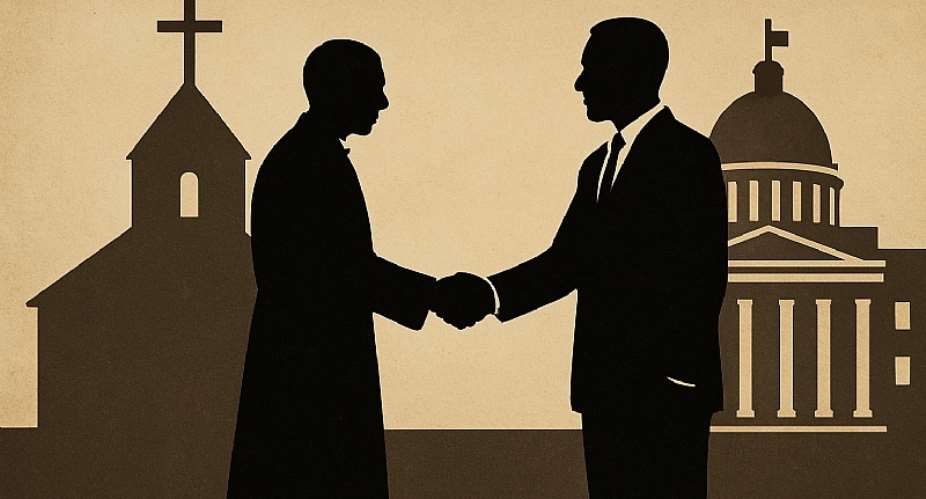
Africa stands at a moral crossroads. Across the continent, ordinary citizens are trapped between corrupt political systems and compromised religious leadership. At the center of this dilemma lies an uneasy alliance: the priest and the president. Once expected to act as moral watchdogs and defenders of the people, religious leaders in many African societies now appear as strange bedfellows with political elites, blurring the lines between faith and governance.
For centuries, religion has shaped African societies, providing moral codes, social cohesion, and spiritual refuge in times of turmoil. Political leadership, on the other hand, is meant to ensure justice, equity, and the material welfare of the people. Ideally, these two forces should complement each other, the priest holding the president accountable, and the president guaranteeing freedom of worship. Yet today, we often witness a dangerous inversion: priests blessing presidents who preside over injustice, and presidents funding churches or mosques in exchange for legitimacy.
The result is a moral crisis. When faith leaders become entangled with political power, their prophetic voice is muted. Sermons shift from calls for justice to endorsements of political agendas. Politicians exploit religious platforms to sanctify their ambitions, while clergy enjoy privileges that distance them from the suffering masses. This marriage of convenience leaves citizens disillusioned. Who, then, will speak truth to power when both the pulpit and the statehouse echo the same rhetoric?
Consider recent elections in parts of Africa where religious endorsements were wielded like spiritual weapons. Congregations were told that opposing certain leaders was tantamount to resisting divine will. In such scenarios, religion loses its essence as a beacon of truth and becomes an instrument of manipulation. The silence of many clerics on issues such as poverty, corruption, and human rights violations exposes the depth of this moral compromise.
Yet, history reminds us that religious leaders can be powerful agents of change. From Desmond Tutu’s prophetic resistance to apartheid in South Africa, to clerics who sheltered persecuted communities during genocides, Africa has seen how faith and courage can transform societies. The tragedy is that today, such voices are drowned out by transactional relationships between the altar and the throne.
The way forward lies in reclaiming the integrity of both institutions. Religious leaders must recover their prophetic role challenging injustice regardless of who sits in power. They must return to the sacred duty of guiding consciences, not political campaigns. Equally, political leaders must stop instrumentalizing faith for selfish ends and instead create conditions where religion can flourish freely, untainted by patronage.
Africa’s moral renewal depends on the disentanglement of these strange bedfellows. The priest must remember his sacred vow to truth, and the president his constitutional duty to justice. Only when both reclaim their authentic roles can ordinary citizens find in them the compass needed to navigate the continent’s deepening crisis.


 Nigeria's onion dispute with Ghana tests West African free trade
 Uganda suspends military ties with Turkey over extradition of Museveni critic
 US fears wider Middle East escalation after Houthi attack Riyadh
 Pop star Ed Sheeran calls Gaza situation “unjustifiable” amid controversy
 'We have spent 60years arguing about Nkrumah and rather less time doing what he ...
 Judge recounts attempted MoMo scam on him moments after jailing scammer
 'Systemic failure due to NACOC removal from port inspections' – Inusah Fuseini o...
 Foreign Affairs Ministry releases 200-page RTI response on GH¢49.7m South Africa...
 Chartered flights account for GH¢27.18m of South Africa evacuation cost


