




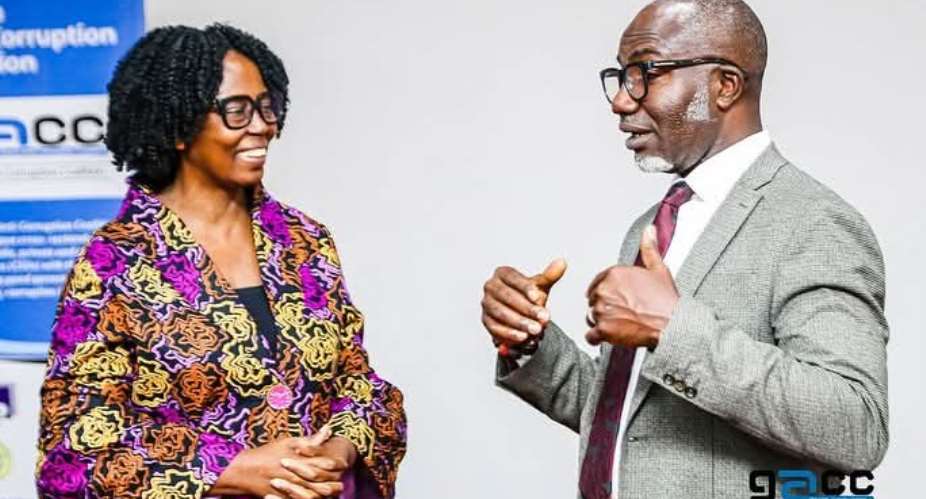
The Ghana Audit Service has clarified the constitutional mandate of the Auditor General while urging journalists to improve accuracy in reporting audit findings by checking facts and seeking clarity when necessary.
The Assistant Director of Audits and Information Officer of the Service, Frederick Lokko, made the call during a 3-day media workshop organised by the Ghana Anti-Corruption Coalition (GACC) in Accra as part of efforts to deepen the media’s understanding of the Auditor General’s role and audit processes. He said it was also meant to strengthen collaboration between the Audit Service and the media in the national fight against corruption.
According to him, the Auditor General’s powers, as outlined in Article 187 of the Constitution and the Audit Service Act, stop at reporting financial irregularities and making recommendations. Against the popular misconception and questions people ask about the Auditor General, he explained that “The Auditor General doesn’t have prosecutorial powers to enforce findings. What we do is report deviations and recommend corrective measures. Agencies such as the Attorney General’s Department and EOCO take up matters that require prosecution or enforcement.”
He added that public misunderstanding of this distinction often leads to misplaced expectations about what the Auditor General can do. To clear this, the Service is deliberately engaging the media to ensure accurate communication of its mandate.
Mr. Lokko also explained that funds recovered through audit queries are paid into the Consolidated Fund in accordance with financial management procedures. “Our role is to identify, report, and recommend. Other institutions continue the process where sanctions or enforcement are required,” he said.
Mr. Lokko said the GACC, like the Audit Service, is committed to fighting corruption and has seen the need to support training for journalists on how to interpret and report on audit issues.
He observed that some media reports misrepresent audit findings because of a weak understanding of the audit process. He noted that “Sometimes the headline says one thing, but the body of the report says something else. This creates a disconnect and misleads the public. We don’t want a situation where different meanings are read into the Auditor General’s report.”
Mr. Lokko therefore urged journalists to take their responsibility seriously by cross-checking facts, consulting relevant agencies, and contacting the Audit Service whenever they need clarity. “Journalists are professionals, and I urge them to be professional in what they do. Very importantly, they should check their facts and reach out for clarification when necessary. We are a service for clarity, and we are always ready to assist,” he stressed.
He noted that the training was timely in an era of misinformation and disinformation. He stated that the media is a very important part of Ghana’s democratic process, but like every human institution, there is always room for improvement. “In this age of misinformation, it is better to have this kind of interaction to improve the quality of information reaching the public,” he said.
Mr. Lokko expressed confidence that the workshop would have a positive impact on reporting. He expected the media’s reports to be more enriched, not only in relation to the Auditor General’s reports but in their overall practice. This, he explained, included giving proper context, seeking clarification, and avoiding misleading headlines.
He further emphasised that a better-informed media would contribute to stronger accountability in public financial management. He added that by working closely with the media, the Audit Service could ensure the public receives reliable and accurate information about how public resources are used, which would build trust and enhance the fight against corruption.
Journalists were also educated and trained on how to study audit reports on the Auditor General’s website to verify facts and also report on other aspects of the annual report like recoveries, performance, public accounts and more to inform and educate the public as well as to support the fight against corruption.
Mr. Lokko concluded by highlighting that the Auditor General’s mandate is not about prosecution but about ensuring accountability through reporting. At the same time, journalists, as watchdogs of society, must play their role professionally by providing accurate, contextual, and fact-checked information to the public.

 GJA Applauds Ghana’s Sharp Rise in Global Press Freedom Rankings
 US Embassy Cautions Against Censorship in Fight Against Misinformation
 Interior Minister Blames Weak Enforcement by Assemblies After Avenor Building Co...
 Gov’t Warns Against Rising Misinformation, Calls for Stronger Journalistic Stand...
 Ramaphosa Warns Against Vigilante Crackdowns on Foreign Nationals
 Global InfoAnalytics Boss Rejects Claims Polls Are Destabilising NDC
 Bawumia to Propose Policy Alternative as Cocoa Sector Tensions Deepen
 ECG Announces Scheduled Outages and Technical Fault Affecting Multiple Regions o...
 Investigation committee uncover GH¢19.5m loss at Bolgatanga Technical University...
 Afenyo-Markin calls for protection of journalists, warns against suppression of ...


