




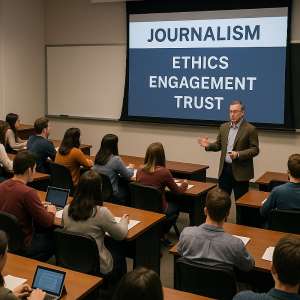
The crisis facing journalism education in Africa can no longer be ignored. For too long, universities have operated as if the media industry exists in a different universe. They keep producing graduates who can recite theories but cannot pitch, write, edit or fact-check to the standard of a modern newsroom. The result is predictable: media organizations are forced to retrain these graduates from scratch, wasting scarce resources on what should have been done at the university level. This gap between the classroom and the newsroom is widening by the day, and at the centre of it lies a stubborn refusal by journalism faculties to adapt.
The problem is not that African journalism schools lack talented lecturers or enthusiastic students. The real issue is that the curricula remain outdated and the faculty, in many cases, disconnected from the realities of contemporary media practice. While the world is moving at the speed of artificial intelligence, algorithm-driven news distribution and immersive storytelling tools, too many African journalism faculties are still trapped in the 1990s, teaching print-centric syllabi that have little relevance in today’s digital-first media economy.
This has dangerous implications, not just for graduates but for the credibility and sustainability of journalism itself. In an age where misinformation spreads faster than truth, we cannot afford to keep training journalists for a media environment that no longer exists. What is urgently required is a radical shift: journalism faculty members must be embedded within active newsrooms. This should not be optional; it must be mandatory. Only by working alongside editors, reporters and producers who are grappling with the daily challenges of modern journalism can faculty gain the practical insight needed to recalibrate journalism education for today’s realities.
Outdated Curricula
Across the continent, many journalism curricula are designed with little to no input from industry professionals. Modules are often recycled year after year with minor cosmetic adjustments. While students learn about inverted pyramids, objectivity and perhaps media law, they are rarely exposed to newsroom workflows shaped by algorithms, multimedia production or AI-assisted reporting.
For instance, few journalism schools in Africa have integrated courses on data journalism, drone journalism, mobile storytelling or verification tools for combating fake news. Even fewer have practical labs where students can experiment with AI-driven platforms that many global newsrooms already use. This academic lag means that graduates step into the industry with skills better suited to the past than the present.
Media employers feel the pain most acutely. Instead of onboarding graduates who are ready to contribute meaningfully, newsrooms spend time and money retraining them to handle basic tasks such as digital content production, social media optimization and fact-checking in high-velocity environments. In an era of shrinking newsroom budgets, this inefficiency is unsustainable.
Why Faculty Embedding in Newsrooms Is Essential
The heart of the problem lies not only in the outdated curricula but also in the limited industry exposure of many faculty members. Once appointed, too many lecturers spend decades within the university system, teaching theory but losing touch with the rapidly evolving dynamics of professional journalism. This isolation produces a dangerous loop: faculty teach outdated content, students graduate underprepared and the industry bears the cost.
Embedding faculty in newsrooms is the only practical solution. Just as medical educators must practice in hospitals to stay competent, journalism educators must immerse themselves in active newsrooms. This exposure ensures they are not teaching from memory or from textbooks alone but from lived, current experience. In practice, such embedding could take several forms:
Faculty Fellowships in Newsrooms: These fellowships would allow lecturers to spend at least one semester embedded in active newsrooms, not as passive observers but as working reporters, editors or producers. By being part of daily editorial meetings, breaking news coverage, and multimedia production, faculty gain firsthand experience with the challenges and innovations shaping contemporary journalism. They return to the classroom equipped with current skills, industry anecdotes and practical assignments that reflect real newsroom dynamics.
Dual Appointments: Under this model, journalism educators would split their time between universities and media houses, holding formal positions in both. For instance, a lecturer might teach courses during the academic year while also serving as a contributing editor or producer for a media organization. This arrangement ensures a constant flow of knowledge between academia and industry, students benefit from lecturers who are practicing professionals, while newsrooms gain access to research-based insights from the university.
Industry Sabbaticals: Similar to how academics take research sabbaticals, journalism faculty could be granted paid leave to work directly in media organizations for a fixed period. During these sabbaticals, lecturers could participate in investigative projects, digital strategy teams, or innovation labs. Upon return, they would not only bring updated skills and fresh perspectives but also build stronger partnerships between their universities and industry players, fostering collaboration in training, research and content production.
The goal is not to turn lecturers into full-time journalists but to ensure they are immersed in the evolving craft so they can adequately prepare their students.
Lessons from Elsewhere
Other regions offer valuable lessons. In the United States and parts of Europe, journalism schools increasingly collaborate with newsrooms on investigative projects, multimedia storytelling and even fact-checking initiatives. Faculty often serve as editors on student-industry collaborations, ensuring that teaching and practice are intertwined. For example, the Craig Newmark Graduate School of Journalism at CUNY embeds students and faculty into community reporting labs, producing journalism that serves actual audiences while doubling as a training ground. Similarly, the Reuters Institute at Oxford ensures that research and teaching are grounded in newsroom realities by maintaining strong ties with working journalists worldwide.
Africa cannot afford to lag further behind. In fact, the urgency here is greater because the continent is both the youngest demographically and the most vulnerable to misinformation. Without agile, well-trained journalists, African societies risk being overwhelmed by propaganda, conspiracy theories and disinformation campaigns.
The AI Imperative
The rise of artificial intelligence has further widened the gap between African journalism faculties and global industry standards. AI is no longer a futuristic concept; it is already shaping news production. From automated transcription and content personalization to AI-driven investigations that process massive data sets, these tools are now indispensable.
Yet, how many African journalism faculties can boast a single AI-centered module in their curricula? How many have labs where students learn to use machine learning tools for fact-checking or trend analysis? The answer is depressingly few.
This failure does not just disadvantage students; it threatens the credibility of journalism itself. In a world where deepfakes can undermine truth and bots can distort public opinion, the journalist’s role as verifier has never been more important. If our graduates lack the training to navigate this environment, journalism risks ceding ground to misinformation merchants.
Faculty embedding in newsrooms is crucial here because journalists are already experimenting with these tools. By working alongside them, educators can learn what works, what fails and how best to integrate AI into teaching.
Breaking the Academic-Industry Wall
The current divide between academia and industry is not only structural but also cultural. Universities pride themselves on theory and research, while newsrooms thrive on speed and pragmatism. The two worlds rarely intersect and when they do, the collaboration is often shallow.
To break this wall, governments, accreditation bodies and media associations must enforce reforms. Accreditation standards for journalism programmes should require evidence of faculty-industry immersion. Universities should not be allowed to run journalism programmes in isolation from the very profession they are supposed to serve.
Equally, media organizations must recognize their role. They cannot continue to complain about underprepared graduates while refusing to open their doors to faculty partnerships. If the profession is to survive, industry and academia must co-invest in building a talent pipeline fit for today’s challenges.
The Cost of Inaction
The danger of ignoring this crisis is stark. Journalism schools that fail to modernize risk becoming factories of irrelevance, producing graduates destined for underemployment or retraining. Media organizations, already struggling financially, cannot sustain the burden of fixing what universities refuse to address. Most importantly, societies will suffer. Journalism plays a critical role in democracy by holding power to account and informing citizens. If we continue to graduate journalists who lack the skills to do this effectively, we weaken not just the profession but democracy itself.
A Call to Action
Journalism education in Africa is at a crossroads. Universities must abandon their ivory-tower detachment and embrace a new model of embedded, industry-driven training. Faculty must step out of lecture halls and into newsrooms, where the real craft is being reshaped daily. Governments and accreditation bodies must enforce this shift, and media organizations must open their doors to collaboration. The alternative is grim: a steady stream of graduates who are irrelevant from day one, frustrated employers, and a society deprived of the journalism it needs.
This is not merely an academic debate. It is a question of survival, for journalism education, for the media industry and for democracy itself. The time for polite conversation is over. Journalism faculties must step into the newsroom or risk fading into irrelevance.
The writer, a PhD-holding journalist and international affairs columnist, focuses on geopolitics, education policy and journalism’s future. He is a journalism educator and member of GJA, IRE, CCIJ and AJEN. Contact: [email protected]


 Appointment of Emelia Agbenyo as EC deputy chair was well calculated, reasoned –...
 Relief for students as GAUA and TUSAAG call off strike; declare return to work o...
 Who gave Cabinet authority to decide for Ghanaians to join BRICS without parliam...
 Mahama urges Ghanaian businesses to tap CSIR innovations
 Partisan EC appointments could set dangerous precedent — NPP's Kamaldeen
 Winneba: Afenyo-Markin commissions police apartments at Fetteh-Osakam
 Council of State failed Mahama over Emelia Agbenyo’s EC appointment – Prof. Asa...
 CDD‑Ghana: EC Deputy Chair Should Step Down Now
 Family Announces October 23 Memorial Mass for Nana Konadu Agyeman-Rawlings
 Eduwatch Urges Nationwide Audit of Sexual Misconduct in Secondary Schools


