




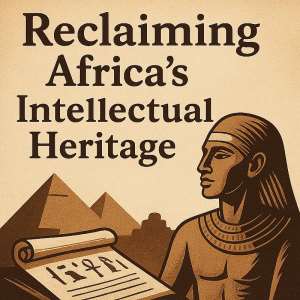
In the grand narrative of human civilization, Africa has often been cast as a passive recipient of knowledge rather than a birthplace of it. This is not because Africa lacked genius, but because empire rewrote the script. The conqueror’s pen did more than record history, it erased and replaced it.
Take Imhotep, the ancient Kemetic polymath who, more than 2,000 years before Hippocrates, diagnosed diseases, performed surgical procedures, and compiled medical treatises. His work is considered the earliest recorded practice of scientific medicine. Yet, in many classrooms worldwide, he appears as a mere footnote,if at all while Hippocrates is crowned the “Father of Medicine.” This is no accident; it is the quiet theft of intellectual heritage.
The same pattern runs through the story of Timbuktu, once a thriving centre of scholarship with hundreds of thousands of manuscripts on astronomy, mathematics, law, and literature. Colonial powers dismissed these achievements as primitive, only to later celebrate similar advancements when framed within European contexts. The brilliance of African metallurgy, the engineering of the Great Zimbabwe, the statecraft of the Mali Empire all reduced to curiosities rather than recognized as foundations of human progress.
This erasure is not just a matter of wounded pride. It shapes our present. When generations grow up believing that science, philosophy, and innovation are foreign imports, they approach the future as dependents rather than inheritors. Colonial education was designed precisely for this, to cultivate admiration for Europe and amnesia for Africa.
Reclaiming Africa’s intellectual heritage is therefore not nostalgia; it is a strategic necessity. We must tell the full story of Africa’s contribution to global civilization in our curricula, our media, and our cultural institutions. This means teaching Imhotep alongside Hippocrates, reading the manuscripts of Timbuktu alongside Aristotle, and placing Mansa Musa beside Europe’s so-called “great kings” in the public imagination.
The work is already underway. From scholars digitizing ancient African texts to educators introducing decolonized history modules, a quiet revolution is brewing. But it must grow louder. Governments, universities, and civil society must invest in research, translation, and public dissemination of Africa’s own archives.
History is a battlefield, and memory is the prize. If we do not reclaim our intellectual past, others will continue to define our intellectual future. Africa does not need permission to celebrate its genius, it needs the will to teach it, loudly and unapologetically.
Because the day Africa fully remembers who it is, the world will have to remember too.

 The week in pictures: Syria protests, Céline Dion on stage and Quito wildfires
 Nigeria's onion dispute with Ghana tests West African free trade
 Uganda suspends military ties with Turkey over extradition of Museveni critic
 US fears wider Middle East escalation after Houthi attack Riyadh
 Pop star Ed Sheeran calls Gaza situation “unjustifiable” amid controversy
 'We have spent 60years arguing about Nkrumah and rather less time doing what he ...
 Judge recounts attempted MoMo scam on him moments after jailing scammer
 'Systemic failure due to NACOC removal from port inspections' – Inusah Fuseini o...
 Foreign Affairs Ministry releases 200-page RTI response on GH¢49.7m South Africa...
 Chartered flights account for GH¢27.18m of South Africa evacuation cost


