




He couldn’t sit still.
Nine-year-old Kekle mounted his desk, tapped his pencil like a drumstick and blurted answers before questions were finished. The teacher sent him to the back. Again. His classmates called him “the noisemaker.”
Until one day, a special educator observed him and gently said:
“He’s not defiant. He may have ADHD.”
That sentence changed Kekle’s entire story.
What is ADHD?
Attention Deficit Hyperactivity Disorder (ADHD) is a neurodevelopmental disorder that affects attention, impulse control and self-regulation. It’s not a behaviour problem. It’s a brain-based difference in how children process, prioritise, and respond to information.
ADHD is typically grouped into three types:
- Inattentive type – struggles to focus, finish tasks, follow instructions
- Hyperactive-impulsive type – fidgeting, talking excessively, interrupting
- Combined type – a blend of both
“ADHD isn’t about not paying attention. It’s about paying attention to everything — all at once,” explains a renowned Clinical Psychologist is Accra.
When Does ADHD start?
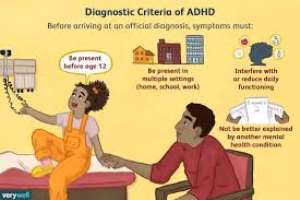
ADHD symptoms typically manifest before the age of 12. While some symptoms may be noticeable as early as age 3, diagnosis often occurs between ages 4 and 16. For a diagnosis, the symptoms must be persistent, noticeable for at least six months, and cause problems in multiple settings like home and school.
The Numbers: A Global Lens
- ADHD affects an estimated 5–7% of school-aged children globally (APA, 2021).
- In the U.S., over 6 million children have been diagnosed with ADHD.
- It is reported that in Africa, prevalence is underreported — but studies suggest 4–6% of children may meet diagnostic criteria.
- In Ghana, a 2023 study by the University of Ghana found that one in twenty schoolchildren exhibit signs of ADHD, yet less than 2% of these students receive a formal diagnosis, according to research by the Postgraduate Medical Journal of Ghana. This indicates a significant gap between the estimated prevalence of ADHD and the number of students receiving necessary support and treatment
Signs of ADHD in the Classroom
| Inattentive Type | Hyperactive-Impulsive Type |
| Forgets instructions | Can’t stay seated |
| Easily distracted by sounds or movement | Talks nonstop or interrupts others |
| Loses books, pencils, assignments | Climbs on furniture or runs around indoors |
| Doesn’t complete tasks | Acts before thinking |
| Appears to daydream or "zone out" | Can’t wait their turn |
These behaviours are often misconstrued as laziness, rebellion or lack of discipline.
“We punish what we don’t understand,” says a primary teacher in Wa.
“And in doing so, we lose children who are trying their best.”
What’s Really Going On in the ADHD Brain?
Brain imaging studies show that children with ADHD have delayed maturation in the prefrontal cortex — the part responsible for planning, inhibition, decision-making and organisation. This delay, typically around 3 years, is observed in the timing of peak cortical thickness, meaning the brain reaches its maximum thickness in these areas later than in typically developing children.
Additionally, dopamine and norepinephrine levels — neurotransmitters crucial for attention and reward processing behave differently.
It’s not that children with ADHD can’t focus. They just can’t regulate what they focus on, or for how long.
ADHD in Ghana: The Silent Struggle
In Ghana, ADHD is rarely diagnosed — and often mislabelled. Teachers report behaviour problems but hardly refer for assessment; parents fear stigma — many associate ADHD with spiritual causes or poor parenting.
Only 80 psychiatrists serving Ghana’s 35 million population – Mental Health Authority. That a publication by Myjoyonline.com on March 24, 2025.
“We once had a child with ADHD tied to a chair,” recalls a school counsellor. “They said it was for ‘classroom safety.’”
Strategies for Supporting ADHD Learners
1. Chunk Tasks and Give Breaks: Instead of 40-minute lectures, use 10–15-minute blocks with short stretch or movement breaks.
2. Use Visual Schedules: Children with ADHD often benefit from predictable routines and visual prompts.
3. Provide Fidget Tools: Small, non-distracting items (stress balls, textured erasers) help focus by channelling energy.
4. Seat Strategically: Place the child near the front — close to instruction, away from windows or noisy peers.
5. Use Positive Reinforcement: Acknowledge desired behaviours often — catch them being good.
6. Offer Choices: Give autonomy: “Do you want to write with pen or pencil?” Choice improves focus and motivation.
7. Allow Movement: Build in jobs – “Pass out the books,” “Hold the clock.” It turns energy into engagement.
Real Story: From Chaos to Confidence
At a school in Sunyani, 11-year-old Kobby was on the verge of being expelled for “aggressive behaviour.” But a visiting NGO-trained learning support specialist recognized signs of ADHD. Instead of suspension, the school tried a daily behaviour tracker with visual goals and a quiet corner for cool-downs; weekly “check-ins” with a mentor teacher.
In three months, incidents dropped by 70%. Kobby began helping lead group work and — to his teacher’s surprise — excelled in science experiments.
“He needed structure, not punishment,” she says.
“Now, he’s showing us who he really is.”
What the Research Says
- A 2022 meta-analysis in The Lancet Psychiatry found that behavioural interventions reduced ADHD symptoms by 42% in classroom settings.
- Studies point to the fact that mindfulness-based strategies improved emotional regulation in ADHD learners.
- Ghanaian pilot projects led showed that teacher training on ADHD led to about 50% drop in classroom disciplinary removals.
ADHD-Friendly Tools and Tech
| Tool/Strategy | Purpose |
| Time Timers | Visual countdown for transitions |
| Audio Books | Helps children who struggle to focus on written text |
| Classroom Calendars | Enhances organisation and routine |
| Task Boards | Breaks assignments into visible, manageable parts |
| Noise-Cancelling Headphones | Reduces distractions for better focus |
What Families Can Do
- Routines Matter: Predictability reduces stress
- Visual Reminders at Home: Charts for chores, bedtime, homework
- Focus on Strengths: Celebrate what they can do, not just what they can’t
- Work with Teachers: Share strategies that work at home
- Don’t Over-discipline: ADHD is not defiance — it’s dysregulation
Humour in the Journey
A teacher in Accra shared this:
“One child with ADHD asked me, ‘If my brain moves faster than your lesson, can I go outside until it catches up?’”
We laughed. Then we adjusted the lesson.
Ghana’s Way Forward
- Incorporate ADHD into teacher education and Special Education training.
- Strengthen school-based screening and referral systems.
- Scale up partnerships with NGOs offering behaviour and mental health services.
- Equip inclusive classrooms with behaviour-friendly resources and tech.
- Launch public awareness campaigns to reduce stigma and misinformation.
We must replace punishment with partnership. We should also understand that children with ADHD aren’t broken — the system is just unprepared.
Final Word: From Troublemaker to Trailblazer
What if Anyidoho or Achebe had been sent out of class for “daydreaming”?
What if Agatha Christie, who likely had inattentive-type ADHD, was never allowed to write?
What if Kekle was expelled — instead of understood?
When we support learners with ADHD, we aren’t just managing behaviour.
We are unleashing brilliance.
And we begin not by fixing the child — but by re-designing the environment so every child can succeed.
By James Attah Ansah
Website: https://jaansahpublications.com
By James Attah Ansah


 How IGP Yohuno led Police team to rescue victim, arrest four kidnappers in Assin...
 Akufo-Addo would have used Accra-Kumasi expressway for galamsey – Mahdi Gibrill
 Nigeria's Dangote refinery launches continent's biggest IPO
 Accra-Kumasi Expressway to cut travel time to 2hours, drive 120km per hour — Mah...
 'Our own money $2billion ready, we have not gone to borrow money from anywhere' ...
 Founder’s Day September 21 declared public holiday
 Council of State was not qualified to determine prima facie case against Torkorn...
 'Grounds for removal of Chief Justice and justice of superior court shallow, eph...
 Don't be a Bar that flips on principles but a Bar that is consistent — AG tells ...
 Prostate cancer may show no symptoms until advanced stage – Urologist warns


