




A few years back, over coffee at one of Addis Ababa’s business hotels, I found myself in conversation with an executive from a textile company operating in one of Ethiopia’s industrial zones. His firm had survived the usual hurdles: currency swings, unstable power supply, even moments of local unrest. But those were not the things that kept him awake at night. What really worried him was logistics, specifically, the rising costs and growing unpredictability of moving goods in and out of Ethiopia through just one port corridor.
That conversation has stayed with me, and in light of Ethiopia’s recent attempts to re-secure maritime access, it feels more relevant than ever. The January 2024 memorandum of understanding signed with Somaliland, proposing port and naval access on the Gulf of Aden, has sparked both national debate and international headlines. Most of the public discussion so far has focused on geopolitics, national identity, and diplomatic implications. Yet the real issue at the core of Ethiopia’s maritime push is economic, not symbolic.
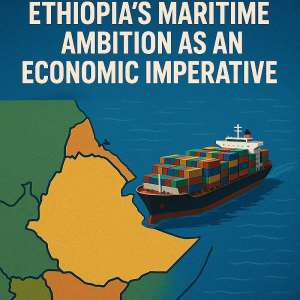
Ethiopia is not seeking a coastline for prestige. It is responding to a structural challenge that threatens its long-term growth: a logistics model that is increasingly expensive, risky, and unsustainable. The data is clear. Every year, Ethiopia spends between 1.5 and 1.6 billion dollars on port handling, transit fees, and inland transport, most of it tied to Djibouti. Over 95 percent of the country’s imports and exports currently pass through this single corridor. This level of dependency is not just a geopolitical risk; it’s an economic drag that affects businesses, jobs, and the broader development agenda.
Moving a single container via the Djibouti corridor costs expensively than expected these days. For perspective, that puts Ethiopia among the most expensive inland trade routes in Africa. These costs don’t just affect shipping companies. They ripple across the entire economy. Exporters lose competitiveness. Manufacturers in industrial parks see their margins shrink. Foreign investors, who often look at logistics efficiency before making location decisions, hesitate and shift their focus to neighbouring markets. And consumers, in the end, bear part of the cost.
This is not merely a problem for today. It has implications for Ethiopia’s ability to realize its ambitions of becoming a manufacturing hub in Africa, a goal that requires efficient supply chains. Integration into the African Continental Free Trade Area also becomes complicated when logistics remain this expensive. Trade agreements open doors, but without affordable ways to move goods, the benefits stay limited.
In practice, global investors are no longer just interested in low labor costs or tax incentives. They want to know about infrastructure, particularly logistics. When international firms conduct due diligence before entering the Ethiopian market, they routinely ask: How predictable are the supply chains? How long does it take to move goods to port? What happens if the corridor faces a disruption? If the answers raise concerns, investors will often look elsewhere.
Ethiopia’s current setup leaves no room for supply chain mistakes. If Djibouti’s port faces delays or political tensions arise, Ethiopian trade grinds to a halt. That’s not a hypothetical risk, it’s a lived reality for many firms. The longer Ethiopia remains dependent on a single route, the more difficult it will be to convince businesses, both local and foreign, that manufacturing here makes sense.
This is why diversifying port access is no longer just a development aspiration—it’s a business necessity. Other landlocked countries have recognized this and acted. Rwanda, for instance, has invested in dry ports and linked its supply chains to Tanzanian ports to reduce over-reliance on one trade route. Uganda and South Sudan are also working to avoid single-corridor dependencies. For Ethiopia, given its population size and economic ambition, the stakes are even higher.
At the same time, this issue is not just about reducing logistics costs. The broader global context matters. In recent years, supply chain resilience has become a core concern for governments and private companies alike. Global trade disruptions from pandemics to regional conflicts, have forced everyone to rethink logistics strategies. Countries and corporations are now prioritizing flexibility and risk management, not just speed or price. Ethiopia’s logistics model, as it stands, offers neither.
Maritime access also links directly to economic security. Ethiopia moves billions of dollars’ worth of goods through international waters each year, even without having a navy or ports of its own. Having some role—whether through regional agreements, leased facilities, or legal partnerships—in securing trade routes is fast becoming a necessity, not a luxury. That doesn’t mean Ethiopia needs to build a large military navy, but it does mean thinking strategically about protecting commercial corridors, maintaining infrastructure, and ensuring trade continuity in the face of regional risks.
Of course, there are differing views. Some argue that Ethiopia should simply deepen its cooperation with Djibouti rather than seek new options. Others worry about the diplomatic and financial risks of expanding maritime interests. These perspectives are valid and deserve consideration. But what’s often missing from the debate is an honest assessment of the cost of inaction. Overdependence on a single trade route has already proven to be a drag on growth. One disruption—be it logistical, political, or natural, can bring billions of dollars in trade to a standstill. In today’s fast-paced global economy, that level of exposure is not just inconvenient; it is untenable.
High logistics costs also undermine Ethiopia’s industrialization drive. No matter how cheap the labor or how abundant the land, manufacturers cannot compete globally if transportation eats up too much of the budget. This is why port diversification is directly tied to Ethiopia’s larger economic goals. It is not about flexing national pride or making symbolic moves on a map. It is about fixing a real structural barrier to growth.
The country’s maritime ambition should be understood as a practical adjustment to economic reality. Reducing transaction costs, opening new trade routes, and improving competitiveness are all part of this process. So is creating a more stable and predictable investment environment. Ethiopia must build the kind of infrastructure system that supports jobs, exports, and regional influence, not in theory, but in day-to-day practice.
Geography cannot be changed, but access can. Through partnerships, infrastructure development, and careful negotiation, Ethiopia can move from being landlocked to being land-linked. That shift requires thinking beyond old models. It requires a new mindset about trade, security, and industrial growth.
Moving forward, Ethiopia needs to continue pursuing agreements that expand port access while developing the supporting logistics infrastructure at home, dry ports, rail networks, customs systems, and storage facilities. This will not happen overnight, and it won’t be without diplomatic complexity. But the alternative, continuing with the status quo, is far riskier in the long run.
For Ethiopia, the journey toward industrialization and broader regional influence will ultimately depend on solving the logistics puzzle. Access to the sea is part of that solution. It is not just a strategic option anymore, it is an economic imperative.

Mikiyas Mulugeta G. Yohannes (PhD) ( [email protected] ) is a Consultant and Director of Training and Development Programs at the Centre for African Leadership Studies (CALS)/XHub-Addis.


 From the Acropolis, Rubio calls on Europe to emerge from ‘slumber’
 Mahama proposes financing scheme to help Ghanaians complete unfinished houses
 'Free SHS not in crisis; it was suffering under you and we reviewed it' – Haruna...
 Mahama orders sanctions for officials who fail to enforce building safety rules
 2026 World Cup: Minority alleges how GTA charged $7,000–$14,000 for visa process...
 Mahama announces GHS1bn for revolving National Housing Fund
 PAC orders CWSA to recover GH¢2.5m public debt within 30 days
 Former NPP chairman Samuel Odoi-Sykes dies
 Stop taping, gluing damaged cedi notes for re-issuance – BoG tells Ghanaians
 NPP keeps pressing the self-destruction button by doing things anyhow – Akwatia ...


