




Picture this: It’s Monday morning in a packed classroom at Gabi M. A. Basic School. Madam Adzo walks in, books in hand, chalk in pocket, ready to conquer Pythagoras Theorem. She turns, faces her class and says, “Who can explain this formula?” Kormi’s hand shoots up. Again. It always does.
But in the back, Esi is doodling, Yaw is staring at the ceiling (which spins like it’s tired of life) and little Kofi is chewing his pencil like it owes him money.
The problem? The class is built for the “Kormis”—the fast responders, the textbook lovers, the “raise-your-hand-before-I-finish-the-question” types.
The solution? Say hello to Universal Design for Learning (UDL), a teaching framework that says, Hey teacher, perhaps it’s the lesson that needs fixing, not the child.
What is UDL—and is it Sold at Makola?
No, you won’t find it in Makola Market. But UDL is every bit as essential as gari during food shortages.
Universal Design for Learning is about tailoring education for everybody—not just the top of the class. It means planning your lessons so every child, regardless of ability, learning style or background, can participate meaningfully.
Think of it like designing a building. If you only put stairs, you exclude the fella in a wheelchair. Add a ramp, and boom—everyone gets in. That’s UDL in action.
Three Secrets of UDL (That Shouldn't Be Secret)
Multiple means of representation: Give students info in different ways. Videos, real-life demos, local language translations, memes, you name it.
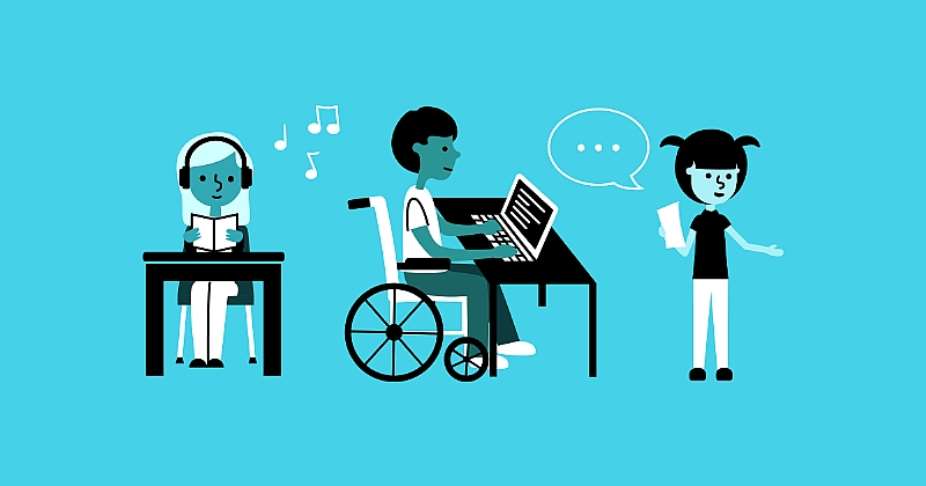
Multiple means of action and expression: Let students show understanding in various formats: drama, drawing, song, even rap (as long as they don’t rap “math” for “bath”).
Multiple means of engagement: Make lessons interesting enough that students don’t fake stomachaches to skip them.
How Ghanaian Teachers Are Already Doing UDL (Without Knowing It)
Let’s go to Kpong, where Mr. Akyea uses storytelling to teach history. Instead of listing dates, he tells tales: how Nkrumah's shoes got stolen at the airport, and how independence was like breaking up with a controlling partner. Suddenly, even Kwabena, the class joker, is listening.
Or over in Elmina, Madam Hilda noticed that Yaa, who is shy and struggles with writing, lit up when acting. So now, she allows her to act scenes from the literature texts. Guess who got the highest score in English oral presentation?
Even in Togbekope, where internet is patchy and textbooks are rare, a teacher uses local songs to teach science. “Photosynthesis” becomes a catchy chorus. Everyone sings along—even the kid who can’t spell “leaf.”
But What About Overcrowded Classrooms and Broken Ceilings?
Yes, Ghanaian classrooms face actual challenges. Some have 60 students, one duster, and a blackboard that’s black only in theory.
But UDL isn’t about fancy tools. It’s about intentionality. It asks: “Have I given all learners a way to access this lesson?” Sometimes, that just means explaining things twice—once in English, once in the native language. Or giving students a choice: “Do you want to write a paragraph, draw a diagram or explain orally?”
It’s small changes with big results.
The Real Power of UDL? It Levels the Learning Field
Inclusive education in Ghana is often misunderstood as just “including children with disabilities.” But UDL goes further: it’s about recognizing that all children learn differently—some by reading, some by doing and some...
Imagine if we designed lessons like we cook jollof. Some want it peppery. Others like it mild. But no one should go hungry because the cook only made one kind.
Conclusion: If Learning Was a Market...
UDL reminds us that if learning was a market, no one should be priced out. The girl who can't hear well, the boy who writes slowly, the child who thinks better while moving—all deserve a stall.
So, let’s stop designing classrooms for the perfect student who only exists in textbooks. Let's teach for real kids—fidgety, diverse, sometimes confusing, always full of potential.
Because if we teach every child the same way, only the Kormis will shine. But when we teach with UDL, every child gets a chance to be brilliant—without having to pretend they’re Einstein with perfect handwriting.
By James Attah Ansah
Website: https://jaansahpublications.com


 How IGP Yohuno led Police team to rescue victim, arrest four kidnappers in Assin...
 Akufo-Addo would have used Accra-Kumasi expressway for galamsey – Mahdi Gibrill
 Nigeria's Dangote refinery launches continent's biggest IPO
 Accra-Kumasi Expressway to cut travel time to 2hours, drive 120km per hour — Mah...
 'Our own money $2billion ready, we have not gone to borrow money from anywhere' ...
 Founder’s Day September 21 declared public holiday
 Council of State was not qualified to determine prima facie case against Torkorn...
 'Grounds for removal of Chief Justice and justice of superior court shallow, eph...
 Don't be a Bar that flips on principles but a Bar that is consistent — AG tells ...
 Prostate cancer may show no symptoms until advanced stage – Urologist warns



Comments
Very inspiring and wisdom filled message, Thank you