




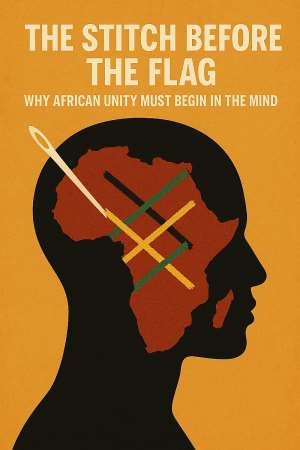
"You cannot unite the body of Africa when the soul remains colonized." - Abubakar Isah
Africa has long dreamed of unity. From NkrumTheah’s bold vision of a United States of Africa to Gaddafi’s continental ambition, the idea has floated like a banner of liberation above decades of struggle, speeches, and summits. Yet, the continent remains fragmented not just by colonial borders, but by mental fences: linguistic rivalries, tribal suspicions, inferiority complexes, and foreign allegiances. The problem is not merely geographical. It is psychological.
Before we raise a flag for continental unity, we must stitch its fabric one woven from shared values, revived memory, and healed identity. This is the work of the mind. It is where true freedom begins.
Colonialism Didn’t End - It Mutated
The colonizer’s greatest success was not in drawing arbitrary borders or exploiting mineral wealth. It was in altering how the African sees himself. Through education systems that erased precolonial brilliance, through religions that demonized indigenous cultures, and through languages that made African tongues seem vulgar colonialism embedded itself in our consciousness.
We were taught to admire foreign heroes while forgetting our own. Timbuktu became a myth, not a milestone. The pyramids became the property of tourists, not of legacy. To this day, many African children still learn about Europe’s Enlightenment but remain blind to the intellectual fire of ancient Mali, Ife, or Axum.
A disunited mind cannot build a united state.
Language: A Tool or a Trap?
English, French and Portuguese are the languages of instruction, governance, and diplomacy across most of Africa. But they are also the languages of alienation. They separate the educated from the uneducated, the elite from the masses, and one region from another.
True African unity cannot thrive if our people are not speaking to each other with understanding. We must explore a multilingual future where African languages are taught, translated, digitized, and preserved where Swahili, Hausa, Yoruba, Amharic, and others connect rather than divide.
Language, if decolonized, can become a bridge. But when imposed, it remains a cage.
Reclaiming the African Self
The European did not come with only a sword; he came with a story. A story that said Africa was primitive, dark, and broken in need of saving, managing, and civilizing. Unfortunately, many of us have inherited that story and continue to live within it.
A new United Africa must begin with a new African story: one that affirms dignity, recalls genius, and celebrates struggle. This means revising our history books, rethinking our heroes, and returning to our roots not in nostalgia, but in clarity.
Unity begins when Africans no longer see each other as “foreigners,” but as siblings of a shared struggle.
Pan-Africanism as Cultural Immunity
Pan-Africanism is not a museum relic. It is not a slogan or a scarf. It is a cultural immune system, built to defend the continent against the spiritual, economic, and psychological viruses left behind by colonialism.
Today, Pan-Africanism must be revived in our art, education, media, and homes. It must be lived not just quoted. A Nigerian should be able to feel kinship with a Ghanaian, a Senegalese with an Ethiopian, not because of continental borders, but because of a shared vision of justice, dignity, and destiny.
Let the young not inherit disunity as normal. Let the old pass down not only wisdom but pride in Africa’s possibility.
Conclusion: The Flag Will Fly, But Stitch First
Africa will not unite by the stroke of a politician’s pen. Nor will unity emerge simply by constructing shared institutions. It must be born in the silent, personal revolution of thought in classrooms, poetry, films, prayers, street corners, and conversations like this.
Before we raise the flag of African unity, let us stitch its fabric mind by mind, soul by soul.
The United States of Africa is not just a political destiny. It is a mental journey.
Let’s begin.

 The week in pictures: Syria protests, Céline Dion on stage and Quito wildfires
 Nigeria's onion dispute with Ghana tests West African free trade
 Uganda suspends military ties with Turkey over extradition of Museveni critic
 US fears wider Middle East escalation after Houthi attack Riyadh
 Pop star Ed Sheeran calls Gaza situation “unjustifiable” amid controversy
 'We have spent 60years arguing about Nkrumah and rather less time doing what he ...
 Judge recounts attempted MoMo scam on him moments after jailing scammer
 'Systemic failure due to NACOC removal from port inspections' – Inusah Fuseini o...
 Foreign Affairs Ministry releases 200-page RTI response on GH¢49.7m South Africa...
 Chartered flights account for GH¢27.18m of South Africa evacuation cost


