




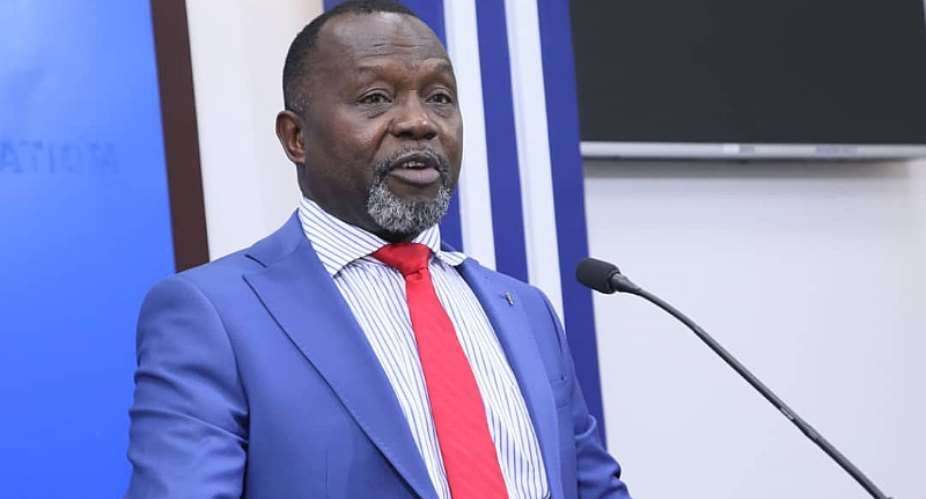
Attorney-General and Minister for Justice, Dr. Dominic Akuritinga Ayine, has mounted a strong defence of his decision to halt the criminal prosecution of former Finance Minister Dr. Kwabena Duffuor and others involved in the UniBank case, arguing that pursuing non-conviction-based asset recovery offers a more effective and strategic path to protecting public funds.
Speaking at the Government Accountability Series on Monday, Dr. Ayine confirmed that on July 22, 2025, the state formally entered a nolle prosequi in the case of The Republic vs. Kwabena Duffuor and Seven Others, bringing an end to the years-long criminal trial.
He explained that the decision followed extensive negotiations between state prosecutors, the Receiver of UniBank, and the defence lawyers. It was driven by a recalibrated strategy that prioritises recovering assets over pursuing criminal convictions that may yield no financial returns.
The original GH¢5.7 billion financial exposure, which formed the basis of the case, was revised after a detailed reconciliation exercise. Fictitious accounting entries amounting to GH¢2.1 billion were removed, and GH¢300 million lodged with Unisecurities—already under liquidation by the Securities and Exchange Commission—was excluded. This reduced the state’s exposure to GH¢3.3 billion.
In response, the accused proposed a structured recovery plan that included GH¢824 million in landed properties already transferred to the Receiver, active assistance in retrieving GH¢1.2 billion from third-party beneficiaries, and a commitment to cover any remaining shortfalls through further asset sales.
Dr. Ayine disclosed that GH¢500 million of the third-party funds has already been recovered. The outstanding GH¢700 million is expected within 18 months, along with additional proceeds from the ongoing disposal of assets. Oversight of the process will be jointly handled by the Attorney-General’s Office, the Bank of Ghana, and the Ministry of Finance.
While critics have slammed the move as leniency disguised as pragmatism, Dr. Ayine dismissed allegations that the accused had been allowed to “keep 40% of the loot.”
“The evidence did not establish that any of the accused personally enriched themselves,” he stated, adding that the charges related to financial loss and falsification of accounts—not direct theft of public funds.
He acknowledged that while a full cash recovery would have been ideal, the structured agreement represents the most realistic route toward retrieving significant value for the state, especially in light of legal precedent.
Dr. Ayine cited previous cases, such as Bej Capital, where the state opted for prosecution over settlement and ended up recovering nothing. That experience, he argued, underscores the need for a more flexible, results-driven approach.
He grounded his decision in Ghana’s legal framework, referencing Section 35 of the Courts Act (Act 459) and the Plea Bargaining Act, both of which empower the Attorney-General to pursue restitution in lieu of prosecution when it serves the national interest.
“Recovering stolen resources and jailing looters are not mutually exclusive,” he said. “But where conviction is uncertain and assets may be lost forever, recovery through negotiation is not a compromise—it is accountability.”
Dr. Ayine reaffirmed that custodial sentences will still be pursued where necessary, but insisted that the public purse cannot be protected solely through drawn-out court battles.
Updates on Other Cases
The Attorney-General also offered updates on other high-profile investigations and prosecutions. He said the trial of Bank of Ghana Governor, Dr. Ernest Addison, is ongoing with prosecution witnesses already testifying. The SkyTrain case is progressing despite delays related to changes in legal representation and health concerns.
On the National Service Scheme scandal, Dr. Ayine revealed that investigations into a GH¢189 million transfer involving the Bank of Ghana are advancing. So far, GH¢80 million remains unaccounted for. Eight suspects, including former National Service officials, have initiated plea negotiations with the state.
Prosecution dockets on other major cases—including the All-Africa Games scandal, buffer stock mismanagement, and Akonta Mining—are either completed or in their final stages.
Dr. Ayine concluded by reiterating his commitment to a balanced approach that ensures justice while securing tangible outcomes for the country.
“We are determined to hold wrongdoers accountable—whether through the courtroom or through lawful, transparent settlements that prioritise the national interest,” he said.
 Government to introduce ID verification for access to porn sites — Sam George
 African governments failing on commitments to increase agriculture funding — Eri...
 45-year-old ex-convict arrested over alleged rape and murder of wife's 17-year-o...
 We’re working to provide shelter for police officers displaced after barracks fi...
 No arrests made over Accra Central Police Barracks fire yet — Police
 Mahama told UK Prime Minister anti-LGBTQ+ bill is far from becoming law — Minori...
 Leaked judgment? NDC activists confirms jail term for Wontumi on social media
 Minority demands passage of original 2024 anti-LGBTQ+ bill, accuses NDC of decep...
 "Flagrant disrespect" — Court remands Abronye over failure to surrender passport...
 High Court remands Abronye over failure to surrender passport


