




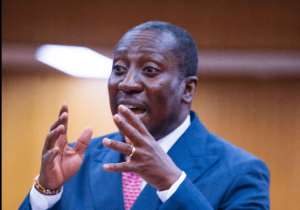
Ghana’s Parliament descended into political theatre once again on July 22, 2025, when the Minority side staged a dramatic walkout during the swearing-in of Ewurabena Aubynn, the newly elected Member of Parliament for Ablekuma North. The incident, sparked by a procedural disagreement, was far more than a mere walkout. It symbolised a growing trend of obstructionism that has come to define the conduct of the current Minority under the leadership of Alexander Afenyo-Markin.
The Minority, led on the floor by their Chief Whip, protested the Speaker’s refusal to allow them to raise concerns about the electoral irregularities surrounding the July 11 rerun election in Ablekuma North before the swearing-in could take place.
The Speaker, Alban Bagbin, ruled that such statements could only be made after the swearing-in. That ruling was enough for the Minority to stage a walkout, declaring they could not participate in what they deemed a flawed process. Despite their absence, the swearing-in proceeded, with Aubynn officially becoming a member of the House.
A pattern of obstruction
This was not an isolated event. It fits squarely into a pattern of deliberate disruption and symbolic resistance adopted by the Minority in Ghana’s current Parliament. Under the stewardship of Afenyo-Markin, the Minority has cultivated a strategy rooted in boycotts, staged absences, quorum frustrations, and procedural ambushes. In debates on budget allocations, ministerial vettings, and legislative approvals, the Minority has increasingly turned to tactical disengagement as a political weapon.
The Minority’s tactics amount to an abandonment of their constitutional responsibility. Parliament is not a battlefield of egos, nor a stage for showmanship. It is an institution of accountability, debate, and consensus-building. When parliamentary business is constantly interrupted by walkouts, the citizens lose, not just the Majority.
The rise of the “micro-minority” and Afenyo-Markin’s role
At the heart of this obstructionist style of opposition is Minority Leader Alexander Afenyo-Markin. In his role as a “micro-minority” leader, a term that refers to the numerical weakness of the Minority in this Parliament and the narrowness of their political scope under his leadership, Afenyo-Markin has cultivated a style of engagement that leans heavily on confrontation rather than persuasion.
His Minority seems more interested in controlling narratives and optics than in influencing policy direction or legislation. The Ablekuma North incident is a textbook case. Rather than using the moment to raise objections constructively or build cross-party consensus, the Minority chose to abandon the process altogether, leaving the floor and the debate to their rivals.
This irresponsible behaviour reflects a deeper insecurity within the Minority ranks. Facing a super-majority NDC and weakened by internal fractures, Afenyo-Markin’s caucus seems to have adopted symbolic resistance as its main mode of relevance. But symbolic resistance, if overused, becomes political noise rather than meaningful dissent.
The cost of political grandstanding
There are consequences to this kind of politics. First, the institutional credibility of Parliament suffers. When MPs walk out of sessions that they were elected to participate in, they diminish the public’s trust in democratic institutions. Second, the Minority risks alienating the very electorate it claims to fight for. Voters are not blind to disruption. They see through grandstanding when it lacks substance or results.
Moreover, walkouts do little to change outcomes in a Parliament where the numbers are not in the Minority’s favour. What they do achieve, however, is media attention, and perhaps that is the point. In a political climate driven increasingly by soundbites and social media moments, disruption sells.
But attention is not influence. The more the Minority relies on exit tactics and symbolic absences, the more they forfeit their chance to shape legislation, hold the Majority accountable, and present themselves as a government-in-waiting.
A call for strategic opposition
It is not too late for the Minority to reimagine its role. A vibrant opposition is essential in any democracy. But opposition must be strategic, thoughtful, and responsive to the needs of the people. The parliamentary floor must be a space for argument, not abandonment.
If Afenyo-Markin wants to leave a legacy as more than a minority showman, he must recalibrate. Ghana needs an opposition that chooses engagement over evasion, critique over complaint, and substance over symbolism. The time has come to shift from obstruction to construction.
The walkout during the swearing-in of Ewurabena Aubynn was more than political drama. It was a revealing moment about the nature and future of opposition politics in Ghana. And unless the Minority changes course, it risks becoming remembered not for what it stood for, but for when it walked away.
*Dr Moses Deyegbe Kuvoame is an Associate Professor at the University of South-Eastern Norway. He is also a member of the NDC Nordic Chapter Policy Team.


 Household waste fees could fall to GH¢50 every two weeks under new system — Ayar...
 Tamale: Three missing children found dead inside parked vehicle at Koblimahagu Z...
 Kojo Bamba’s election projects mindset of violence, it’s backward politics – Mus...
 'You can expose corruption without insulting people's humanity' — Agyinasare on ...
 Prof Mike Ocquaye backs Kojo Bamba’s Vice Chair election, cites need to protect ...
 I was not part of any negotiation to swap NPP vice chair positions with Bamba – ...
 NPP is not putting ‘old wine in new bottles’ – Ibrahim Adjei on new executives
 John Boadu comes nowhere near Asiedu Nketiah in terms of pedigree, gravitas, val...
 Gov’t renames 24-hour economy markets as District Economy Markets, targets 100% ...
 BoG, Police arrest 7 in Accra over alleged use of cedi notes for money bouquets,...


