




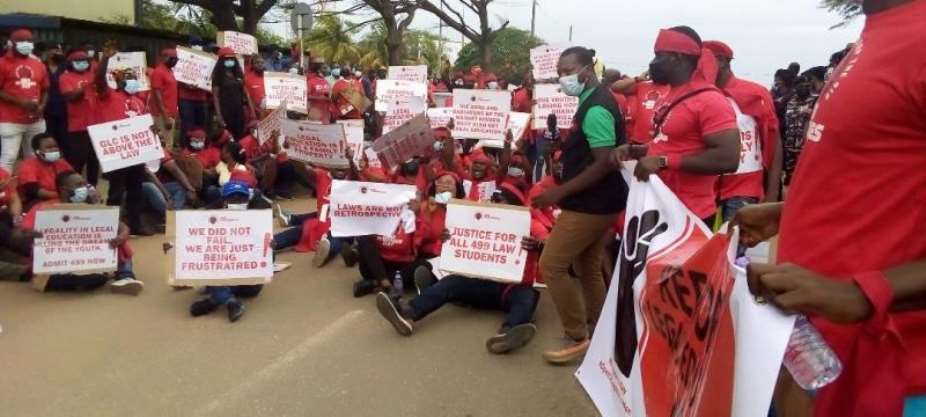
Ghana’s legal education system needs urgent reform to remove restrictive barriers and create a fair, modern pathway for aspiring lawyers across the country
For decades, Ghana’s professional legal training system has been locked in an exclusive arrangement with one institution — the Ghana School of Law (GSL). A model once built for quality assurance and centralization has, over time, evolved into a bottleneck that threatens both justice delivery and the dreams of thousands of aspiring lawyers .
The time has come for Ghana to move beyond a monopolistic model of legal education. And this month, Parliament appears poised to do just that.
The Legal Education Reform Bill, currently under consideration, proposes a fundamental change: allowing accredited public universities to offer professional law training, backed by a national bar exam framework. While it’s taken years of frustration, mass rejections, and public outcry to get here, this bill — if passed — could transform the future of legal access in Ghana .
A System Under Strain
The limitations of Ghana’s current system are not theoretical. In 2021, more than 499 qualified LLB holders were denied entry into the GSL despite passing their entrance exams — a scandal that drew public outrage and exposed the arbitrary nature of access to professional legal training . Every year since has followed a similar trajectory: thousands apply, only a fraction are admitted.
This has created a parallel crisis: a backlog of qualified students with no clear path forward, many of whom now turn to foreign institutions or give up entirely. In a country where access to justice already has geographic and economic inequalities, choking the supply of legal professionals only deepens the problem.
A Reform Long Overdue
Critics of the monopoly, like legal academic Prof. Kwaku Asare , have long called for the liberalization of legal education. He notes that Ghana is one of the few countries in Africa where a single institution controls professional legal access. Other jurisdictions — like Kenya — have successfully diversified training institutions while maintaining high national standards through bar examinations.
The reform bill aims to follow suit. Key features include:
Opening professional legal education to all accredited universities .
National bar exams to serve as the final qualifying benchmark.
Biannual bar exams to offer multiple pathways within a calendar year.
A Legal Education Council to regulate curriculum and standards .
This is not deregulation — it's structured decentralization, and it mirrors how countries like the U.S. and U.K. have managed legal education.
What Are the Stakes?
Access to legal training is not merely an academic issue. It touches on employment , constitutional rights , and national development. Ghana's judiciary cannot be strong if its legal pipeline is artificially constrained. Nor can citizens enjoy equal protection under the law if legal services are inaccessible or unaffordable due to a lack of qualified practitioners.
Additionally, Ghana’s ambitions to become a regional hub for dispute resolution and investment require a well-resourced and accessible legal system . That cannot be achieved if professional training remains limited to a single institution with finite capacity.
Guardrails, Not Gatekeepers
Concerns have been raised about maintaining quality if more institutions are allowed to train lawyers. These are valid — but solvable. Accra Street Journal believes that rigorous national bar exams, clear institutional benchmarks, and active oversight can safeguard standards. The goal is not to lower the bar, but to widen the gate for those who can meet it.
It’s time to build guardrails, not maintain outdated gatekeepers.
A Vote for the Future
The Legal Education Reform Bill represents a generational opportunity. It is an inflection point not only for law students, but for Ghana’s justice system, economy, and democratic health . As debates continue in Parliament, we urge lawmakers to keep the broader vision in sight — a Ghana where legal access is not rationed, but responsibly expanded.
A single law school may have served us in the past. But the future demands something bolder — and more inclusive.
Accra Street Journal is committed to covering structural reforms that shape Ghana’s institutions, justice, and economic future. Follow Accra Legal Journal on Accrastreetjournal.com for more updates on Ghana’s education and justice systems.


 Credit Godfred Dame for Ghana's US$393 million tax arbitration victory against T...
 How can EOCO be accused of wanting to kidnap Baffour Awuah in full glare of the ...
 'She is not party operative' – Kwakye Ofosu defends EOCO officer
 Baffour Awuah wanted over alleged financial loss, dissipation of public funds an...
 Brazil is the main source of cocaine in Ghana by sea concealed in sugar containe...
 'The cacophony of noises surrounding my comments were pure mischief' — Chief Jus...
 ‘Judges must not abandon their humanity because of their judicial office’ – Chie...
 GTEC flags over 100 tertiary institutions as unrecognised
 Political protection may be behind decline in visible cocaine trafficking in Gha...
 Ghana identified as source of explosives used in Sahel conflicts — Crime Index r...


