




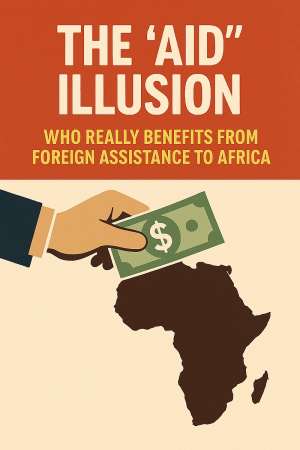
In the grand halls of global diplomacy and donor conferences, foreign aid to Africa is often paraded as an act of benevolence a lifeline extended by wealthier nations to lift the continent out of poverty. But behind the press statements, photo ops, and flashy project launches lies a complex and uncomfortable truth: aid is not charity. It is strategy. And more often than not, it benefits the giver more than the receiver.
For decades, Africa has received billions of dollars in foreign assistance. Yet many of its nations remain stuck in the same cycle of underdevelopment, debt, and dependency. Why? Because aid, in its current form, is designed less to empower African nations and more to preserve the global economic order that keeps them weak.
Let’s begin with the tied aid system, where donor countries provide financial support only if the recipient agrees to buy goods or services from them. This practice inflates costs and limits local participation, ensuring that the bulk of the money flows back to foreign contractors, consultants, and corporations not the people it was meant to help. It's a clever loop: money leaves Washington or London with one hand and returns with the other, wearing the mask of altruism.
Then there’s the issue of non-governmental organizations (NGOs) many of which are foreign-funded and foreign-led. While some do important work, many operate with top-heavy bureaucracies, high administrative costs, and limited local input. They compete for funding, replicate efforts, and sometimes function more as vehicles for foreign influence than agents of real change. A young African graduate might earn $100 a month working on a donor project while a foreign “expert” overseeing it earns $10,000 for advice that may be out of touch with local realities.
Even more troubling is how aid comes tied with strings that control policy. Structural Adjustment Programs (SAPs) imposed by the World Bank and IMF in the 1980s and 1990s forced African governments to cut spending on healthcare, education, and subsidies in exchange for loans. These programs devastated public services and deepened inequality all in the name of "fiscal discipline."
Today, the aid illusion continues through climate finance, humanitarian assistance, and development loans, often coated in the language of partnership. Yet the pattern remains the same: foreign interests shape the agenda, and African governments are left with little room to design policies that truly reflect their people’s needs. Meanwhile, domestic industries are stifled, traditional knowledge is dismissed, and innovation is sidelined.
Of course, not all aid is harmful. In emergencies like floods, famine and epidemics humanitarian support can save lives. And there are donor programs that genuinely build capacity and promote long-term development. But these are the exception, not the rule.
What Africa needs is not more aid, but more autonomy. Trade, not charity. Investment, not instruction. Respect, not rescue. Our greatest assets lie not in the hands of foreign benefactors, but in the minds of our people, the strength of our soil, and the richness of our cultures. It’s time we turn inward and upward.
Foreign aid, as currently structured, is not a gift. It is a system, a business cloaked in compassion. Until Africa reclaims its voice and charts its own course, we will continue to dance to tunes we did not compose.


 The week in pictures: Syria protests, Céline Dion on stage and Quito wildfires
 Nigeria's onion dispute with Ghana tests West African free trade
 Uganda suspends military ties with Turkey over extradition of Museveni critic
 US fears wider Middle East escalation after Houthi attack Riyadh
 Pop star Ed Sheeran calls Gaza situation “unjustifiable” amid controversy
 'We have spent 60years arguing about Nkrumah and rather less time doing what he ...
 Judge recounts attempted MoMo scam on him moments after jailing scammer
 'Systemic failure due to NACOC removal from port inspections' – Inusah Fuseini o...
 Foreign Affairs Ministry releases 200-page RTI response on GH¢49.7m South Africa...
 Chartered flights account for GH¢27.18m of South Africa evacuation cost


