




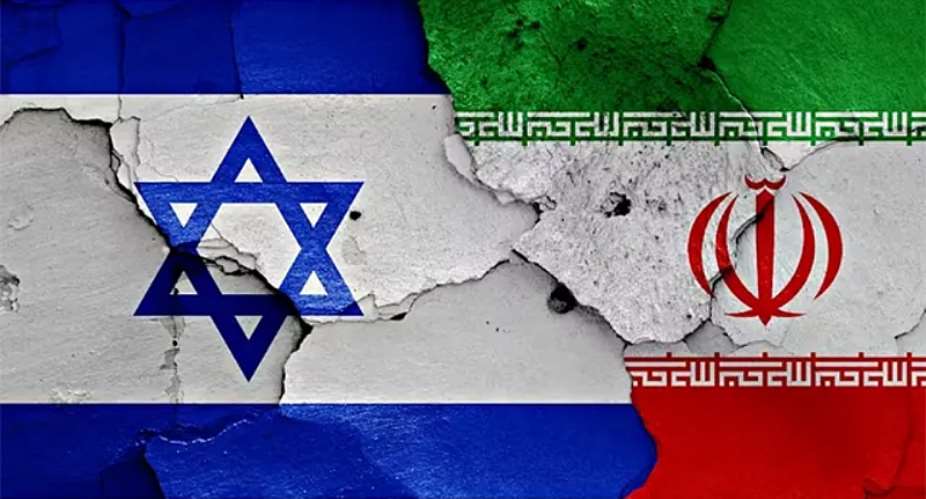
Many of us in Ghana and across Africa hear about Israel and Iran clashing and quickly assume it’s a religious fight --- Jews against Muslims, or Christians against Muslims. But that’s not quite the truth. If we look closely, we will see that this is more of a power struggle than a holy war.
First, let’s clear something up: Iran is not even an Arab country. Iranians are Persians, and they are mostly Shi’a Muslims, while the Arab world --- including places like the Kingdom of Saudi Arabia (KSA), Egypt, Jordan, and the United Arab Emirates (UAE) --- is largely Sunni Muslim. This split is not just theological --- it comes with several centuries of tension and mistrust.
Even though Iran is a Muslim country, many Arab nations don’t support it. Why? Because Iran’s influence across the Middle East --- through groups like Hezbollah in Lebanon, Houthi rebels in Yemen, and militias in Iraq --- are seen as threats to the leadership and security of Arab governments. For example, the Kingdom of Saudi Arabia and Iran are bitter rivals, both wanting to be the top power in the region. The UAE and Bahrain have gone as far as to sign peace agreements with Israel, known as the Abraham Accords, to stand together against Iran’s growing reach. So religion alone cannot unite Muslim countries --- politics and power interests speak louder.
What’s the fight really about?
Most Arab nations pay heavily for the security of their countries and governments, especially to the United States of America. The Arabs do not dread Israel as they dread the Iranians. Not surprising Qatar could gift President Trump an aircraft to replace Airforce One. Surely, with Iran developing nuclear armaments, when Pakistan has done so and is so close, Israel and the Arab countries feel uneasy, especially with its support for armed groups in the region. Iran, on the other hand, positions itself as a defender of the Palestinians and as a force resisting Western dominance in the region. This back-and-forth has created a long and dangerous rivalry --- but it’s not about Jewish people hating Muslims or vice versa.
It’s also important to note that Israel is not a Christian country. In fact, it has a large secular population --- people who don’t follow any religion. A 2016 Pew Research report found that over 60% of Israeli Jews identify as secular or non-religious. Some estimates put the figure at 65% being Atheists. Christians make up about 2%, and Muslims about 18% of the population. Is it not strange that Muslims far outnumber Christians where Prophet Issa (Jesus) was born? For many Israelis, Prophet Issa (a.s) was like any ordinary Jew. In fact, many accounts show that Prophet Issa (a.s) was really not a Jew, as he spoke Aramaic.
Maltreatment of Christians in Israel
There have been troubling reports about skirmishes between some Jews and Christian pilgrims. In 2023, Church leaders in Jerusalem issued a statement condemning acts of disrespect and aggression toward Christian clergy --- including cases of spitting, insults, and vandalism. These acts are usually blamed on ultra-Orthodox Jewish extremists, not the State as a whole. While Israeli law protects religious freedom, minority groups --- both Christian and Muslim --- still face challenges, especially in terms of land rights and political recognition.
The role Ghana should play
As a peace-loving country and a respected voice in international diplomacy, Ghana must continue to advocate for dialogue over destruction. Ghana can use its position at the United Nations, the African Union, and within the Non-Aligned Movement to encourage restraint and support peace-building initiatives.
We are a country with Muslims and Christians living in harmony, and should not take sides as if the conflict in faraway Middle East is a Muslim – Christian confrontation. Ghana’s foreign policy should remain balanced --- condemning acts of aggression on both sides, and supporting the rights of all people, including Palestinians who deserve dignity and Israelis who deserve security.
Ghana can also support peace education, especially through religious and academic platforms. Our media, mosques, and churches must avoid spreading misinformation that fuels hatred. This is the time to preach understanding, not outrage.
It is also important that government keeps an eye on happenings in the Middle East. Any escalation could lead to shortages of many items, since Ghana imports everything including tooth-picks. It is important like Egypt during the time of Prophet Yusif (a.s) to quickly store food for any eventualities. To sit unprepared could be disastrous for our impoverished country. We can avert suffering and starvation, should World War III rear its ugly head.
Lessons for Christians and Muslims
Let’s not be quick to take sides based on religion. The Middle East is not a battleground of holy people --- it is a chessboard of political interest, military strategy, and national pride.
As Noam Chomsky once said in his book, ‘Failed State: The Abuse of Power and the Assault on Democracy’, “If you want to understand war, follow the power --- not the prayer.”
The Israel-Iran conflict is a dangerous rivalry, yes, but it is not the end of the world. And for those of us in Ghana, the best thing we can do is to stay informed, speak peace, and stand for truth.
FUSEINI ABDULAI BRAIMAH
0550558008 / 0208282575 (WhatsApp)
[email protected]

 Government appoints Brig. Gen. Okae-Yeboah to lead nationwide flood mitigation t...
 South African Police link killing of Ghanaian national in Cape Town to extortion...
 GMet forecasts moderate rainfall over the weekend
 Gov't to build 10 new SHSs, rehabilitate 150 existing ones — Haruna Iddrisu
 GH¢100m allocated annually for special needs education — Haruna Iddrisu
 Dada Joe Remix pleads guilty in US Court to multi-million-dollar romance fraud
 'Stay off teacher transfers' — Pusiga GES Director urges politicians, chiefs
 One Ghana Movement, GAFCSC hold Republic Day lecture on maritime insecurity and ...
 Child's body found in Alajo gutter after being swept away by floodwaters
 Ghana must reject low-quality carbon credit projects — Annoh-Dompreh
