




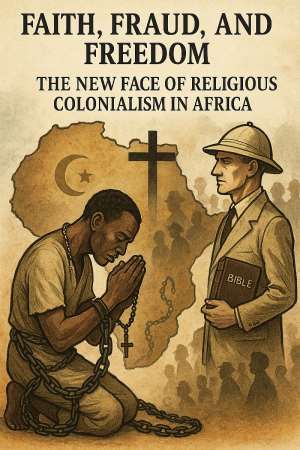
An honest call to reclaim African spirituality and protect faith from exploitation.
In this age of independence and digital enlightenment, Africa remains entangled in chains less visible than before, yet no less potent. Among these is a new form of religious colonialism: a subtle but sweeping invasion of minds, cultures, and identities disguised as faith. As missionaries once rode in on ships alongside colonial administrators, so now come modern-day spiritual empires wrapped in glittering suits, satellite television, and viral hashtags. The question before us is urgent: Are we nurturing faith, or feeding fraud at the expense of freedom?
A Legacy Rebranded
Africa has long been a battleground for religious influence. From the advent of Islam through trans-Saharan trade to the arrival of European Christianity during the colonial era, faith traditions have played pivotal roles in shaping African societies. But today, a different pattern is emerging.
Megachurches, many foreign-funded and international televangelists now dominate airwaves across the continent. With promises of miracles, wealth, and divine favour, they draw crowds larger than political rallies. Often headquartered in the U.S., South Korea, or Nigeria, these empires operate like religious franchises: exporting doctrine, demanding allegiance, and extracting wealth from the faithful.
“Some of these men claim to be messengers of God, but they live like kings while their followers remain in poverty,” lamented Kenyan theologian Timothy Njoya. “This is not salvation; it is exploitation.”
From Faith to Fortune
In cities from Accra to Kinshasa, Lusaka to Lagos, churches outnumber clinics, and pastors enjoy a status that rivals if not exceeds that of elected officials. Faith has become a marketplace; seed-sowing has replaced sincere worship, and spiritual manipulation masquerades as prophecy.
Tithes and offerings are no longer acts of devotion, but rather, compulsory fees for access to divine favour. Healing sessions are staged. Poverty is blamed on lack of faith. Criticism is silenced in the name of blasphemy.
This is not the Africa envisioned by our forebears.
In the words of the late Ghanaian intellectual Prof. Ayi Kwei Armah, “When the doors of the spirit are flung open to fraud, truth must wear a mask or flee.”
The Cultural Displacement
Worse still is the erosion of Africa’s indigenous spiritual heritage. In the name of “deliverance,” many churches label Africa’s once-harmonious traditional practices as demonic. Sacred African symbols are mocked. Ancestral wisdom is dismissed. Children are punished for speaking indigenous languages during worship.
This mirrors the same colonial logic that dehumanized African identities as “primitive” and “savage.” We must ask: How free are we if our faith alienates us from our own history?
Between Faith and Freedom
True religion uplifts. It empowers the individual to seek truth, serve humanity, and live in moral harmony. But religious colonialism old or new turns followers into dependents: unable to think critically, challenge injustice, or envision alternative paths to truth.
Religion should be a source of hope, not a tool of control.
Former Tanzanian President Julius Nyerere warned decades ago, “Religion is personal. But it should not be used to colonize minds and pockets.”
The resurgence of this concern today calls for urgent reflection. African governments, civil society, and traditional religious leaders must engage in this conversation not to ban religion, but to promote religious literacy, accountability, and ethical leadership in faith communities.
Conclusion: Decolonizing the Soul
It is time for Africa to reclaim its soul. We must distinguish between faith and fraud, between spiritual leadership and spiritual capitalism. The gospel of prosperity must not be allowed to replace the gospel of truth, justice, and liberation.
Africa’s freedom was never just political; it must be spiritual, intellectual, and cultural. Until then, the chains of religious colonialism will remain firmly in place binding not our hands, but our minds.

 Nigeria's onion dispute with Ghana tests West African free trade
 Uganda suspends military ties with Turkey over extradition of Museveni critic
 US fears wider Middle East escalation after Houthi attack Riyadh
 Pop star Ed Sheeran calls Gaza situation “unjustifiable” amid controversy
 'We have spent 60years arguing about Nkrumah and rather less time doing what he ...
 Judge recounts attempted MoMo scam on him moments after jailing scammer
 'Systemic failure due to NACOC removal from port inspections' – Inusah Fuseini o...
 Foreign Affairs Ministry releases 200-page RTI response on GH¢49.7m South Africa...
 Chartered flights account for GH¢27.18m of South Africa evacuation cost



Comments
LIFE ( OR ) DEAD
Author's Reply
Hi,I saw your comment 'dead or alive' could you clarify what you meant?