




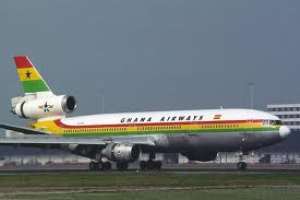
To the younger generation: Ghana Airways used to fly big planes called the DC-10 (by McDonnell Douglas, an American company) from 1970s – 2000s, and VC-10 (by Vickers-Armstrongs, a British company) from 1960s – 1970s. Those days, the VC-10 was a nickname for “akpeteshie”, our powerful local gin. Why? Because just like the VC-10 airplane took off fast, “akpeteshie” could get people drunk very fast!
When Ghana Airways was grounded in 2004, the nation lost more than a fleet --- it lost a symbol of ambition, connectivity, and global presence. Once a proud carrier linking Accra to London, New York, and beyond, Ghana Airways fell victim to years of mismanagement, political interference, and operational inefficiencies. Two decades later, the question still hangs in the air: Can Ghana revive its national airline --- and this time, get it right?
Founded in 1958, Ghana Airways was among Africa’s earliest national carriers. For decades, it served as a critical bridge for trade, diplomacy, tourism, and national identity. However, by the early 2000s, years of poor oversight and spiraling debt had brought the airline to its knees. In 2004, the U.S. Department of Transportation banned Ghana Airways due to safety concerns. Later that year, operations ceased entirely. An attempted replacement, Ghana International Airlines (GIA), emerged in 2005 but folded within five years. Once again, issues of under-capitalization and poor governance took center stage.
Following these failures, Ghana wisely redirected its efforts toward foundational reforms. The expansion of Kotoka International Airport (KIA), yet to be renamed for obvious reasons --- especially the completion of Terminal 3 in 2018 --- marked a significant leap forward. Today, Accra boasts one of West Africa’s finest airport facilities, fully capable of handling long-haul international flights and serving as a regional hub.
Meanwhile, Ghana has signed bilateral air service agreements with over 65 countries and adopted liberal aviation policies to attract investment and partnerships. These are strategic moves that position Ghana well for a return to commercial aviation.
Beyond economics, a national carrier represents identity, pride, and strategic autonomy. For Ghana, this is particularly important during peak travel seasons such as the annual Hajj pilgrimage and quarterly Ummrah pilgrimages. Thousands of Ghanaian Muslims travel to Saudi Arabia each year, yet the country continues to rely on foreign carriers to fulfill this essential need.
Notably, Lion Air of Indonesia --- a frequent choice for Hajj charters --- has been used in recent years. While the airline offers large capacity, it has faced significant safety concerns, including high-profile crashes and a patchy safety record. For a country like Ghana, with a safety-conscious public and increasing demand for religious tourism, having a reliable, national alternative could ensure greater trust and accountability. The absence of a Ghanaian carrier during the Hajj season means lost revenue, limited logistical control, and missed opportunities for national visibility.
Ghana’s central location in West Africa offers a unique opportunity to become a regional air transport hub. The presence of the African Continental Free Trade Area (AfCFTA) Secretariat in Accra further increases the city’s prominence. The resurgence of tourism and business travel also makes a strong economic case.
The government’s recent steps to establish a new national airline --- tentatively named Ghana Airlines --- in partnership with Egypt Air reflect a more pragmatic approach. The hope is that this time, technical expertise, financial prudence, and strategic growth will prevail.
To sustain a successful national airline, Ghana must:
- Hire professional, non-political aviation managers
- Build strong partnerships with technically competent and safety-conscious airlines
- Ensure sound financial planning and operational transparency
- Prioritize internal and regional routes before expanding long-haul
- Tap into high-demand travel seasons like Hajj and Ummrah
At the same time, and perhaps, most importantly, Ghana must avoid the following:
- Political interference and cronyism
- Overambitious expansions not backed by data
- Underfunding and over-reliance on state bailouts
- Poor maintenance practices and outdated fleets
Ghana’s withdrawal from commercial aviation was not a sign of defeat --- it was a tactical pause. Now, with world-class airport infrastructure, clearer aviation policy, and renewed public interest, the runway is open again. A reborn Ghana Airways, built on professionalism and purpose, could do more than ferry passengers. It could carry Ghana’s flag proudly into a new era of strategic and economic opportunity --- from the corridors of trade to the sacred journeys of faith.
Fuseini Abdulai Braimah
0550558008 / 0208282575 (WhatsApp)
[email protected]


 Gov’t renames 24-hour economy markets as District Economy Markets, targets 100% ...
 BoG, Police arrest 7 in Accra over alleged use of cedi notes for money bouquets,...
 SkyTrain trial: High Court adjourns case management conference to October 19
 Edudzi Tameklo recalls how Duffuor was slapped with GH¢100 million bail in 2020,...
 About 800 Director I and II applicants unreachable due to invalid contact number...
 'Boakye Agyarko was seen as anti-Bawumia' – Lecturer on John Boadu’s victory
 'NPP delegates made wrong choice electing John Boadu as chairman' — Political Sc...
 MTN Ghana secures new 5G spectrum in 700 MHz and 3 GHz bands
 Bawumia explains NPP hunt for winnable parliamentary candidates, not deep-pocket...
 Ghana to tap Egypt’s expertise for new capital city, housing projects – Mahama


