




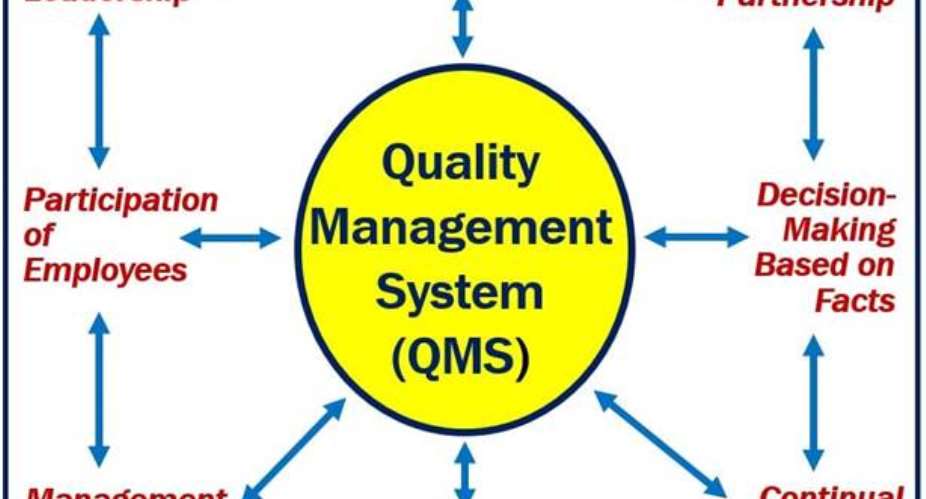
In today's fast-paced and competitive business environment, organizations are constantly seeking ways to improve their operations, products, and services. In this era medical laboratory science systems are only sustainable if they are well structured for productivity and efficiency based on established standards.
A quality management system (QMS) is a critical component of any organization's success, as it enables businesses to consistently deliver high-quality services, reduce costs, and enhance customer satisfaction. In the case of Medical Laboratory Science quality is to assure accurate, reliable and timely patient results to support diagnosis, treatment, monitoring of disease progress and for disease surveillance in public health settings.
My motivation for this articles is a recent situation I faced involving persons who have built systems around individuals and feel that they can sabotage the entire laboratory system when they are unavailable believing they have a system. In the mind these people, they believe all is well and they doing very well and is untouchable and must be hailed for even misbehaving and demonstrating unprofessionalism. Professionalism cannot thrive without a system with the right authorization and accountability, where persons are accountable for these systems and there reward for good work. There is a systems to correct deviant character in the system.
To assure quality, medical laboratory systems must be resilient, effective and built around processes and teams rather than personalities. However, many laboratory organizations make the mistake of building their QMS around individuals rather than processes. This approach can lead to a number of problems. In this article, I will be discussing some of the challenges of building systems around personalities than teams and also benefits of the team and process approach in quality management system.
Firstly, lack of sustainability will result when a QMS is built around an individual, it can be difficult to sustain when that person leaves the organization. Secondly, inconsistent performance will be the result when we build a system relying on individuals rather than processes. This can lead to inconsistent performance, as different people may have different ways of doing things. Furthermore a QMS built around individuals can be difficult to scale, as it may not be able to accommodate increased demand or new products and services.
Opposed to the few challenges discussed above, organizations that build a sustainable QMS must device some key strategies to be successful. In the next few paragraph below I will discussing my view points on the best approaches.
The process approach is the way to go. Laboratories must focus on developing and documenting processes that are repeatable, measurable, and improvable. This approach ensures that the QMS is built around processes rather than individuals. Secondly, emphasis must be placed on standardize procedures within the system. The standardized procedures that outline the steps required to complete a task or process which are known to everyone and practiced routinely by all persons within the system. This helps to ensure consistency and reduces the risk of errors.
In addition, providing ongoing training and development opportunities to ensure that employees have the necessary skills and knowledge to perform their roles effectively. Encouragement of a culture of continuous improvement, where employees are empowered to identify areas for improvement and suggest changes to processes and procedures. This culture must be built on data from the system looking at the successes and failures recorded in the past.
In today's world there is no effect system without the necessary reliance of modern technology. Leveraging on technology to support the QMS is the way to go, such as quality management software that enables organizations to manage processes, track performance, and identify areas for improvement. Again, by a laboratory adopting a process-based approach, standardizing procedures, providing training and development opportunities, encouraging continuous improvement, and leveraging technology, organizations can build a sustainable QMS that is not reliant on individuals.
In all the above mentioned, the question is what are the benefits of a Sustainable QMS? I will attempt to enumerate some of the benefits of a sustainable QMS. Firstly, a process-based approach ensures that processes are repeatable and consistent, reducing the risk of errors and improving overall quality. Also standardized procedures and technology enablement can help to streamline processes, reducing waste and improving efficiency. Technology can create an avenue for effectiveness and the right data for future decisions and improvements.
A sustainable QMS ensures that services meet customer requirements, leading to increased customer satisfaction and loyalty. A good QMS can help to reduce costs by minimizing waste, improving efficiency, and reducing the risk of errors. That is the goal of standardization in medical laboratory science.
In conclusion, building a sustainable QMS requires a process-based approach, standardized procedures, training and development opportunities, continuous improvement, and technology enablement. By adopting these strategies, organizations can create a QMS that is not reliant on individuals, but rather on processes and procedures that ensure consistency, efficiency, and quality. A laboratory system paid on individuals than is team is not sustainable. If a leader or manager absent from work in a day and there is disorder, then there is no sustainable system. Let build a system around teams nor ourselves.
By. Solomon D.Y. Kwashie, Dr.
Medical Laboratory Scientist and Public Health Informatician


 NPP rejects Mahama's appointment of Emelia Agbenyo as EC deputy, demands withdra...
 Excessive consumption of processed meat can expose one to cancer – Health expert...
 Education Minister appeals to University Administrators to call off strike, resu...
 'You're doing yeoman’s job' — Mahama lauds Police over declined unresolved murde...
 Wilmar Africa, De Heus, other food processing companies face CID action over dat...
 NPP’s Baba Amando runs to police over alleged death threats
 Ghana repatriates 120 Nigerians arrested in cybercrime operations
 PIAC unable to verify GH¢21million petroleum-funded projects in Ayawaso West
 Wontumi pleads not guilty to five charges in GH¢30m Exim Bank fraud case
 Ghana among stronger-performing economies in sub-Saharan Africa — IMF


